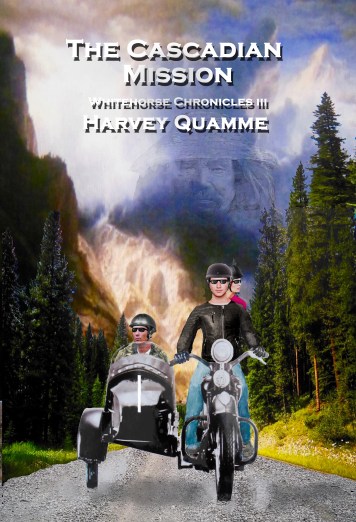
The Valley government (now the Yukon) enlists Amy Brown, Cap Ironshank and Joe Otter, a young military student, to accompany Leon James, the chief envoy, to San Francisco on a mission to discuss boundary and trade issues with the Cascadians. The mission is shipwrecked near Prince Rupert and Amy is separated from the main party. As she attempts to re-join her friends, she is involved in some fascinating encounters and meets a colourful cast of characters. Meanwhile, on the way to San Francisco, a mysterious woman representing a revolutionary faction within Cascadia approaches Cap with a signifcant proposal. The complications of this meeting and subsequent Confederate-Cascadian intrigue put the delegation in danger. Cap must find Amy and then carry vital information that is crucial to the Valley survival back to Whitehorse.
Excerpts from the “The Cascadian Mission”
Whitehorse Chronicles III, Harvey Quamme, Copyright ©2016 by Harvey Quamme, Eye-spy Press, ISBN 978-0-9878355-2-9 (pbk.) ISBN 978-0-9878355-5-0 (html),Printed in Canada
Introduction
I, Ardor Zapec, the most diminutive of the Twelve, having been given the assignment of uncovering and documenting mankind’s history at the Twelve’s last meeting, now rarely hear from them. Only one or two of them communicate with me and years can go by between messages. Not that their messages contain anything newsworthy; all their messages are like the author had left yesterday, and all they do is exhort me to continue my work whatever the cost and hope that the truth will not fall on deaf ears. Anyway, I can’t reply; my messages wouldn’t catch up to them anyway. Meanwhile, Belza Xerok and I have come to an accommodation and live a comfortable and tranquil lifestyle. We are even searching old and new memory banks to create worthy progeny.
You may also remember that I wrote about a third book in the series that describes the history of the people who sparked the explosion in scientific and artistic achievement called the Second Renaissance Period (2531-2650 C.E.). The first book,“The James Expedition” described the journey of an expedition, led by the trader Leon James, that was sent from the Yukon Valleys near Whitehorse to Boston on the other side of the continent to find an AI memory storage unit, called Memory 97. This AI machine contained an extensive body of knowledge that was recovered from the Golden Age (1820-2078 C.E.), the period of industrialization during which civilization flourished as never before. The book was written by Capability (Cap) Ironshank, who had earlier had found and rescued another AI machine, Celebric 67, which had the ability to read Memory, and knew of its importance and where it was hidden. The Valley government initiated the expedition after Celebric warned them of the possibility that Memory could fall into the hands of the Confederate government. Cap’s memoirs largely describe the role that Leon James, and the Mormon shepherdess, Amy Brown, and he played in the recovery of Memory.
The second book was the memoirs of Amy, who rescued Cap when the Confederates took him hostage in order to obtain the secrets of the Valley’s walking machines. In particular, it dwells on Cap’s rescue and Amy and Cap’s flight to freedom.
In the third set of memoirs Amy and Cap describe their journey to Cascadia, on the Pacific coast of North America, with a delegation of emissaries from the Valleys led by Leon James, to negotiate a peace and trade treaty with Cascadians. Their stories diverge, when they are separated en route. Their tale is of their struggle to reunite and carry important information back to the Valleys.
Amy, Leon and Cap lived at the end of the period often called the Great Decline (2120-2530). During the Great Decline, the population of the earth dwindled, and civilization had reached a nadir. The causes of the low point lay in the Golden Age. By the end of the Golden Age, fossil fuel and many of the essential resources that industrialization had depended upon had become depleted and the discharge of greenhouse gases from the burning of fossil fuel had caused the temperature of the earth’s atmosphere to climb to unprecedented levels. This in turn caused the ice caps to melt and sea levels to rise. High levels of atmospheric carbon dioxide increased ocean acidity and produced anoxic conditions, which caused many marine species to go extinct. These conditions combined with frequent variable and extreme weather events produced severe stress in societies throughout the world. Civil unrest and turmoil set in, called the Time of Troubles (2079-2119). The Great Decline followed.
During the Time of Troubles, the Southwest desert spread into much of the Great Plains region of North America, separating the population of the east coast from that of the west coast. As the Great Decline set in, dissension between these two populations caused the old nation state of United States of America to rupture and form two new nation states, the North American Confederation in the east and Cascadia in the west. After North American Confederation swallowed the eastern Canadian provinces, the Canadian province of British Columbia in the west joined Cascadia. Several smaller populations, which were aligned with neither of the two large nations, remained in the northern regions. Chief among them was the people of the Valleys in the Yukon.
This history tells of the unintended consequences of burning fossil fuel, the stresses it causes in society, especially the displacement of human population from places where the impact of climate change was high. It is also an account of the distortion in society caused by undue inequality in wealth and privilege and how these distortions endanger good governance and an appropriate response to the challenge of climate change.
I have added footnotes to the manuscript to provide the reader with the benefit of modern knowledge and to explain some of the obscure passages.
Ardor Zapec. February 16, 3039 (C.E.)
One
I sat on the mooring post on the dock in Prince Rupert looking out onto the water, waiting for the boat that was to take us to San Francisco, the capital of Cascadia—a country that few Valley people had visited.[1] Amy was sitting on one of her traveling bags next to me, resting her head on her elbows, also looking out onto the harbour.
[1] [San Francisco was made the capital when the western states of California, Oregon, Washington, Idaho, Arizona, and Nevada broke away from the United States of America, in 2155 C.E., to form the nation of Cascadia. British Columbia was added at a later date, 2167. A.Z.]
Suddenly she sat up. “I think that’s it,” she said. Then she turned to the man on her left and called out, “Wakey, wakey, Joe, the boat’s here.” Joseph Otter, a member of our party, lay sleeping on the dock not far away with his head on one of his food parcels. When Amy called to him, he rolled over and sat up to watch the boat enter the harbour. Leon James, the leader of our party, paced impatiently up and down the dock. He was angry at the way the Cascadians had received us on our arrival and brooded over its implications to the success of the mission. “To top it off we are being transported to the conference as freight,” he railed.
Leon was recently appointed the leader of the Valley delegation journeying to Cascadia and is our boss. The Council of All-Chiefs had selected him because of his experience, honesty, judgement and political insight. They had set out the goals of the mission, the Grand-Chief approved them and the All-Assembly overwhelmingly endorsed them. Leon was to travel to San Francisco to begin negotiations on boundary issues, inform Cascadian government on the extent of the Confederate invasion in the north, request their aid in our defense and determine if they would be willing to sell us aircraft production technologies. The Valley leadership had gone as far as to give Leon the authority to barter walking machine technology for these technologies should the Cascadian government be willing to enter into an arrangement.
I’m Capability Ironshank and was a member of the James Expedition led by Leon James to recover the AI machine called Memory. Amy is my partner, confident and lover; we met on the James Expedition. Leon selected Amy and me to be his eyes and ears, his advisers, his security personnel and general go-fors. After all he is in his mid-seventies, and although he is not frail, neither is he in his prime.
Joe Otter was added to our team at the last minute by our new northern ally, the Northern Gwich’in Nation. When Joe was in his late teens, the Gwich’in council had chosen him for military training at the Valley Military College in Whitehorse, where he became the top student in his class. When the Gwich’in council was informed of our mission, they requested that Joe be included as an observer and junior aide. The Council of All-Chiefs happily agreed to their request.
Joe came on board with a pack, a sleeping bag and a basket of assorted dried and smoked meats and bannock. He had grown up in a family that lived off the land and supplemented their income by trapping. His habits and routine reflected this early life.
He was a short, dark man. Originally, he had a ponytail and beard as was common among the men of his region, but now his hair was cropped and his face clean-shaven as is the custom of our military personnel. He wasn’t exactly taciturn for he had a lively curiosity and constantly asked questions about the equipment, the manners and appearance of people we met and the geography of the regions that we traveled through, but he kept his reflections to himself. However, when questioned or called upon for advice, he provided considered, thoughtful answers. In all, he was a bright, friendly, good-natured man and we all got along well.
Our mission would be pretty much on its own. The range of our High Altitude Rosiere Communication-balloon (HARC) system only extends to our border. The Cascadians only let us broadcast up to the edge of their territory, and if we extend the HARC’s range over their borders they shoot down the balloons. On this journey we will have to rely on short-wave radio to communicate, which is subject to interception and eavesdrop.
Leon’s request for Amy and I to participate in this mission came five months after we returned from Great Slave Lake where Amy had rescued me after I had been captured and imprisoned by the Confederates. Once Joe was added and we had our final meeting with the All-Chiefs Council and Council of War, we packed up and said goodbye to our families before leaving by train for Skagway. There we boarded one of the new Zodiac type of boat for the seven hundred fifty kilometer trip down the Inside Passage to Prince Rupert, which lay at the northern border of Cascadia. The trip took almost a day.
The boat we’re waiting to take to Port Hardy is late—already two hours late. With all that has happened during the last two days, the delay was another sign that our mission was off to inauspicious start. The trip from Skagway to Prince Rupert went smoothly, although it rained most of the way. However, our reception upon arriving at Prince Rupert was anything but welcoming. When we were forty kilometers out of port, a Cascadian cutter came into view and sent a signal for us to stop. We came to a halt. The cutter then approached us, and when it was within hailing distance, a sailor stepped out on the forward deck and called out to us, “This is Cascadian Navy. You are in Cascadian waters. Identify yourself.”
Our captain came out from the bridge and replied, “This is a Valley naval boat and we are carrying the Valley mission leader and his aides to Prince Rupert to catch transport for San Francisco to meet with your President and the Secretary of State.”
“We have been given no notice of visiting emissaries. You will require our escort to enter port. You will follow our wake,” the sailor answered back.
Prince Rupert is located on Karien Island in the mouth of the Skeena River. It is a deep-water harbour protected from the open ocean by nearby islands. A causeway and bridge connect it to the mainland. As we came into port from the south, we passed several ancient dockyards that once lined the harbour. These were signs that during the Golden Age this was a bustling port, but during the Decline the docks appeared to have fallen into a state of ruin as foreign trade dried up. Much of the infrastructure, wharfs, railway yards, roads and main buildings that been built during Golden Age had disappeared. Long ago, iron pickers had removed anything made of metal: steel derricks, rails from railroad beds, and roofing and siding from the warehouses. In one place, perhaps a grain loading facility, the grey hulks of concrete storage buildings remained. Shrubs and large trees grew through the cracks and holes of the debris that surrounded them.
When we were close to the city center, the escort boat led us to a harbour on the southern outskirts of the town where a number of naval boats were tied up. A squad of uniformed and armed men were waiting for us beside two military trucks on the dock where the Cascadian escort directed us to moor. After our boat tied up, one of the officers came up to the boat, held up an identity card and announced, “Homeland Security. We would like to talk to your captain.” After the captain stepped forward, the man continued. “This is a Cascadian port. On what authority do you enter here?”
“We are delivering the Valley mission leader and his aides en route to San Francisco. Have you not have been notified of their call?”
“We received no such notification, and everyone arriving in Cascadia has to be cleared by Homeland Security. No exception. You will tie up and remain here with your men until this matter is straightened out and we are given further instructions from headquarters. The emissaries are to disembark and come with us while we examine their papers.”
When the four of us stepped onto the dock, the leader ordered each of us to take out our papers and hand them to him. He looked at them for a moment, and then signalled to a security man sitting in one of the trucks. This man, who appeared to be the most senior officer of the group, got out of the truck and came over to us. He took our papers from the subordinate who had first addressed us, and began reading them. After he finished, he motioned for us to approach him. Holding up our photo credentials in order to match facial likenesses, he asked Leon, “You are the leader of this group and these are your aides?”
“Yes,” Leon replied.
“You are all to get in the truck and come with me. Your boat is to remain tied up here.”
He went and talked with our captain, who then ordered the seamen to unload our gear. After our gear was unloaded, he commanded, “Pick up your things and put them in the back of the truck.”
I motioned to Amy and Joe to help Leon with his luggage. With the luggage loaded, the security chief ordered us all to get into the back of the truck beside our effects. Two security men climbed in to sit with us and we were driven off the pier along the shore toward the center of the town. The other security men remained on the pier.
As we drove away we met more signs of disintegration. Most of the wooden construction on the outskirts of town had burnt or had been pulled down for other purposes leaving gaping open spaces with only the concrete steps and walkways as monuments to their existence. No one lived here, but closer to town we observed that the buildings and streets were intact and filled with people, who watched us go by.
The truck stopped in front of a large gray building in the town center that was marked Cascadian Federal Customs, Excise Tax and Border Control, Prince Rupert. Here we were told to gather our luggage and get out. After we left the truck, we were searched and herded into the building. Then the officer in charge led us one by one, beginning with Leon, into an interrogation room where they questioned us as to our origin, purpose of our visit, name and location of our Cascadian contacts and the route that we would be taking. Leon protested, but he was abruptly informed that this was procedure and if we weren’t prepared to comply we would be refused entry. After they interrogated us, they took our bags and led us to separate jail cells where we spent the night.
The following morning we were fed and ushered from our cells for more questioning, this time by a squad of plainclothes men, who presented badges that indicated they were from the Federal Bureau of Investigation, a federal agency. After this second session of questioning they again returned us to our cells.
Just before noon, we were led, down several corridors and up some stairs to a room where we were ordered to stand before a senior FBI agent seated at a desk. “Welcome to Cascadia,” he said, “I am sorry for the trouble we had to put you through, but headquarters did not make us aware that a diplomatic mission was to arrive here. You have to understand our federal government in San Francisco is in a dither. They have had a Pineapple Express, which has dumped a huge amount of rain in British Columbia, Washington and Oregon—although California has been hardly touched. First a long drought followed by a deluge—seems a continuous cycle.[2] Usually, this storm occurs in late autumn and mid-winter but this year it came in September. On top of it all, there’s rumour of a summit with the Confederates to engage in peace negotiations. Your mission appears to be of lower priority. This is a small outpost of Cascadia, and communication with the capital is slow. We finally got hold of someone last night who knew something about your visit. The central administration in San Francisco has called for you to be transported south as soon as it can be arranged. Thus, your time here will be short. The FBI will look after your security at the beginning of your journey, but once you are in Vancouver, you will be turned over to the Bureau of Diplomatic Security’s Office of Foreign Missions. Unfortunately, you missed the regular ferry to Vancouver Island—runs only once a week. It left yesterday, but the Northern Princess is leaving for Port Hardy and has cabin space. We’ve made preparations for this boat to pick you up at the docks tomorrow morning. A train will take you from Port Hardy to Nanaimo. There you will catch a ferry to Vancouver and then you will travel by train to San Francisco. Hopefully, the government will be more on top of things by the time you arrive in San Francisco. Two of our FBI agents, Patrick Wiggens and Winston Wong, will be in charge of your journey as far as Vancouver and will deliver you to the people from the Bureau of Diplomatic Security. Good luck with your mission.”
[2] [This storm was an extreme weather event called an atmospheric river and caused the diversion of the Jet Stream, which is the band of rapidly flowing air at the boundary of the cold polar and warm tropical air. The diversion results from a high-pressure system off the Pacific Coast of North America, which is associated with warm ocean water. A split in the jet stream develops, the high moves westward, the Jet Stream re-merges on a more southern course and then it picks up moist air from the tropics, which flows as a thin stream across the ocean onto the land and precipitates as rain or snow. The flow of low level, moist air is called an atmospheric river because of the vast quantity of water it carries. It is sometimes called the Pineapple Express because of its origin near Hawaii. A.Z.]
With that we were dismissed and put in the hands of Agents Wiggins and Wong who took us to a security house where we lodged until the following day. The accommodation was basic but adequate, but I felt that our every movement was being watched and monitored.
This is how we came to be waiting on a pier for a boat to take us three hundred and fifty kilometers further down the Inside Passage to Vancouver Island. All the while we waited, the two FBI agents stood nearby their valises on the shore-side of the pier; I guess to cut us off should we make a run for it. But we had no intention of remaining in Prince Rupert or anywhere near here for we were eager to get on the boat and proceed with our mission.
It was fortunate that they stood so far away, because Leon was able to express his concerns to us about the upcoming Cascadian–Confederate meetings. “This will now be the uppermost objective of our mission. We need to determine what this meeting is about and what the consequences are for the Northern Alliance. Use your eyes and ears. If you see or hear anything, let me know.”
They were far enough away that they also didn’t notice Amy as she filled her servo-bag with wasp and bat servo-bots that she flew in from the Valley boat. She brought two servo-crows from the boat too, but she perched them on a signal light post at the far end of the pier.[3] They would be flown to the transport ship after we got onboard and eventually one would be placed in her bag and the other one into my pack. I have a prosthetic leg with robotic capabilities in the belt, and it is so realistic that the Cascadian security personnel haven’t noticed it. Celebric and Memory also gave me fly-, spider- and flea-bots for surveillance activities, but I was able to secret them in my luggage where they weren’t noticed. Parts for two defense wasp-bots with stinging capability were likewise hidden in my luggage for re-assembly after we had passed security inspection.[4]
[3] [These were the robots that the technicians at the Electric Works had designed with the help of Celebric and Memory as self-defence weapons and surveillance instruments for Amy. Amy’s sensory inputs and motor nerve outputs could be displaced into a servo-bot allowing the servo-bot that she was using to be in effect her avatar. She describes her servo-bots in her memoir, Saving Capability, and how she effectively used them to rescue Cap from the Confederates at Macleod Bay. A.Z.]
[4] [The prosthetic leg and foot was a servo-bot and besides its real purpose of allowing Cap to walk normally, it served as a transmitter for signals to and from his defense-bots and as a recording devise to record all conversations and images from his surveillance-bots. His prosthesis and servo-bots were an earlier technological development than Amy’s and didn’t have avatar capability; he controlled them as he would electronic puppets. The prosthesis looked so realistic and worked so well that most people couldn’t tell that his leg was missing. A.Z.]
The Northern Princess was not a large ship. Being one hundred and fifty meters long, it was typical of coastal freighters that I had seen docked at Skagway. The ship’s bridge was near the stern. It had a high prow, enabling it to sail an uncertain ocean in which sudden and powerful storms quickly arise. Holds ran from the bridge to the prow and there was a place for containers on the deck.
When the boat neared the pier, I realized that it was a steam-powered freighter, for smoke and steam rolled out from a stack aft of the pilothouse. As it got closer I could hear the chuff of a reciprocal steam engine. It wasn’t what I expected to see in a country that I supposed to be technologically advanced, but I later learned that it was steam powered because of the fuel source. Pressed wood pellets made from waste from the many sawmills located along the coast was the primary available for powering a steam engine—old technology merged with new.
The boat came up to the dock and stopped. Two deckhands rolled out a gangplank, lowered it to the dock, then climbed down and began pulling out the mooring lines. When they had enough length, they looped them over the mooring posts and signalled to a man handling the winches to pull the boat tight against the dock.
As we watched the boat being docked, the sudden sound of two women screeching at each other on the deck diverted our attention from the mooring activities. At first we could not see who it was, but soon a young woman descended the gangplank carrying a suitcase. An older woman who had a mop in her hand followed her and frequently used it to hurry her along. “Whore, hussy,” the older woman shrieked, “Get off my ship and leave Ralfe alone. I don’t want to ever see you again.”
“Don’t worry, you old crone. I’ll not soon be back to this old tub or your old man. He’s the one that made the passes at me,” the younger one replied.
At this point the older women swung the mop at the younger one. The younger one caught the end of it with her free hand and pulled on it causing the mop-holder to fall forward onto her, and then both to tumble down the ramp into a heap on the dock. As the two women extricated themselves from the tangle and got to their feet, the older woman began to punch the other, who returned the punches. The two deckhands on seeing the melee quickly ran to pull the women apart. After the fight was broken up and the women restrained, I could see the younger one was scratched and bleeding. Even as the older woman was being held, she swore and spit at the other, but eventually the younger woman detached herself from the deckhand that was holding her, picked up her bag and limped away. She called back, “Stupid woman, you think your old man is something. He’s a pervert who can’t keep his hands off the help.”
The older woman would have continued the brouhaha but remained in the grip of the deckhand. Meanwhile, the captain came out from the bridge and momentarily looked down on the fracas, and on seeing the older woman in the hands of the deckhands, left and went back to the bridge. Finally, after she calmed down under the deckhand’s restraint, he released her. She then picked up the mop and climbed up the gangplank back onto the ship.
“What was that about?” I asked.
“Looks like the captain’s lady didn’t get along with one of the crew,” Amy replied.
“The captain had some part in the quarrel, no doubt. Another inauspicious event.”
The two FBI agents looked on without comment, and when all seemed under control, picked up their valises and walked toward the ship. Leon signalled for us to do likewise, and we preceded them. We all gathered at the foot of the gangplank waiting to be called forward onto the ship. As we waited, we could hear the older woman now on deck shouting at the captain, “It’s my ship. My daddy gave it to me. You better shape up. If that ever happens again, this boat will have a different captain.”
It took a while, but the captain eventually appeared at the top of the gangway and motioned for us to come aboard. “Captain Ralfe Wakewater—welcome aboard the Northern Princess,” he said as we boarded. He shook our hand as we introduced ourselves. When we were all assembled on the deck, the captain offered an explanation for the woman’s behaviour. “I apologize for the unseemly behaviour of my wife, Odit. She has little patience with the crew. They make one little mistake and she becomes upset. This is unlikely to happen again on this voyage. Our steward will conduct you to your cabin. You are invited to have dinner at my table at 18.00 hours this evening. The steward will provide lunch in the dining room as soon as you are unpacked.”
After he had finished his speech, the ship steward came and led the way to our quarters. When the steward was out of earshot of the captain, he murmured, “Not that this hasn’t happened before. And it probably won’t be the last time.”
The steward first led the two FBI agents and Leon to accommodations at deck level, and then led us to accommodations in the next level below, Joe to one cabin and Amy and I to another. After he showed us the cabin, he gave us a key and left. The cabin was small with a bunk bed on one side and a table and chair on the other. A small porthole on the sidewall barely let in enough light to make out the inside of the cabin and its contents. The walls were part of the hull, undecorated and painted a dull grey, the same as the ship. A toilet and shower, shared by the lower level passengers, was located down the corridor. No doubt, our cabin was designed to accommodate working crewmembers with a single or double occupancy. Its availability had probably necessitated shifting the former occupants to double up with their shipmates in another location.
After the steward left, we deposited our luggage on the floor. Amy sat down on the bed looking glum. “Our digs are a little cramped,” she commented,
“Looks like we will be spending most of our time on deck. We’ll have to post a servo-bot to keep an eye on our things. No telling who has another key.”
“I’ll leave a fly-bot in the room to keep watch. Then we can both go up top and watch the scenery,” I replied.
Topside, we watched the crew untie the Northern Princess, and then watched as the boat built up steam, left the dock and followed the shoreline south leaving a trail of smoke. It stopped at another dock and pulled up to a large hopper. After freighter was moored, the crew swung the hopper spout to the ship’s fuel hold and topped it up with a stream of wood pellets. I questioned a crewmember who was standing nearby, “I thought that steam-powered ships in Cascadia were a thing of the past?”
“This is an old ship. It’s been in operation for over forty years. The old captain, Odit’s father, kept it in trim shape. It’s not that Odit hasn’t tried, but it’s an old boat. Newer boats use multiple cylinder hot air engines, and some have flow-through battery systems that power electric motors. You’ll find electric boats mainly in the south where electricity from solar power is cheap.”
“Really, what kind of solar power?” I asked.
‘Solar cells and solar thermal engines—there’s lots of room for such power plants in the California desert. You can’t do much else there. The sunlight here is not dependable. But this ship also has a kite sail that we put up when the wind is right.”
“I’d like to see a kite sail work.”
“Not on this trip. The Inside Passage is too narrow and it takes too much work to control the sail. And we will be sailing at night.”
When the hold was full of pellets, the Northern Princess left port and steamed south across the river mouth and into the narrow channel that was the Inside Passage. We entered the channel about noontime. The channel was so narrow in places that both shores seemed but a stone’s throw away from the boat. There we passed dense forest that grew down to the tide line on both sides.
The skies that had been clear began to turn grey. It looked like rain was on its way again.
Two of the sailors in rain gear came up from the lower deck with automatic rifles and took position near the prow. I went to one and asked, “Why are armed guards posted on bow of the ship?”
“We’re to watch for pirates. They’ve swarmed freighters in these waters more than once. I don’t think it will happen to us because the Cascadian marines have recently caught a bunch of them and now regularly patrol the Passage. But Odit still posts a guard. If we see a flotilla of small boats, we’re to break out arms and it’s every man to his station.”
“Pirates? Pickings must be slim in this region.”
“Locals. Fishing’s not good and logging’s down—too far from markets. The salmon and the herring are long gone. Market for jellyfish is not good.[5] Farming’s bad around here—too wet. People barely get by. The federal and state government do nothing for them. There’s bad feeling. Makes for the temptation to take things into their own hands. What’s it like in the Valleys?”
[5] [These fish disappeared as the ocean became warmer and more acidic as it absorbed carbon dioxide. Jellyfish swarms were now common in these waters. Sea turtles, especially the leatherback, eat jellyfish and are common off the British Columbia coast. The sailor doesn’t say, but eggs and meat from this species of turtle may have been important source of food for the local populations at this time. A.Z]
“I thought that Cascadia was a wealthy country.”
The sailor laughed. “Some say that, but it’s in the hands of the few and they mostly live in the south.”
“Well, Valley people are not rich but they are not poor either.”
Lunch was provided in the dining room shortly after this. Afterwards, Amy and I found deckchairs under an overhang and watched the scenery go by. By this time it was raining, but we stayed dry under the overhang. We remained there all afternoon to avoid the cramped quarters of our cabin. At times I napped while Amy read a book. During this time, we passed through Wright Sound and entered another narrow channel. At six o’clock our relaxing scrutiny of the shoreline was interrupted by the dinner bell, right on time. The captain had arranged for the FBI agents to sit on his right and Leon on his left. That left Amy, Joe and I sitting at the end of the table. Odit didn’t make an appearance, leaving an empty chair.
The captain appeared to be in a jovial mood and chattered on about the operation of the boat, ranting about fuel prices. The rest of the table remained silent. The FBI agents treated us like we were felons being escorted to prison and didn’t speak to us. The captain, therefore, didn’t think it seemly to ask us any questions either, and directed his remarks to no one in particular, nor did he engage in any relevant discussion. He did ask Amy whether her accommodations were comfortable. Amy later told me that she had several times caught him looking at her in a most unwelcome way. The food that the steward served was good and hearty with overgenerous portions, which more than sated our appetites. Everyone ate quickly and then left.
Amy and I returned to our cabin. She took out a book and began to read. I assembled the wasp-bots and retrieved the other servo-bots, placed them all in a small case in which I carried my glasses and attached the case to my belt. I put the crow-bot in a special pocket in my coat.
“Would you like to go up top?” I asked Amy, when I had finished.
“It’s still raining and I’m tired. I’m going to read for a while, and then go to bed.”
“I’ll try to not wake you when I come in.”
I went and found our former position near the side of the bridge. It was dry under the overhang, but a cool wind blew on this side of the boat. To be more comfortable, I picked up one of the chairs and went to the other side of the bridge. As I looked around for a location to place my chair, I saw Joe laying in a sleeping bag near the bridge wall.
“I couldn’t stay in there. It’s like a coffin. I’ll sleep here,” he said.
“I had to get out of there too.”
We now passed the narrow part of the channel and sailed across the open water of Finlayson Sound toward another narrow channel. The two crewmembers on watch at the prow turned on searchlights that appeared like two shafts probing the rain and fog ahead. From our position on the deck we could see that the captain and the first mate were on the bridge. It was not long after we passed the channel light that we saw Odit climb the stairs from the lower level and enter the bridge. The light was dim but we could make out the two figures in the bridge window standing before each other speaking in loud angry voices, but neither Joe nor I could make out what they were saying. The first mate left the bridge quickly, leaving the couple alone in their conflict. The guards turned toward the bridge to watch too, but neither one left their post. The conversation went on for a long time with rising and falling of voices. In the faint light we saw Odit gesturing and then began hitting the captain. At first the captain attempted to distance himself from her and then came back seeming to put his hands around her throat. I looked at Joe. “I think we better see what is going on in there,” I said.
“Yes, this doesn’t look good,” he replied.
I was just ascending the stairs to the bridge when there was a sudden crunch of steel and I was thrown out of the stairwell and onto the deck. Joe had been thrown off his feet and had slid down the deck against the ship’s rail. “The ship’s hit something,” he shouted. The screech of folding steel plates and clang of breaking beams and tearing metal joints followed the initial crunch. The ship came to a halt but the engine continued to turn over. Minutes went by and nothing seemed to happen on the bridge. The captain seemed incapacitated; either he was trying to ascertain what was happening or was in state of disarray from the conflict with his wife.
The guards at the prow had been thrown from their feet, but they quickly got up and began to inspect the ship’s bow. Soon one came running toward the bridge. “The ship’s hit a rock and there’s a big gash in the side. Get your life jackets on,” he yelled as he went by. He ascended the stairs to the bridge and went inside. The other guard immediately began breaking out life rafts from their containers near the bow.
Whatever the guard told the captain, it had the desired effect. Alarm bells went off and the ship’s crew began to emerge from ship’s innards. The loudspeaker came on and the captain began speaking, “Please remain calm. The crewmembers are to go to their stations. Passengers are to come single file to the upper deck.” Odit exited the bridge and descended the stairs weeping. After the a few minutes the guard left the bridge to re-join his mate on the bow.
As soon as Odit left, the ship began to list and sink into the water. The captain must have contacted the engine room because the engine stopped. As it came to a halt, the hiss of burst steam lines could be now heard from the bowels of the ship. The ship’s engineers emerged from an escape hatch on the top deck in front of the bridge. “The engine room is filling with water,” one said.
Then the lights went out, leaving the ship in darkness with only some emergency lighting. By this time, both Joe and I had retrieved and put on life jackets. The angle of the deck was changing rapidly by the time captain issued another warning, “Abandon ship. The ship’s run aground and is sinking. Everyone to the lifeboats.” The FBI agents came out of their cabins, supporting Leon who was clad only in his pyjamas.
The crew that had arrived on deck tried to lower the lifeboat on high side of the ship, but by the time the lifeboat dropped on its lines, the side of the ship was at such an angle that it hung up on the side of the boat and couldn’t be lowered into the water. The sailors abandoned the lifeboat and began opening one of the life raft capsules to use them to escape instead of the lifeboats. They didn’t even attempt to lower the lifeboat on the low side because it was already under water.
The bow of the ship eventually hit bottom and hung up on a rock leaving it above water, but the ship continued to turn on its side while its stern sank. As the ship turned on its side, the angle of the deck became too steep to walk on. The crew at both ends of the ship now released life rafts to provide for survival of the passengers and crew.
“Joe help Leon, I must go and get Amy,” I said.
“No, it’s too late.” I made move toward the stairs, and he put his hand forcefully on my shoulder. “No, there’s no time. We must go before the ship goes under. She would have made it out by now and is likely with some of the other crewmembers.”
The crewmembers on our side of the boat were already sliding down the side of the ship into the water. Joe pushed me along to the rail, forced me to go over it to slide down the hull. He then went to help Leon. I looked up to see them clamber and slide down the side of the ship. I was too distracted by the sight of others leaving the ship that I slid across a porthole, which caused me to tumble and hit my head on the steel plate of the boat. It was the last thing I remembered. When I came to, I was inside the life raft with a large cut on my forehead that oozed blood. I was wet and felt chilled; I had been in the water.
Joe was scrunched beside me in the raft. Leon was with the FBI agents on the other side of the raft. “We had to drag you in. You were unconscious. Are you all right?” Joe asked.
I looked around, “Where’s Amy?”
“She’s not here. She should be on one of the other life rafts. They couldn’t lower any of the lifeboats. Everyone that’s made it is on rafts, but they are not powered. A southwest wind was pushing us up the channel. I counted three rafts when we were near the ship but they have drifted apart.”
I had a sickening feeling. “I should have gone back for her.”
“The ship went down so fast that you would have gone with it and you couldn’t have saved her. We’ll see if she is in one of the life rafts when we are picked up.”
A mayday call had gone out from the ship, but it was light in the east by the time a search plane first showed up. Two hours later a coastguard boat arrived and picked us out of the water. We were in the first life raft to be rescued, and I kept hoping Amy would be in one of the next two. I was beside myself with worry. But she was not among them when the last life raft was located and the people in it were aboard the coastguard cutter. The captain of the cutter came to me. “We’re taking you back to Prince Rupert. The search for missing people will continue by air and another coastguard boat is on its way.” I was shivering with cold and couldn’t protest.
We were given blankets and hot drinks, and brought inside to warm up. I still felt chilled when we arrived in Prince Rupert. After we got off the coastguard boat, a doctor came to give us a medical check-up. Although Leon was as chilled as Joe and I, he had survived the dunk in the sea. “I’m OK,” he said, “I have survived worse than this. I didn’t see Amy but don’t give up hope. She’s a survivor. They’ll soon find her.” His bravado didn’t ease my anxiety.
After the shipwreck and rescue, the two FBI officers, Agents Wiggens and Wong, were relieved and replaced by Agents Roberta Wright and Norm Bradley. I don’t know if it was because of our ordeal or if we had become more familiar to the FBI, but these agents were more accommodating than the first set. They took the three of us to the security house that we had stayed on our arrival.
We spent four painful days waiting for news of Amy. On the morning of the fifth day, two men in a jeep stopped in front of the lodging came up the path and knocked at the door. The landlady answered and then went to get Leon. Leon called me to come from my room. “Cap, these men are FBI agents and they may have news about Amy,” he said, “But I’m afraid it may be bad news. Brace yourself. The body of a woman was found inside the wreck of the Northern Princess. It was examined by the state police in Port Hardy, turned over to the FBI and shipped here because of the foreign status of the individual.[6] They would like you to come to identify it.”
[6] [At the time that British Columbia joined Cascadia, the Royal Canadian Mounted Police, a federal police force in the old state of Canada, policed the province. This police force continued to police British Columbia when it joined Cascadia, but as a state police force; it was called the British Columbia Mounted Police; the FBI took over the federal policing. Resentment by British Columbia Mounted Police at their demotion continued over the centuries and led to a severe lack of communication between the two forces. A.Z.]
My heart dropped. The FBI had taken over the investigation because the dead person was a foreign citizen—it must be Amy. My knees weakened, “No, it can’t be,” I exclaimed. Leon put his arm on my shoulder to steady me.
By this time Joe had joined us. “Joe, get our coats. We’re going to the FBI station,” Leon directed. Joe left and came back with the coats. Leon offered me his arm; I took it and followed the men to the jeep. After Agents Wright and Bradley joined us, we were driven to the station.
I anxiously waited as the morgue attendants wheeled out the gurney and placed it below the light. When they finally pulled back the sheet covering it, one of the officers said, “We found papers on the body that indicated that she was Amy Brown of your delegation. Will one of you identify her?” Leon nodded to me. The morgue attendant pulled back the sheet.
I looked and gasped, “That’s not Amy—that’s the captain’s wife.”
Two
After Cap left I read for a while and then, feeling tired, changed into my pyjamas, crawled into bed and immediately went to sleep. I hadn’t slept long when I awoke to the sound of the clanging and groaning of bending steel plates, and the banging of breaking steel beams. The ship came to a sudden standstill almost throwing me out of bed. The major din suddenly stopped as the ship came to a halt, but it still creaked and groaned as it began to roll on its side. By the time I got out of bed, the ship had already developed a noticeable list. I wasn’t sure what had happened, but it seemed urgent that I get up to the top deck as quickly as I could. I grabbed my sweater and coat; it would later prove fortunate that I had dressed so warmly. Now clad in my pyjamas, sweater and coat, I grabbed my pack and opened the door. A flood of rapidly rising water met me. As it coursed into my cabin, I realized I had to get up the stairwell, and quickly, but first I snatched the life jacket off the wall where it had been hung for an emergency such as this, put it on, quickly tied the retaining cords. By the time I reached the stairwell, the water in the corridor had risen to my waist. The alarm bells came on and I heard the captain announce, “Please remain calm. The crewmembers are to go to their stations. Passengers are to come single file to the upper deck.” Too late for that, I thought. Water was now beginning to pour down the stairwell, first a trickle then a torrent. Halfway up the stairs the force of the water was so great that I was almost swept back down the stairs. I hung on the handrail, and struggled hand over hand to reach the top of the stairwell. The lights were still on when I looked out the deck. I saw that the boat had rolled over precipitously on its side. The bow appeared to be grounded on a reef while the stern continued to sink. I was on the lower edge of the deck. The gunnels and the rail near me were already under water. I held onto the stairwell rail for several minutes as the force of water flooding down the stairwell prevented me from moving. As I waited for the flow of water to subside, I heard the captain call out over the speaker system, “Abandon ship. The ship’s run aground and is sinking. Everyone to the lifeboats.” He repeated the message several times. I looked toward the bow and saw sailors readying the rubber life rafts, but no one was coming to my aid or to lower the lifeboats or life rafts on my side of the ship. I couldn’t make it to the bow; not only did the current hold me, but the deck was already at a pitch that I couldn’t cross. Helplessly I watched the sailors inflate life rafts, drop them over the side and then jumped in after them.
The flow of water eased once the water level in the stairwell rose high enough, and I was able to let go of the handrail and work myself around the side of the bridge in the back eddy. There I found another handhold and rested while I tried to decide what to do. The water level around me was rapidly rising and was past my chest. I realized I had to get away from the ship immediately to prevent going down with it. As I struck out to swim away, I encountered water that was frothy with air bubbling up from the ship’s interior. Even the buoyancy of my life jacket and my pack of servo-bots didn’t keep me afloat in this milieu. I was drawn down, and struggled with all my strength to reach the surface, but the light continued to recede. It seemed forever that I was under water.
I don’t know if it was a benign underwater turbulence or my exertions that eventually carried me up, but I broke the surface and gasped for air. I took in some salt water, choked then coughed it out, and finally breathed deeply.
I floated on my back for some time until I fully caught my breath and the panic had receded. After recovering some self-possession, I turned and looked around. It was still raining, and a light breeze was blowing me up the sound away from the ship. The main lights on the ship had gone out by this time leaving only a few emergency lights to light up the boat. In the dim light I couldn’t see any of the life rafts or lifeboats. Only the flotsam that had come loose from the boat surrounded me. I knew that land was close by but I couldn’t see the shoreline and I was too exhausted to make it ashore if I could. I could only float in the water, hoping that someone would come to rescue me.
Numbing coldness began to set in within minutes. As a deck chair floated by, I swam over to it, and hung onto it, and then lay across it, allowing my body to be partially out of the water. This gave me some relief from being immersed in the icy water. I rested the on the chair for some time, shuddering with cold. My hands had become so numb that I could hardly hold onto chair.
Every once and a while a wave would splash over me and almost knock me off the chair but I managed to hang on. The numbness spread up my legs and arms and into my body, and I began to lose my sense of time and place; I didn’t know if minutes or hours had passed. Then I saw a light that danced and moved about, but I couldn’t be sure that I wasn’t hallucinating. The light, while still moving about, came closer, and I heard a woman’s voice. “Over there. There’s something in the water.”
“Anything worthwhile,” a male’s voice replied.
“Help, I’m over here,” I tried to shout out, but only a weak whisper came out.
“Get closer, so I can see,” said the woman.
I could make out a skiff and heard the soft hiss of the single cylinder hot air engine that powered it. A woman at the bow held a lamp that she shone toward me.
“There’s someone in the water,” she said. When she got closer, she called out to the man, “It’s a woman floating on a chair!”
The skiff came up beside me. “A woman—young and pretty too,” the man said, “Now there’s a find.”
“She looks cold. We need to get her in the boat and warm her up,” the woman said.
The man maneuvered the skiff alongside the chair, and the woman grabbed the shoulder straps of my life jacket and hauled me up to skiff. I was like a ragdoll and could not summon enough strength to help her, but she was strong and pulled me over the gunnel and onto the bottom of the skiff. Then the woman shone her lamp on me and looked me over. “Thank you,” I whispered.
“We have to get these wet clothes off of her and get her warmed up,” she said.
“You do that, but give me the light. I’m going to fill up the boat before we go back,” the man replied.
The woman proceeded to remove my clothes. The man shone the light on us. “She’s pretty, very pretty. She’s a good piece of salvage. Look after her.”
When I was completely naked, she unfolded a tarp to cover the bottom of the boat, dragged me onto it, removed her clothes and rubber boots and lay down behind me. She then covered us with her coat, sweater and pants, and put her arms around me, enclosing as much of my body with hers as she could. “Brrh, you’re cold,” she said.
The warmth of her body seared my skin. We remained embraced in this position while the man circled the freighter to pick up more pieces of jetsam. “This is a godsend,” I heard him mutter. When the skiff was full, he turned it around and headed for shore.
The sky was beginning to lighten when we reached the shoreline and beached near a set of rails used to pull the boat out of the water.
“Warmer now?” the woman asked, after we had arrived and the man got off to tie up the boat.
I still shivered but whispered, “Yes.”
The woman released me, got up, pulled me up to a sitting position and draped her coat over my shoulders. Then she sat on a seat and put on her clothes and rubber boots.
“After we get you out of the boat, I’ll help you to the cabin and then come back for your clothes and pack,” she said.
“No, I can carry my pack, and my pouch, too.” I grabbed both from where they had been piled in the boat and clung on to them.
When I had my pack strap over my shoulder and my pouch with my money and identity papers in my hand, she asked, “Do you need my help to get out of the boat?”
“Yes,” I replied.
But before I got up to leave, the man announced, “I’m going back out there to see what more I can find. No need to pull it in.”
I hadn’t realized I was so weak; the woman had to use both hands to steady me as I climbed out of the skiff. Once I was standing on the beach, she put her arm around my waist to support me as we went up a path that led toward a cabin in the trees. While the woman helped me, the man unloaded his salvage, fetched a fuel can and fuelled the skiff’s engine.
When we reached the cabin, the woman opened the door, helped me through the doorway to a bed. She then lit an oil lamp. In the light I could see the cabin was a single room with only the bare necessities: table, three chairs, stove, cupboard, a wardrobe, bed and a leather couch. “Get under the covers,” she said, “You can stay there until I bring you your clothes and fix up the couch for you. When I come back, I’ll light a fire and make you a nice warm drink. I’m Gwen, by the way. What’s your name?”
“I’m Amy Brown.”
“I’m happy to meet you, Amy.” I could tell from her voice that she was sincerely glad of my company.
Gwen was a short, stocky woman whom I guessed was about my age. She wore simple men’s clothes. The wrinkles and creases in her face indicated that she lived a hard life. When I looked carefully, I could see a scar above one of her eyes and another near her mouth. I thought that her nose had been broken at one time too. She seemed to be kind and generous, and I couldn’t imagine how she had landed in this isolated place.
I climbed into bed between the covers. Gwen went over to the wardrobe, took out a shift, and came back to my bedside, “After I fetch your clothes, I’ll wash out the saltwater and dry them. You better put this on in case Bork gets any ideas. He’s the man in the boat. Goes by his last name—his first is Bobby, but doesn’t use it. I put a pail by your bed for you to pee in. If you have to do number two, I’ll have to help you outside to the biffy.”
She left and soon returned with my clothes, and then filled the stove with the firewood and lit a fire. After the wood caught, the cabin became noticeably warmer. She boiled some water and made a hot drink from boiled cranberries and honey, which she had me drink. After I drank two glasses of this bitter fruit drink, I began to feel better. When the couch was ready, I transferred from the bed to it, and had Gwen bring me my pack and money pouch. I put the pack and pouch on the couch with me and curled up around them. Then Gwen piled blankets over me. I was beginning to feel a little warmer and fell into a deep sleep. I slept all that night and the following day. I only blearily remember Gwen helping me get up to relieve myself. Each time I got up she gave me one of her hot drinks.
I awoke late in the afternoon of the next day to a dispute. Bork had arrived home and they were arguing. “Look, my friend, Gord, wants a woman and is willing to take her in trade for his boat. It’s a better boat than mine,” Bork said.
“You have no right to trade her for anything. What if the state police find out?”
“They have little authority around here. Nobody will come to look for her here. If they do, they are not going to find her. And there is no way she can leave here.”
“She has papers.”
“I’m going to take them to Gord and have him read them to me. Besides the tide was out when I went back to the ship, and I found something that I think Gord can help me make her disappear.”
“Do you mean to own her like you do me?”
“I bought you fair and square from your uncle.”
“He was drunk at the time.”
“Don’t get uppity with me. I found her and she owes me her life. I’ll do with her what I like. I’ll trade or sell her or whatever.”
“Don’t do this, Bork. And give her bag and money back to her. Go to the authorities and tell them you rescued her.”
“Never! Woman, in these parts a man can do with what he likes with what he owns, and that includes women.” And he slapped her across the ear with the back of his hand, then turned and stalked out the door. “And there’s more of that if you talk back to me again,” he bellowed back to her.
I felt around for my pack and money pouch. They were gone. A pang of fear surged through me. This man was nasty. I needed my servo-bots to get out of this situation and make my way back to see if Cap and Joe had made it from the ship alive and if the mission was still continuing. I was angry with myself; I couldn’t believe I slept so soundly that he was able to take my things.
Gwen sat on the bed crying. I would need her help if I were to recover my pack. I still felt chilled and weak from my ordeal in the water. I got up and went to her. “He’s mean,” she said, “He thinks more of his chickens and dog than me or anyone else. He went to feed them. But he won’t be bothering you for a few days. He’s all worked up about the ship that sank and is heading off with his buddies to salvage as much they can before a regular salvager arrives, thanks to your money. He opened your pouch and took all your money and papers. He’s rented a barge and a tug from someone up north that he’s taking out to the wreck tonight. He’s already got a pile of stuff from trips with his own boat. Apparently the coast guard has left the site and nobody has shown up to salvage it yet.”
I tried to comfort her and put my arms around her. “That’s no way to treat you. Does he often hit you?”
“All the time. I hate him. I don’t know why my uncle did this to me.”
“You shouldn’t have to put up with it. Can’t you leave?”
“It’s not easy to leave. Where would I go? How would I get away from here? Besides he said he would come after me and kill me if I did.”
“I think that we can do something about this. Where’s my pack?”
“He got a hold of it when you were sleeping—had me put some poppy tea into your drink. He’s taken your things and hidden them. He thinks there is something important in the bag, but he couldn’t open it. He tried to cut it with his knife but couldn’t cut through the cloth. He’s waiting for you to come round and open it for him.”
I didn’t blame her for helping Bork steal my stuff—he had forced her. “That’s all right,” I said, “Let’s pretend that we have not had this talk and that I’m still too weak from being in the water to do anything. But I need my glasses. I can’t see without my glasses. They should be in my pack. Ask him to give me my pack so that I retrieve my glasses. Tell him that if I have my glasses I will show him what is inside my pack.”
If he would return the pack now and have me open it, I would insist on putting on the control glasses first and then I could use the wasps to keep him in check. I got back on the couch and pulled up the covers to wait see what he would do.
Bork entered the cabin from the chicken house carrying a basket of eggs and a dead chicken. He handed the chicken to Gwen and said, “Pluck and gut this hen and make me some soup. I’m hungry, and it’ll perk our guest up too. I’m going to catch some sleep. Wake me when it’s ready. After I eat I’m going to see Gord and then tonight I’m going to the wreck with the boys.”
I peeked through the covers. This was the first time I had a good look at him. He was a tall, lean, muscular man with grizzled hair. The stubble on his chin, his unkempt hair, and torn shirt indicated he wasn’t one for worrying about appearances. His eyes and face betrayed an intense, obsessed mind. Thus far, his behaviour indicated that he had a quick temper and that a dispute with him could easily end in violence. To escape his clutches I would have to be careful and have a plan.
Gwen put the basket of eggs on the table and then took the chicken and went outside. After she left, Bork came over to the couch and stood looking at me for several minutes; I could see his feet through a crack in the covers. Then he went over to the bed, took off his shoes, peeled off pants and his shirt, climbed into bed in his underwear and soon lay snoring.
After Gwen finished dressing the chicken, she brought it inside, prepared some vegetables and proceeded to make the soup. After it was boiling, she mixed up some baking powder biscuits and put them in the oven. I watched her through a chink in the covers until I again fell asleep.
Gwen’s voice awakened me. It was evening. She was speaking to Bork. “She says she can’t see without her glasses. She’s still too weak to go to outside by herself, and I don’t want her to miss the pail or tip it over. I think that it wouldn’t hurt to return her glasses. It would be good if you would do it tonight before you leave.”
They had finished the meal and were sitting at the table. They were drinking hot cranberry compote, and Bork frequently added a yellow liquid from a large jug into his cup.
“I think I will leave the glasses where they are. She won’t be tempted to wander off while I’m away. Don’t you think?” he laughed.
“But there’s nowhere to go, is there.”
“Mind what I told you,” Bork said looking up from his drink.
On seeing me stir, Gwen ladled chicken soup into a bowl, picked a spoon and brought it over to me. She helped me sit upright and held the bowl while I ate. Meanwhile Bork got up from the table. “The boys and I need to get out there when the tide goes out and we can get into the wreck’s holds. And I want to see Gord before we leave for the wreck about her papers. I won’t be back until morning. Have my breakfast ready,” Bork said. He picked up his raincoat and put on his rubber boots and went out the door.
When Bork was safely away from the cabin, I told her, “I can see but I need my glasses. And there are other things in my bag that I don’t want him to take.”
“I think I know your pack is, but wait until I’m sure he has left.” Gwen said. In a few moments she poured some of the soup into a bowl. Then she went to the cabinet took out a bottle of pale brown liquid, which she added to the soup. She opened the cabin door, looked around, came back, picked up the bowl and left the cabin. She returned in a few minutes.
“Shortly, we will see if I’m right. You can put on your clothes now. I think that you’re up to making a short trip outside where we’ll see if your things are where I think they are.”
Gwen brought my clothes from the line by the stove where they hung. I got out of bed and put them on. They were nice and warm, but I still felt chilled. She then brought me a pair of rubber boots and wool socks. After I put these on, she lit a lamp and led me out the door and up a path to a dog enclosure. Inside the fenced area, a large dog lay beside the kennel curled asleep. “He’s vicious. Normally he won’t allow me near him, but a little poppy tea has quieted him down.” She opened the gate, got down on all fours in front of the kennel, shone the lamp into the entrance and reached in and brought out my bag. “When he went out to hide it, he wasn’t gone that long. And the chickens didn’t cackle, so I knew it had to be the doghouse. This is where he keeps an extra key for the lock on the boat. And his guns, too.”
When she got up and handed me the bag, I hugged her with joy. “I think that we have nothing to fear from him now,” I said,
“If you can open the bag and take out the things you need, let me put it back in the kennel. Don’t show the glasses or anything else that you take from the bag to him until after you open it. He’ll beat me bad if he finds out I showed you where your pack was,” Gwen said.
“We need the key and the guns too.”
“Bork will kill me if I take them.”
“Then blame me.” I took the lamp, got down on my knees and looked into the kennel. A key hung on a nail inside the door. “The key’s there, but there’s no sign of any guns.”
“He must have taken them with him.”
“What kind of gun?”
“A hunting rifle and a pistol.”
“Let’s take the key and my bag back to the cabin. With them I will be able to warn you when he is about to return,” I said, “Gun or no gun, he’s not going to ever hurt you again—not if I can help it.” She looked at me with surprise and confusion. “Don’t worry, we’ll be ready for him when he returns and if he tries to do anything to us.”
When I opened the bag, I took out the glasses and put them on. Then I took the bat-bot, and I asked Gwen to hold the door open while I let it go and flew it out the door. I would use the bat-bot to reconnoitre the surrounding shoreline; I wanted to see who else lived here and what the surrounding landscape looked like.
I could see the shoreline to the north. It was steep and the tree line came to the water’s edge. South of Bork’s cabin I saw a small inlet with a cluster of houses around it. A floating dock and a breakwater had been built to create a harbour. Bork’s cabin was on a small sandy beach about one-half kilometre away. A well-used path linked the cabin to the village.
Dowager Island, where the wreck of the Northern Princess lay, was almost directly west. From my vantage point, I saw a tugboat pulling a barge toward the wreck. It was surrounded by a flotilla of smaller boats, which I surmised had come from neighbouring villages to partake in a free-for-all of scavenging. I suspected that in short order hardly anything would remain of the grounded ship or its contents, perhaps not even the steel hull. All what that could be taken would be cut to pieces with acetylene torches and plasma cutters. Bork’s personal boat was not among them; it remained on shore near the cabin.
After observing the lay of the land, I flew my bat to hang high in a tree near the cabin. Through it I could view the harbour and pathway. When I returned to my presence in the cabin, Gwen was staring at me. “I gave up talking to you an half-hour ago—you weren’t listening. You looked like you were in a some kind of trance,” she said.
“I was and now I know where I am,” I replied, “Come look. Bork and his gang are heading out to the wreck.” I had decided to show her some of the capabilities of my servo-bot to gain her confidence and ensure her help that I would need in escaping. I then showed her the view in my glasses of the boats as they moved toward the wreck.
She watched the fleet for several minutes, and then looked up amazement. “How are you able to do that—it’s like you’re looking from the sky? Is it magic?”
“It’s not magic but some special equipment invented by two very intelligent beings allow me to watch from afar. I also have some special little warriors that will protect us should we need them. I need to prepare them for battle.” Gwen looked me quizzically. I had three large Japanese wasp-bots climb out of my bag, fly to the table and line up. Gwen watched with growing interest, but with some concern.
“It’s amazing to me that you can make these tiny things fly around, but how will they protect us?
“I will show you.” To demonstrate to her what they could do, I had one fly around her head, then drop down and nip her on the neck.
“Ouch!” she said as she grabbed her neck.
“They are under my control and can bite much harder than that. With their bites I can have them inject a poison.” I took out two selections of toxins, one to cause extreme pain and another that caused paralysis, and filled their little tanks with a small syringe.
I was curious about Gwen’s history, and as I worked on the wasp-bots, I began to question her, “I overheard Bork say that he had bought you. How did this happen?”
“It’s not a long story,” she replied, “I was born in a fishing village near the west coast of Vancouver Island. My real parents were killed in the giant quake and tsunami of ‘Ninety-eight’. Most of the village was washed away but I survived because I was at school in a building above the waterline. After that, I went to live with my aunt and uncle in Port Hardy. Fishing was not good and my uncle couldn’t find steady work. He was a heavy drinker, and things got worse after my aunt died. One night he didn’t have money for liquor and sold me to Bork, who happened to be in town. Bork brought me here and I have been here ever since.
“Do you have any friends?”
“Not many. There’s not many people living here, and I don’t like drinking.”
“You have had a very difficult life.”
“Do you know Bork is going to trade one of us?”
“Really, to whom?”
“To one of the men in this or another village.”
“He says his friend, Gord, is interested in a woman. I think that I’m to go to Gord and Bork will keep you. I will not regret the move. Gord’s a better man”
“Does he think that I will stay here?”
“He thinks that once he is alone with you he can bend you to his will. It’s surprising what you will do when you’re lonely and under threat of a beating. He enjoys making women do what he wants.”
“He’s mistaken if he thinks that he is going to control me.”
“I hope you are right. Bork is going to keep your papers so you can’t leave. I can read, and I read your papers. You’re from another country and are a very important person. I expect that you won’t give in easily. He said he has a plan up his sleeve to keep you here but he wouldn’t tell me what it is.”
“I have no wish to find out what it is. If I can start the boat motor, I’ll be leaving here tonight. It’s the only way I can escape this place.” I then asked, “How do you feel about leaving? You can come with me. This might be your only chance, and I could use your help.”
She was silent for a moment but eventually replied, “I can’t go. Bork will get very angry. I know he’ll come after me if I leave, and I’m afraid I’ll be beaten or even killed. And I don’t how I would manage if I left him or what I would do to support myself. I have made my place here, however, bad it is.”
I thought for a moment and then added, “I need your help to run the boat. I haven’t fully recovered from my time in the water and still feel weak. And you know the land and sea hereabouts and can help guide me to Port Hardy where I hope I’ll arrive in time to meet up with the three other members of my mission. I owe you my life. I’ll see that you are taken care of. But we need to leave now while Bork is away at the wreck. This isn’t a woman-friendly place, and your life with any man here will be a hardship.”
“How can we go—the boat doesn’t have a light?”
I could tell that she was considering the possibility of leaving, but was afraid to go. I said, “The servo-bot that you have looked through can help us navigate in the dark. If we leave now, we will be a long way from here by the time Bork returns.”
“No, I’m too afraid. He’ll kill me.”
“Now you have returned my pack to me. I can assure you that he won’t hurt you. You seen that I have the power to see from a far. I also have the power to subdue him whenever I want.”
“Let me think about it.”
I left her and went down the beach to inspect the boat. An ancient hot air engine drove the skiff; I would need fuel to make an escape. I had seen Bork bring fuel from a shed near the cabin. As I went to inspect the shed, I looked out to sea. I was surprised to see boat lights returning from the direction of the wreck. I viewed the harbour through the eyes of the bat. From the movement of lamps onshore, I could see that some of the fleet had already arrived and landed. I immediately went the cabin to show Gwen the scene.
She was sitting at the table staring into a cup of compote. “I want you to see this,” I said.
When I showed her the view though the bats eyes, she murmured, “They`re back so soon and they have nothing in their boats. Something’s gone wrong,” While we watched, a man holding a lamp left the harbour and made his way along the pathway toward the cabin. Gwen exclaimed, “That’s Gord! And he’s coming to the cabin, but where’s Bork?”
As Gord came up the path to the cabin, I found a blanket, lied down on the couch and covered myself, my wasp-bot ready. He came to the door and knocked. Gwen answered the door. “I have something important to tell you. Do you mind if I come in?” Gord inquired.
“Please do,” Gwen said. Gord entered the cabin. “Where’s Bork,” she asked, “You’re back so soon. Has something happened?”
Gord was tall and muscular like Bork, but heavier. Unlike Bork his stomach hung over his belt and his rear, cheeks and jowls betrayed a propensity to, as they say, ‘chow-down’.
“I have some bad news,” he said in a sombre voice, “Bork is dead. The coastguard shot him. We were at the shipwreck, when a coastguard boat showed up. They ordered everyone off the wreck and we were told to stay off the barge—they were seizing it along with any property that had been taken off the wreck. Bork got angry and wouldn’t leave. A couple of coastguard men approached the wreck to take him off, and Bork went berserk. He went for his pistol and one of the coastguard men shot him dead. He’s down at the harbour, lying on a table in the boat shed. You can go down and see him. Gwen, I am sorry for your loss. If there is anything I can do, call me any time. You can rely on me.”
Gwen seemed stunned. I couldn’t tell what her emotional state was—whether it was joy or grief—but she didn’t weep. She sat down, I thought, to regain her composure.
Gord looked over and stared at me. “Oh, and lady, you won’t be seeing your papers anytime soon. Bork found a woman’s body on his first trip to the wreck—must have went down with the ship. He found a picture of her among the boat permits. I helped him cut and paste it onto your papers. I made the changes to them so that they fit her description. Soaked your papers up good so they’d think they were in the water when she drowned. He put them in your pouch and left it on the body. He said the police in Port Hardy are so dumb that they won’t know what to make of it and they won’t come looking. I guess you’ll be staying in here for a while.”
Gord didn’t leave immediately, but sat down at the table. Gwen got up a poured him a glass of compote along with some of the yellow liquid from Bork’s jug.
“He was a good man and my friend. I’m going to miss him,” he murmured as he drank his compote. Gwen didn’t say anything. After he finished his drink, he got up to leave. “First thing tomorrow, I’ll drop around and see how both of you are doing,” he said, as he opened the door. Gwen got up and closed it behind him as he left.
“That was just being neighbourly,” she said after he was gone. I thought that she was still afraid of cutting the ties with the life she had become caught up in.
“We need get out of here now,” I said.
She poured some compote in a glass and added liquid from Bork’s jug. She sat down, drank from the glass, stared at it a moment and then, seeming relaxed, said, “I think I’ll go with you.”
“We’ll leave here as soon as the boats stop coming ashore and the activity on the dock dies down for the night,” I said.
Gwen went and got her belongings. She put a blanket on the floor, placed them onto it and tied up the corners. All my clothes were on my back. Then we proceeded to bundle up other blankets, pile food into baskets and fill jugs with water. We carried it all down to the skiff.
“What did Bork fuel the boat with?” I asked.
“Alcohol—the same stuff he drank. It’s brewed from potatoes and other things and is distilled in the village. There are barrels of it in the shed. I don’t have a key—Bork kept it. I’ll get the axe and we can break down the door.” She left briefly and came back with an axe. We went to the shed, and Gwen made quick work of the door. We took out five barrels of alcohol, rolled them to the skiff and up some planks, then dropped them into the boat. When we had the skiff loaded, we let out the winch and let it run down the rails into the water.
By the time we were ready to go, it was long past midnight. I hadn’t been paying much attention to my monitor in the tree, but just as we were about to leave, I looked through it and saw a group of men coming up the trail. They were carrying jugs from which they were drinking. “Come, we must go now. This is no place for unattached women. They are not going to leave us alone.”
I showed her the scene through the bat’s eye. She put her hand to her mouth, her eyes widened and she blinked. “Oh, no!” she uttered.
We quickly untied the boat, got in and Gwen started the motor. I wrapped myself in a warm blanket and took the tiller. I could hear the men banging on the door as we moved away from shore. A moment later they came down to the shoreline and realized that Bork’s boat was gone with us in it. I was worried that they might pursue us, but they quickly distracted by the salvage that Bork had brought ashore and began rummaging through it.
When we pulled out of the cove we headed south along Finlayson Channel toward Port Hardy; it was the closest place where I could contact the mission to tell them I was alive. We were able to navigate the darkness using the lights on the channel buoys to guide us; Gwen also gave me direction from the description of the landforms that I saw through the bat’s eyes. We reached Fisher Channel by first light.
As Gwen saw the sun come up, she whispered, “Am I free, really free?”
“You are as free from this dark period of your life as you’ll ever be,” I replied.
Three
I was relieved to find that the body that FBI called on me to identify wasn’t that of Amy. After I returned to our lodgings from the morgue, the FBI went looking for Captain Wakewater to identify Odit’s body but he had skipped town, possibly fearing an investigation into the causes of the shipwreck. One of her relatives had to be found to give a positive identification.
It was a mystery how Amy’s identity papers came to be on Odit’s body. A few hours later, another FBI investigator came to the door. “We are now certain the documents were placed on the body after she drowned,” he explained, “They weren’t in the water long, and on close inspection Amy’s picture had been overlain with her picture. Someone had also carefully altered the documents so that all the details fit the description of the body. The State police didn’t see that it was a forgery. Someone wanted the police to think the body was the member of your mission, perhaps to conceal that she is still alive. We will now take over the investigation from the state police, and will begin by questioning the residents along Finlayson Channel, especially the looters that the coastguard found at the ship if we can locate them. It will be a difficult investigation because the people in this region are reluctant to talk to the police, and it won’t help that the coastguard killed one of their people while they were securing the wreck. If she’s alive and in their hands, they may be holding her for ransom, or even, I’m sorry to say, waiting to sell her into slavery. Women have disappeared off the streets of Port Hardy to be taken to these villages where they are often passed from hand to hand. We hope this hasn’t happened to her. We’ll contact you as soon as we have any information.”
“I can only hope that you will find her soon and that she is well,” I replied.
“If you continue your journey or return to the Valley, stay in touch,” he said as he left.
The news that Amy was possibly alive eased my anxiety, but I was worried about her circumstances. She was resourceful and self-reliant; I trusted that she could cope with any difficult situation, and I knew that her defence weapons would give her an advantage in a violent situation.
As I watched the FBI agent get into his jeep, Joe joined me. “The rumour that the Confederates will meet with the Cascadians to conduct peace talks is true,” he said, “A delegation from the Confederacy will be arriving in the capital shortly after we’re scheduled to be there.”
“How did you find this out?” I asked.
“Agent Wright told me. She received information from FBI headquarters. She says they are all atwitter there. It’s in the newspaper, too. There’s no mention of our mission but the report says that a delegation from the Confederacy will be in the capital a month from now for peace negotiations. The headline reads, “Talks to End the State of War with the Confederate States of America.” The Confederate Secretary of State, George Chenowitz, will arrive sometime next month to take part in talks between the two countries. I’m afraid that our visit might take a back seat. As for our visit, Agent Wright says her orders are to hand us over to the Bureau of Diplomatic Security who will accompany us to San Francisco. Hopefully we will meet with the Secretary of State and he will arrange for us to meet the President. We’re to get underway as soon as another means of transport can be arranged.”
“I have no intention of leaving here until Amy’s found.”
“I know you are worried, but you can’t help with the search—you know the authorities won’t let you wander around here on your own. You’ll have to let the FBI locate her. Staying here won’t help and it won’t help to go home. It is even more urgent that Leon meets with the Cascadian government officials before the Confederates come. You are a crucial member of this mission—Leon needs you. You must carry on. The FBI will find her if she doesn’t show up on her own.”
“You are right, but I’m very reluctant to leave without her.”
We had missed the weekly call of the ferry and had to wait another week before we could travel to Port Hardy on Vancouver Island. The FBI continued to conduct their search, but they didn’t find Amy. The only encouraging information that they received was from a resident who informed them that a woman had been brought ashore the night of the wreck, but she was nowhere to be found.
Eight days of waiting was terrible but there was nothing I could do. The FBI didn’t let us out of their sight. Leon said that we had to leave. When the next ferry came in, they escorted us to the boat. Agents Wright and Bradley boarded to accompany us as far as Vancouver where agents of the Bureau of Diplomatic Security would take over.
The ferry was scheduled to leave Prince Rupert in the afternoon and arrive in Port Hardy next day. Our mission had been given separate cabins. After we boarded, Leon went to his cabin to rest, while Joe and I went to sit in the ferry lounge where the FBI agents were. After an hour of watching out the window at the shoreline, Joe whispered, “I hate to tell you this, but I think that we a being watched. Don’t look around, but there’s woman that has the look of a lynx stalking a hare. She got on the ferry just after us and has been watching us like we are upwind of her, nibbling on the shrubbery. Walk to the men’s room and on the way back you will see her. She’s reading a paper—third window on what will be your right. Our FBI companions haven’t noticed her.”
“If we are being followed, we won’t tell them unless we need to. I have an even better method of surveillance than the eyes of a cat. Let’s see what she’s up to first,” I murmured, and then left for the men’s room.
There, I undid the cover of my pouch, brought out my glasses and unpacked a fly-bot. As I left the men’s room I saw the woman seated by the window. She was reading a newspaper and appeared to glance toward us as she turned a page. I also caught her looking around the edge. When I reached my seat, I whispered to Joe. “You might be right. See anyone else?” He indicated no with a slight shake of his head. I released the fly, had it buzz to the ceiling, and fly along intermittently stopping to avoid attention. When I was in position over her I made a close inspection of the subject of my attention.
The woman at the window was a beauty, her features set-off by a prudent application of makeup. Her hairstyle and couture was, I assumed, the latest in Cascadian fashion. A red suit wasn’t the first thing I would expect a spy to wear, but that is what she wore—an attractive red suit that showed off a very shapely body. She was a standout in any crowd. As I watched, she eventually folded her paper, placed it in her lap and leaned back on her seat. After a few moments she got up and left the cabin for the deck. I couldn’t follow her with the fly because it wouldn’t withstand the buffeting from the airstream of the forward-moving ship. I had it go to the window and watched as she leaned against the ship’s railing. A tall black man soon joined her and touched her hand briefly. They stood at the rail seeming to watch the shoreline, and after a brief moment she abruptly left the man, came in from the deck and made for the cabins.
I had the fly follow her and watched as she halted in front of a cabin door, opened her purse, took out her key and opened the door. Before she entered the cabin, she paused, looked up to the fly and smiled. I was about to have the fly enter her cabin, but stopped, having realized that she might have recognized that a surveillance-bot had been following her. I flew the servo-bot back to the lounge and returned it to my pouch. I didn’t say anything to Joe about her detection of the fly-bot because I wasn’t sure that she had detected it.
I didn’t see the women in red again until she brushed by me and got in line at the ferry food bar to order the evening meal. The man I saw her with on deck got in line later, and didn’t acknowledge or speak to the woman in red, but sat some distance from her to eat alone. Our FBI minders, oblivious of the pair, now felt comfortable enough in our presence to join us at our table for supper. But before I finished my meal, I looked up to see that both people of interest had left the dining area.
The episode of the woman in red remained a mystery to me. Later that evening after the FBI agents left us, I said to Joe, “The woman who was watching us—she met a man on the deck this afternoon. I don’t know what they are up to, but I’ll show you who he is. I think we should keep an eye on both of them.” He nodded in agreement.
I read in the lounge for a while, then went out onto the deck and returned to my room to prepare for bed. I fell into a fitful sleep full of vivid dreams ending in violent nightmares. At one point a painful electric shock ran up my left arm. I got up and turned on the light but there was nothing that would explain this sensation. Deep sleep eventually came to me in the morning hours. When I awoke, my arm ached from my hand, through my arm and shoulder, up into my neck and throat and into my ear, and I wondered if my electronic implants for controlling the servo-bots were out of order.
It was late when I awoke. I dressed quickly and went to the dining room. Joe was up and had already eaten breakfast. After I snatched a bite to eat, I went back to my room and quickly organized my luggage so that we could leave the ferry as soon as it docked. Then I joined Joe and our FBI minders, who were waiting near the gangway. After the ferry was tied up and the gangplank lowered, we went ashore and got into a military jeep that was waiting to take us to the train.
The driver loaded our luggage into the back of the jeep and drove us to the train station where he stopped, let us out and unloaded our effects. We each took our own luggage and entered the railroad station. It was busy and crowded with people. I took a seat in the row of seats against the station wall, while Agent Wright and Carter went to buy tickets and Joe went to the men’s room. While I waited for the FBI agents to return, several people broke away from the crowd to sit near me. Then to my surprise the lady in red, now in a form-fitting red dress with white piping and matching gloves, came through the crowd to our row of seats. The only seat that remained was the one next to me on the left. “This seat is not taken, is it?” she asked sweetly.
“No, please sit down,” I replied.
She sat down with her bag, and began removing her gloves. One dropped to the floor, and I leaned down, retrieved it and handed it to her. She smiled and took my hand in hers, saying, “Don’t speak. We need to talk—meet me in the bar car one-hour after the train leaves.” I looked at her but I couldn’t see her lips moving—her voice was coming from inside my head, specifically inside my left ear. The voice continued, “You look surprised—don’t stare. I will tell you later how it’s done. Be sure to be there and tell no one.”
The contact was momentary. She withdrew her hand, smiled again, and said in a normal voice, “Thank you.” She then opened her purse, took out a tube of lip-gloss, refreshed her makeup, and returned the tube to her purse. After flashing me another smile, she got up, grabbed her bag and made for the ticket line. I couldn’t help staring, but tried not to make it obvious. One by one, the people in the neighbouring seats got up and left; the meeting seemed a setup. I saw her waiting in line as we got on the train.
The FBI minders had booked us a compartment in the first class section. One hour after the train left the station, I said to Joe, “I’m going to the lounge car.
“I thought you didn’t drink,” he said.
“I’m thirsty. I’m going for a cup of tea.”
I entered the lounge car, went to the bar where several other travelers were seated and took a barstool. When the bartender came, I ordered a cup of tea. After he set it in front of me, I sat back to await my appointment. It wasn’t long before the woman in red entered the car, took the bar stool beside me and ordered a glass of wine. And after a few minutes looked at me and smiled. “You’re a good looking guy,” she said, “From around here?”
“No. From up north.” Not wanting to disclose my origin or nature of my journey.
“Where are you headed?”
“San Francisco.”
“Going there myself. It’s boring trip don’t you think? Nobody in my compartment to talk to.” The barkeep brought her a glass and poured wine into it from a bottle. I didn’t say anything. She studied me for a moment then spoke again. “I can tell the future of a person by reading their palm. Give me your hand and I will read your future and tell you if I’m in it.” She took my left hand, turned it palm up and looked into it.
I heard her voice in my left ear. “Don’t pull your hand away. This is not a come on. I must touch your hand in the initial stages of setting up our line of communication.”
I looked at her. She was not mouthing any words—she sat on the stool studying my hand and then looked at me with a slight smile, her drink in one hand while she held my hand with the other. When she saw that I going speak, she said into my ear, “You are not to talk until I have activated your neural voice output sensor. It will be completed shortly. In the meantime I will tell you what this is all about.
“I represent a Cascadian consortium who want to negotiate an agreement with the Valley government. It is not a trade agreement or arms sale but an agreement that could save many lives. This must be done in secret in order that we not expose our benefactors, because they are at risk and without them our plan will fail. The reason we are communicating in this way is to avoid the comprehensive surveillance that’s conducted in Cascadia. The Cascadian Homeland Security and its Secret Service arm monitor everything. Hidden cameras, listening devices and gadgets for monitoring electronic communication are everywhere and make it difficult to maintain secrecy. Even touching your hand might cause them to be suspicious. They have software that recognizes faces and can lip-read from camera images. Don’t use their internet service for private communication; everything is monitored. You must tell your friends that their every move and word will be recorded, especially after they meet the Diplomatic Security Service in Vancouver, which is also a branch of the Secret Service. The FBI agents also have listening devises that will be turned over to the Diplomatic Security Service.
“But I think that we’re a little ahead of them with the communication technique that I am using to talk to you right now. Our system is similar to that which you use to control your servo-bots—we discovered your bot control system when we surveyed your body at the boarding house in Prince Rupert to determine where to place our micro-sensors, transmitters and actuators. We inserted them last night—drugged your toothpaste to put you out. Micro-pickups that broadcast at a certain bandwidth through your neural system to micro-transmitters in other parts of your body were placed in the nerves of your throat muscles. The voice transmission is then picked up by the other person’s transmitters and transmitted to their ear. The sensors and transmitters run off the body’s natural energy transfer fuel, adenosine triphosphate. Most of our micro-devices are placed in your left arm, throat and ear. A hypodermic needle was used to insert these devices; that’s why your left arm is sore. They were placed in your leg and rump too, but you might not feel those entry points. The system requires close contact to broadcast from one body to another. In future, just close proximity or touching of any of our bodies to setup contact will suffice. I had to touch your left hand to have close contact in our first meeting—I have to use a low transmission voltage until your sensors heal in place. Besides I like the feel of your hand. We have made you our contact because we know Leon likely wouldn’t understand our methods, but we know he trusts you.” While she spoke into my ear, she put down her wine glass and traced the creases on my palm with her finger. I only watched and listened.
“You might see people that you think are following you. We want to keep track of you and your party and watch your back—you’re valuable to us. Our mission is for you to be a conduit of information and transmit an important request to your government. I can’t say what it is at the moment. We will meet in San Francisco to communicate again under similar circumstances, but first we want you to have a good look at our society and meet the people who govern it. Then I will introduce you to the woman in green. Don’t tell anyone about any of this until you have talked to me again. Promise,” she said though her communication system into my left ear.
“We know that your colleague, Amy, is missing from your delegation. We have sent someone to the villages near the shipwreck to search for her. It’s a dead zone for the FBI or state police—they will learn very little in their search. Now think of something to say without actually saying it.”
I thought and formed sentence in my mind without articulating it. It was, “Thank you for searching for Amy—I love her very much.”
“Ah yes, your hidden voice output is working. A good choice for an identity code—I want you to try visualizing her and repeating her name. Six times is enough. This is more than voice identification. It determines an emotional identification pattern that is unique and can’t be copied with present technology. We may ask you to visualize your loved one for purpose of identification at some future time. It is both a lock and a key.
“Too bad Amy is the love of your life. You have lovely hands, and my compartment is empty. We could have much to say to one another on the way to Nanaimo and the trip wouldn’t be as boring for either of us. Now quickly pull away your hand after I whisper in your ear,” she intoned in my ear.
I did as she directed. She gave me a slight smile, leaned over to me and whispered in her normal voice, “I was wrong. I don’t see you in my immediate future,” and quickly rose from her stool and left the lounge car.
“The bartender came over to me, looked quizzically at me and said, “A beautiful woman like that. For a moment, I thought you were going to get lucky.”
My neighbour sitting further along the bar gave me a look of disdain and shook his head.
I got up from my bar stool as Agent Carter came into the lounge car looking for me. We went back to the compartment where the Agent Wright and Joe awaited our return.
The remainder of our trip to Nanaimo was a long six hours as the train stopped in every town. As I watched out the train window, I could see that the population of the island increased the further south we went. At first there were sheep farms in the mountain valleys. All but the most rugged of slopes had been cleared of trees to allow the grazing of sheep. A supply of wool was necessary to keep the population warm in the wet climate; synthetics were obviously in short supply just as they were in the Valleys. As we approached the town of Campbell River I began to see signs of heavy and light industry. It was the first region that I had seen without ruins or dilapidated structures. When we passed several newly built complexes of building I asked Agent Carter, “What are those buildings for?”
“Some are wool mills for making cloth,” Agent Carter said, “Others are smelters for steel and aluminum production. The main source of electrical power for the wool mills and for the metal industry comes largely from offshore arrays of wind machines. These are built here too. There were even more wind machines on the west coast of the island, but the large tsunami in ninety-eight destroyed many of them. Replacement arrays were re-located on eastside to be sheltered from such events, but the average wind speed is lower here. The wind machines on the west coast were replaced with wave nodding machines, which are less expensive and work well in the high waves there. The combined power is sufficient to melt scrap iron in amounts needed for the local steel industry. The primary steel production is carried out in California where solar power is used to reduce iron ore brought in from Arizona and Nevada.[7]
[7] [In conventional smelting, iron ore is combined with a coal-derived carbon called coke. The coke reacts with the iron, producing CO2 and carbon monoxide, leaving pure iron behind. Electrolysis reduces iron in a different way. The iron ore is dissolved in a solvent, e.g., silicon dioxide and calcium oxide at 1600°C, and an electric current passed through it. Negatively charged oxygen ions migrate to the positively charged anode, and the oxygen bubbles off. Positively charged iron ions migrate to the negative cathode where they are reduced to elemental iron, which collects in a pool at the bottom of the cell and is siphoned off. A great deal of power was required but it was supplied from thermo-solar plants in the California desert. The excessive oxidation of the electrodes was solved in the Golden Age. The process was not unlike that used to produce aluminum. A.Z.]
As the train passed Campbell River I saw acres of glasshouses, which Agent Carter told me supplied all the fruit and vegetables for the island. Rice paddies occupied the lower fields, whereas winter wheat was grown at higher elevations. Our train trip ended in Nanaimo where we transfer to a ferry that would take us across the Georgia Strait to Vancouver. Agent Carter said that Nanaimo had become a large port and hub of this industrial area, while the capital of the state, Victoria, had fallen into decline after the Ninety-eight Earthquake.
As we left the train station, I caught a glimpse of the lady in red quickly disappearing into the crowd. A military car and driver dropped us at the ferry terminal. I was looking forward to crossing the Salish Sea to Vancouver. Two hours later we docked on the north side of Vancouver proper, where we were chauffeured to a hotel near the waterfront and stayed the night.
After a sumptuous dinner, our FBI minders generously took us for a walk around Vancouver to point out some of the landmarks. It was a large city that at one time was as large as Whitehorse. I was not impressed for the city was not unlike others that I had seen during my travels. Many of the tall buildings that had been built when the population was greater had been taken down, leaving empty lots. Perhaps they were a casualty of the earthquake or the costs of servicing them. In some locations lower-rise buildings had been built in their place. We returned to our hotel to rest for our journey the next day.
I went to sleep worrying about Amy, as usual.
Four
Gwen became concerned when the wind got up and we felt a few drops of rain. She called back to me at the tiller and pointed to the outline of an island in the distance, “That’s Hunter Island. Beyond it is the open water of the Hecate Strait. We should pull into shore there. It looks like an approaching storm.” We drew up to the island and searched the shoreline until we found a cove into which a creek flowed. We brought the skiff into the creek mouth as far as the depth of water would allow. After we landed, we got out of skiff, pulled it ashore and tied it to a log. We transferred our camping supplies into the protection of the forest, stretched out a tarp and roped it to the trees to form a shelter. When the storm came, the wind was strong enough to bend the treetops over. In the distance I could hear branches breaking and falling through the forest canopy. I could only hope that the ancient giant that we had selected to camp under would remain whole and upright.
“We need to collect wood and tender for a fire before it gets too wet. You gather the wood, and I‘ll gather the tender,” Gwen suggested. We busied ourselves with these tasks as it set in to rain.
The rain, which first came as a few large drops splattering through the canopy, soon developed into a torrent. As it intensified, we piled some of the wood that we had gathered under the tarp, stacked it, added tender, lit it with a match and soon had a crackling fire. The heat from the fire offset the cold misty air that blew in under the tarp from the forest floor. We brewed hot compote, pulled blankets around ourselves and settled in with our drink to wait out the storm.
The main front of the storm passed and was followed by the squalls and wind that did not abate until the third day. We remained under our shelter during all of this time, only venturing out to bail out the boat and to pull it beyond the level of the rising creek and incoming tide. When the rain stopped, low clouds lay over the water. “The waves are still up, but as soon as they drop we need to make a run for it across Hecate Strait to Johnston Strait and then cross over to the Island,” Gwen advised, “I’ll split out some thin wood slivers to bump up the heat in the burner and add a little more power to the engine. It’s sixty kilometers directly across open sea, but we’ll take a roundabout way and shelter on the lea side of Table Island should the final stretch of water look too rough.”
I helped her with this task, and then as the waves dropped and the tide ebbed, we loaded our food and gear onto the skiff, pushed it onto the water, got in and started the engine. At first we made good time, but as the clouds cleared and the sun poured through, a wind came up and the sea became rough. The skiff ploughed on through the waves. “We’ll head toward Table Island and anchor out of the wind,” Gwen said as she opened the cover of the burner and added the thin sticks of wood. I wasn’t sure if the added fuel helped, but the motor chugged on. After several hours, Gwen pointed to an island in the distance, “Table Island. We’ll wait there until wind dies before we attempt crossing the open stretch to the Port Hardy.”
I was glad when we reached the shelter of the island; my stomach was churning from the pitching skiff. We dropped anchor, and although the boat rocked on the anchor line, my seasickness eased. We remained beside the island all that night wrapped in blankets and attempting to find a comfortable spot to sleep. Next morning the sun rose to a clear sky. The wind had dropped and the sea was almost flat. Flocks of seagulls floated in and wheeled above the water in clusters. “They’ve found a bloom of jelly fish,” Gwen said.
After we ate some flat bread and drank the water that Gwen had brought, we lifted anchor and pulled out in the direction of Vancouver Island, which we could see on the horizon. We reached the island in three hours, and followed the shoreline to Port Hardy. There we pulled into one of the docks and tied up. I planned to go immediately to the police station and contact the Cascadian authorities in order to find out the status of the mission and re-join it if it was proceeding. After asking the port master directions to the police station, I left Gwen at the skiff and set out to find it. On the way I stopped at a waste bin and retrieved a newspaper. I searched it for news of our mission. The headlines read that a delegation from the Confederacy was to meet with the Cascadian leadership to negotiate a peace treaty. There was news of the shipwreck: the body of a woman had been found. No one else had been reported missing. I was relieved to find out that the Cap, Leon and Joe had survived. Even though there was no news of our mission I surmised that Leon wouldn’t give up on his intention to meet with the Cascadians, especially now that the Confederates would be soon arriving. I didn’t expect to have much trouble reuniting with my friends once they knew that I was safe and sound in Port Hardy.
I found the state police station, entered it and went to the counter where the police receptionist sat. “I am Amy Brown, member of the Valley delegation sent to meet with your Secretary of State and President,” I announced, “I have survived the wreck of the Northern Princess, and would like to contact the other delegates, Leon James, Capability Ironshank and Joe Otter.”
He looked at me perplexed, “Who are you and who did you say you were looking for?”
“Amy Brown and I’m looking for members of the Valley mission who were on the Northern Princess when it sank.”
“Have a seat, I’ll talk to my sergeant.” The desk officer left and came back. “He’ll see you in a minute.”
I waited for over one-half hour before the sergeant came to the desk. “Who did you say you were?” the sergeant asked
“Amy Brown of the Valley delegation.”
“You can’t be. Amy Brown was drowned when the Northern Princess went down. A salvage operator from here discovered her body on the wreck three days ago. We brought it in. The coroner called it a drowning—death by natural causes. When the FBI in Prince Rupert found out it she was foreigner, they demanded that we ship the body there. They said that that it was a person of special interest and they would handle the case. We sent it to the state police in Prince Rupert on the ferry the day before yesterday and they were to turn it over to the FBI.”
“I can explain. There must have been a mix-up—the body wasn’t mine.”
“Who are you?”
“Amy Brown.”
The sergeant looked at me suspiciously. “You don’t look like the picture of her on the identity papers that we found on the body. We have people assuming other people’s identity all the time.”
“I can explain my papers were taken from me by a man who then substituted the picture of the dead woman for mine.”
“Do you have something in your possession to prove you are this person you say you are?”
“No, as I said my papers were stolen and information on them changed to make it appear that she was the member of the Valley delegation.”
By this time, the station captain came into the room. “The drowning case is closed, sergeant. The body was identified and sent to the FBI in Prince Rupert. Who is this woman?” the captain said.
“She says she is Amy Brown—but she has no identification papers or citizenship card,” the sergeant replied.
“The drowning victim? Our investigation concluded that identity of the drowned person was Amy Brown—the body had identity papers with a photo. This person doesn’t fit the description. I’ll give Prince Rupert a call to find out what’s going on.” He left for his office and returned after a few minutes. “The state police in Prince Rupert said the FBI picked up the body this morning, and the FBI officer, who’s investigating the case, told our station captain there that he thought it was a drowning and he didn’t have any information to indicate that the body was of any other than the foreigner. I think we better hold this woman and run a check on her. We maybe we have an illegal here. Take her to the cells while we run her through our system,” the captain said.
The desk officer came from behind the counter to lead me down the hallway. “Come this way, madam. An officer will be along to fingerprint you, take your picture, an iris print and give you a Radio Frequency Identification Tag, so that we can track your movements. After, an officer will ask you some questions. You can leave the bag here.” As we left the front desk area, he whispered to me, “I think that you’re headed for the refugee detention camp in Victoria. What do you think?”
I didn’t know if this was a warning or a threat and I didn’t like where this latest development was taking me. We had been warned before we left Whitehorse that Cascadian people were insular and xenophobic, that they strictly control their borders, refuse to take in any refugees, and if an alien is found within their borders they could end up in detention camp for months or even years, waiting for processing.
Furthermore, under no circumstances would I give up the power of my servo-bots or let any of the bot technology fall into their hands. And in my absence, I was aware that one of the officers was already trying to open my pack; it is a servo-bot too and I could watch what they were doing. It would be better to find my friends on my own than to wind my way through their system not knowing what the outcome could be.
I made a decision, but to this day I don’t know if it was the right one. Maybe if I had waited, the misunderstanding might have been cleared up. When the captain found that he couldn’t open my pack, he placed it back on the counter. After he put it down, I had four of the large wasp-bots crawl out of the pack and fly above the heads of the police officers and when they were in place, as an avatar I launched a strike hitting the men in the neck. The sergeant and the captain cried out in pain and then slowly dropped to their knees and finally to the floor. O’Keefe, who was guiding me up the hallway, looked toward the front office the moment his colleagues cried out, and before he could make a move, I hit him with one of the wasp-bots, and the interrogator, for good measure, just as he stepped out of his office to head for the interrogation room. All lay flat on the floor where the wasp-bots had bitten them. No one else appeared to be alerted to event. I walked back up the hallway, picked up my bag and left the police station. I felt badly about using a quick acting, pain-inducing version of the toxin, but it couldn’t be helped. It was the mixture of toxins that I had earlier put in the wasp’s tanks to defend myself from Bork.
I walked to the skiff where Gwen waited. The first thing I asked her was, “Do you have a citizenship card?”
“No, Bork took mine and threw it away. I could probably apply for another but it would mean so much trouble that I’m probably better off without one,” she answered.
After I told Gwen what happened at the police station, she asked, “What are you going to do now? You’re in trouble with the state police and you don’t have any money.”
“I’m going to make my way to San Francisco to meet up with the members of my mission. If I don’t get there in time, I’ll contact someone in the Cascadian State Department. I don’t want to deal with the local police and risk disappearing into some detention camp. Do you have any ideas of how I get to San Francisco?”
“You’ll need money. I know a place where we can get work and won’t need a citizenship card. It’s south of here; they farm turtles. Bork used to take some of his eggs and sell them to a man there.”
“He wasn’t a friend of Bork was he?”
“No, it was just a business arrangement. But the man employs alien workers there—people who haven’t citizen cards like you and me.”
“Let’s get out of here before the police come looking for me”
Five
Our mission left Vancouver by train the following morning heading toward a city called Coquitlam on the eastern side of Fraser River. A new set of minders, Agents George Able and Marcus Novak, of the Bureau of Diplomatic Security, had taken over for this leg of our journey. This was the official agency that looked after foreign emissaries, and they were more friendly and obliging than the FBI agents.
At Coquitlam, we turned south and soon crossed the Fraser River. The bridge looked out onto a large river mouth with tidal marsh along the shoreline. Beyond was the ocean. Below the bridge was a large statue in the shape of a fleeing family looking back at the water. “What is that?” I asked Agent Able.
“That’s a monument—the people in the statue are looking toward where a city called Richmond and a region of farmland called Delta used to be. Both now lie underwater, and it is a memorial is to victims who lost their lives in the floods that inundated the region,” he replied.
Agent Novak added, “The whole area once was surrounded by dykes. When the sea levels rose, storm surges broke through the dykes and flooded the land that they were built to protect. They’d repair the dykes after each flood, but eventually the frequency of storm surges overwhelmed the repair efforts and the area was abandoned to the sea.” After we crossed into the state of Washington, Agent Novak pointed out more areas that had been flooded by rising sea levels.
The geography of the region seemed much the same as that we had just passed through, and I thought that the journey would be uneventful. We traveled through the cities of Bellingham, Mount Vernon and Everett without incident, but as we came into Seattle the train came to a halt and we were left waiting for it to resume movement. Finally, an announcement came over the speakers, “We have stopped. An incident has occurred on the tracks ahead, and the overhead power lines are down.”
But after one half-hour had elapsed, and the train still hadn’t moved, Agent Novak left his seat and went to the front coach to see if he could determine what had happened. He returned shortly seeming tense. “The conductor told me that there’s a problem. Protestors have pulled the power lines down, stopped the train ahead of us and set fire to some of its coaches.”
“I’ll check with headquarters,” Agent Able said. He got up out of his seat, took out his phone and stepped away from us to speak into it.
Agent Novak then spoke to Leon, “As soon as Agent Able has our orders, we’ll get off the train and head to a rendezvous point where someone will pick us up. No sweat.”
“Protesters. What are they protesting?” Leon asked.
“Who knows? Food prices, rent—there’s always a protest going on here,” Novak replied.
While Agent Able talked on the phone, some of the passengers picked up their belongings and made for the door. Suddenly, the lights went out. The conductor came to the coach door and spoke in a loud voice calling for everyone to remain calm, but passengers began to push past us and leave the coach. By the time Agent Able finished talking on his phone, only a few people remained. He came to our seat, “There’s a riot, alright. No one’s available to come for us. We are to leave the train and go to the nearest police station. Get your things and come with us.” We picked up our luggage and made for the exit. A large man behind us herded the remaining passengers ahead of him. “Hurry,” he said, “You all must get out and away from here.” He seemed familiar but it took me a minute to remember where I had seen him. He was the man on the ferry, who I had seen standing on the deck with the lady in red.
I was able to better observe what was happening once I stumbled out of the coach onto the railway embankment. The railway corridor ran through the city parallel to a roadway that intersected city streets. Underpasses allowed traffic from the major traffic arteries to flow under the corridor, whereas the traffic from minor streets ended at the roadway. A fence separated the railway corridor from it, and by the time we had exited the train and were on the rail embankment, the passengers who were first out had pushed a hole through the fence to access the roadway and side streets.
From the embankment I saw smoke and fire rising from the stalled train ahead of us. A mass of chanting and shouting people was now advancing toward us. Not only were the coaches of the other train on fire, but smoke and flames were also rising from nearby shops and buildings behind the crowd. In the other direction, flashing lights of police vehicles indicated that a squad of riot-control police had been dropped off and were assembling to take on the rioters. It appeared as if we could be caught between the two factions. The first passengers off the train had already fled up a side street. Agent Able motioned to us that we should do likewise. We ran up the street to avoid the violent clash that would likely take place soon on the roadway.
What we didn’t see was a second group of rioters who were running from riot police from another direction and who had entered the side street that we had picked as our escape route. We couldn’t escape this mob. Most passed by us, but several recognized that our escorts were plainclothes policemen. It didn’t help when Agent Able reached for his sidearm. He was knocked down, and when someone in the mob saw that he had a badge, a number of the crowd pounced on both agents and began to beat them. They didn’t touch Leon, Joe or I. Probably they thought we were detainees from our nondescript appearance.
I believed it my duty to come to the aid of the unfortunate agents and yelled, “Get off them. They have done nothing.” It was then that the man who I had seen behind us on the train, came to drag us away from the melee. “Leave them be,” he said in a low voice, “Save yourselves. There are too many to fight off. You’ll only get hurt. Follow me.” He led us away, pushing through the crowd and brushing aside anyone who attempted to stop us. This caused others to back away, intimidated by his size. “In here,” he shouted pointing to an alley. The alley seemed to be a dead end, but when we reached the end of it, he gestured to a fire escape, which had a landing that was raised to prevent access from the ground. Our guardian went and stood under the landing, then jumped up, grabbed the step of the first landing stage and pulled himself up. He then lowered the landing, allowing us to ascend the fire escape. Once we were all on the fire escape, he raised the landing stage, and we climbed up to the highest fire exit of the building. A ladder at the top allowed access to the roof. After determining that the roof was safe to walk on, our protector signalled us to come up. Joe and I helped Leon ascend the ladder, and we all climbed up onto the roof, which was flat allowing us to walk about.
“Come over here and see what’s going on,” our protector said after he looked over the bulwark of the roof. Joe and I went over to the edge where we could see the latest developments in the riot below. “See, they got them hemmed in. They’re driving them against the fence and railroad bank with the riot police coming from three directions along the railway road and from the streets on this side. There’s going to be some broken heads and bones before this is done. You could’ve been there.”
It was then that I noticed an odd-shaped air machine floating above the crowd. It was like a large, donut with a camera that hung below it. It appeared to be held up by both a buoyant gasbag, which constituted the donut, and by four rotor propellers in the hole of the donut. I presumed the function of the gasbag was to prolong the flight, whereas the rotors were to mainly provide mobility and control height. It appeared to be partly dirigible and partly helicopter. “What is that thing?” I asked.
“It’s a drone. They are used for surveillance by the police and Homeland Security,” our rescuer replied.
“I haven’t seen them before.”
“They were probably there. They can fly them high enough that you mightn’t see them, but the operator brings them down when they need to inspect something up close. They’re more common in the cities than the rural areas. But they can show up anywhere and when you least expect it.”
Of course, there were robotic drones in the Valley. But our politicians hadn’t considered the general practice of using drones to monitor the population nor did I think it would be tolerated by Valley citizens if they had.
Our guardian then put his hand on my shoulder. “Who’s your soul mate?”
“Amy,” I murmured under my breath.
It was then that I heard a voice in my left ear. “I was assigned to watch your back. Don’t ask my name. It’s better you don’t know for now. You have been spied upon right down to your socks since you left Vancouver—except since you left the train. The ringleaders of the riot took the time to knock out the local cameras and transponders. Remember what the lady on the train coming from Port Hardy told you and remind your friends here what the situation is; that you must be extremely careful in passing information to one another.
“I have some good news for you. Amy survived the shipwreck and was last seen in Port Hardy. She’s running from the police. Don’t tell the others just yet.”
“Is she looking for us?”
“Possibly, don’t know.”
I was filled with overwhelming relief, and I wept with joy. Joe noticed tears streaming down my face and asked, “What is it?”
“Nothing,” I answered. He looked at me as if I had gone mad. In my joy I resolved to tell Leon and Joe about Amy as soon as I could.
I asked our protector in my inside voice, “Why are the police looking for her?”
“She downed some state police in a breakout from a police station. If she’s traveling, it’s not by public transport—no citizen card,” he continued.
Then in a normal voice, he said, “When it’s dark we’ll be leaving here and I’ll see you find the FBI office so that you can continue your journey.”
While we waited for nightfall, we saw police vans arrive to pick up the rioters that had been arrested. Scores of ambulances drove back and forth taking the wounded to the hospital. The fire trucks came after order was restored and remained to put out the fires.
As I watched, I noticed large towers under construction to the west. “What are those?” I asked.
“The cause of the riots,” the answer came into my ear.
“Why is that?” I asked.
“You will learn all about it when you reach San Francisco. There’ll be people who will show you why these riots occur.”
When darkness fell, we climbed back down from the roof and into the alley. Our protector and guide led us to a thoroughfare and gave us directions to an FBI station.
“Avoid the road blocks and don’t say who your guide was,” he said, “I’ll remain nameless. Just say that several people you didn’t know helped you.”
As he prepared to leave, Leon said, “I don’t know how to thank you. We could have been in the midst of all that trouble.” Joe and I added our gratitude.
We proceeded to the FBI office. The main door was closed but we knocked and eventually found an intercom address system to signal someone inside that we were at the door. A reply came over the intercom asking us to stand before the overhead camera and identify ourselves. We did so and called out our names and titles and as we held up our identity papers to the cameras. A security guard opened the door and let us in. We were ushered into an office where the FBI agent on duty checked our papers and took a statement of our activities from the time we left the train until our check-in at the station. We didn’t mention that we had met a guide and protector on the way.
We were told Able and Novak had been badly beaten by the rioters and were now recovering in the hospital. After questioning us, the FBI provided us with a safe house where we spent the night. We had to wait there three days for another team to be sent by the Bureau of Diplomatic Security in San Francisco. However, I was in no hurry to reach San Francisco. Any delays in our journey might allow Amy to catch up.
Six
Gwen and I left Port Hardy in the skiff and followed the shoreline to find the turtle farm that she knew existed south of town. After three hours, we came to a spit of land just north of Port McNeill and rounded it to enter a narrow inlet. Pens made of nets held up in the water with floats filled the inlet, all of which contained sea turtles.[8] Rows of turtle hatcheries lined the shore beyond the tide line. Several large buildings for storage and processing turtle meat and eggs were located in the trees above the beach. Gwen drew the skiff up to one of the docks and I tied it up.
[8] [These turtles were the leatherback, and the Oliver ridley. The farm raised turtles both for release into the wild and as farm-grown livestock. These animals were released from this beach and other beaches where they would return to lay eggs. Meat and eggs were sold, making this a commercial operation.]
At another nearby dock, fishers were unloading bins of jellyfish from a boat. A crew of people wheeled the bins along the dock on dollies to floating walkways connecting the pens to the dock and dumped them in to feed the turtles. When I climbed onto the dock I could see numerous heads bob above the surface of the water as the turtles struggled to get at the food.
I followed Gwen up a pathway to a log house in the woods. “The owner’s name is Harrison Greaves,” she said,” If we’re lucky, he may have work for us. He’s known to help people in difficulty, and the lack of a citizen card will not be a problem.”
She knocked at the door and a balding, chubby man opened it. “Gwen, what a surprise. Come in. Where’s Bork? This’s not the time of year for eggs. What has happened? ”
“Bork’s dead. The coast guard shot him when he was caught taking things from a shipwreck that he shouldn’t have.”
“I’m sorry to hear of your loss.”
“It wasn’t a loss, he owned me. And now I’m looking for work.” She was blunt and I hoped her candour would not affect our chances in finding a job.
“I’m sorry to hear about that, too. But I’m not surprised from the little I know of him.” We entered a small, but modest house. Harrison gestured for us to take seat on one of the chairs in the living room. Then he called to the kitchen, “Sharon. We have some visitors.” Sharon came into the living room from the kitchen. “This is Gwen—what’s your last name? ”
“Weatherspoon.”
“She used to come with that man, Bork, who sold us eggs. Who’s your friend?”
“Amy Brown. She’s from up north.”
“I’m a little north of Prince Rupert,” I confirmed. I was glad she didn’t say that I was from the wreck of the Northern Princess.
“I suppose that you are both looking for work?” Harrison asked.
“Yes,” Gwen answered.
“You’re in luck. I need a camp cook. Can either of you cook?”
Gwen answered, “Yes, and Amy can cook too.”
“I can’t pay you much, but it’s a job that can tide you over.”
“Sharon will make us some tea, and then I will show you a place in the woman’s bunkhouse where you can put up for the night. Sharon will be around early in the morning to show you the cook’s duties that she’ll be very happy to give up.”
After tea and more conversation, Harrison led us to the women’s bunkhouse. When we had settled in, I took Gwen aside and spoke to her. “I must continue my journey. Now that I know my friends are alive, they will be continuing their mission. I can’t trust any of the local constabulary to deliver me to them, especially after what I have done. I might just disappear into one of their detention camps. I’m going to try to join the mission in San Francisco, and if they have left before I arrive there, I will then surrender myself to one of the higher ups in the State Department. My partner may try to find me. If he finds out my documents were on the body that was taken to Prince Rupert, I’m sure that he will suspect I’m still alive and he will look for me. If someone comes asking about me and has a betrothal ring like this, it will be him. Don’t give any information to the local police. At the moment I’m on the run and don’t want to drag you into my troubles should I be caught. I sense you’ll be safe here. I owe you my life and have no way of repaying you.”
“Yes, I think that I will like this place. You have made repayment enough. I probably would be living with another man like the one you found me with had you not come. And I understand that you must leave. I will miss you,” she replied.
“I will miss you, too.”
The following morning, after Sharon led us to the cookhouse and showed us where the utensils and supplies were and what to do, I helped Gwen prepare breakfast. While we worked, I shared some of my experience of cooking for large groups in the colony where I grew up. Gwen seemed to fit in well and was happy. She would make a fine camp cook.
When Harrison came to the cookhouse to inspect the food that Gwen had prepared, I questioned him about transport south. “I have no money and wish to leave for the south,” I said.
“There’s a boat leaving with meat for Vancouver tomorrow. If you can help with the loading and unloading I’ll speak with the captain and see if he will allow you to sail with him without paying.”
Later that day Harrison confirmed that the captain of the J.K. Omax hauling frozen turtle meat to Vancouver would give me transportation for the price of helping out on the ship. I packed up and was ready to leave the following morning. I helped Gwen make breakfast for the farm crew and then bade her a teary goodbye. We hugged, and as she pulled away, she handed me a bag of food and stuffed some money into my coat pocket, “I knew where Bork put his money and I pocketed it before we left,” she whispered.
“I’ll be back to see you one day,” I promised her. Then I hauled my things down to the boat, got onboard and helped the boat crew load boxes of meat into their freezer. The crew untied the boat and it moved away from the dock spewing black smoke from its stack. We sailed south through the Johnston Strait toward the Strait of Georgia.
Six hours into our voyage I began to see arrays of wind turbines in the distance. “Campbell River’s coming up,” one of the crewmembers said, “Six more hours before we make port.”
We passed these wind turbine arrays and many more before we turned southeast toward the Port of Vancouver. At sunset the boat entered the narrows of the Vancouver harbour, sailed to the east and eventually pulled into a dock. As it was dark by the time we unloaded the cargo, the captain seemed concerned about my safety and warned me, “I would not venture out in the streets in the dark if I were you. You can find a place to sleep in the lower cabin.” I found a bench there on which I spent an uneasy night.
Next morning as I ate some of the food that I had brought with me from the turtle farm, the captain came and handed me some money and informed me, “I hope this will help out until you find work. You might try the carnival that’s in town—it’s set up at Hastings Park. They often need temporary help in their concessions and aren’t particular about citizens cards. The park is southwest of here.” I hadn’t realized that he knew that I was alien. I expressed my gratitude and then left the ship in the direction of the park.
I had not gone far before I saw a Salvation Army Thrift Store. I used the money that he had given me to buy a change of clothes, some toiletries, and a bag to carry them in. However, when I counted the money that remained from Gwen’s gift and that of the captain’s, I found that it would not provide for more than a few days of food and lodging. I had to find paying work not only to travel but also to keep flesh on bones. I would try the carnival as the captain suggested.
I resumed my walk toward the park. Not far from the harbour I saw a sign over a gate that read Hastings Park. Below the sign, a banner proclaimed, “Luther’s Great North-western Carnival and Midway Show”. A line of people was already gathering at the gate. I went to the back of the line where a lady with two children stood.
“Why is everyone lining up?” I asked.
“Everyone is waiting for the midway to open. The gates open at ten o’clock. The kids want to ride on the amusement rides. Then there’s a show in the main pavilion at one o’clock. I’m taking the children to see the acrobats and clowns. They want to see the horses and trick riders too.”
I retreated to a bench, opened my pack and took out a servo-crow to inspect the grounds. As the crow, I flew high over the park. From the shape of its perimeter, I guessed it must have been a racetrack at one time, and a much larger entertainment complex had once surrounded it. However, the entertainment venues had fallen into disuse and now it was a patchwork of sprawling tenement buildings.
The perimeter of the former racetrack enclosed the grounds in which the traveling carnival was located. The carnival consisted of one large pavilion where the main show was held, a line of tents housing the food and entertainment concessions and a group of amusement rides. Nearby, a roped off paddock contained horses for the horse show. I flew down and inspected the pavilion and tents. It dawned on me that the captain might be right; the carnival could provide me with employment and travel possibilities. I would visit this entertainment enterprise as soon as it opened. Perching the crow in a tree overlooking the grounds, I paid my admission fee when the gates opened and went in.
The carnival manager’s caravan was near the pavilion. I stepped up to the door and knocked. The top door panel swung open and a portly woman answered. Looking down on me, she growled, “What do you want?”
“Madame, I’m looking for work,” I replied.
“Honey, a lot of people come here looking for work. I’m busy. See my grounds manager. He’s always looking for someone to muck out the horses or take tickets. Name’s Horace Munchier—ask for him on the midway.” She then closed the door leaving me standing there.
I did as she suggested, I went to the midway and asked one of the roustabouts to point out Horace. He gestured to the fortune-teller’s tent. “He’s talking to the fortune-teller.”
A short, slight man was speaking to small elderly woman dressed in a gypsy costume. I judged him to be almost the same age as the woman, but he seemed energetic and spritely. I waited for them to finish their conversation, and when Horace broke away from the woman, I spoke to him, “Mr. Munchier, I’m Amy Brown and I’m looking for work.”
“And what can you do, Amy?”
“I’m good around horses.”
“We have enough horse people. I have no work for you—unless you can tell fortunes. What I need right now is a fortune-teller. Can you tell fortunes?”
“I’ll try anything.”
He looked at me sceptically. “You’re young and good looking. That would be a change. Are you prepared to travel?”
“Where to?”
“Cities from here south to San Francisco. We are packing up to leave tomorrow. We will be taking everything down and loading the train tonight.”
I was immediately interested; it was work and was traveling in the direction I wished to go.
“Yes, I can travel,” I said eagerly.
“What is your experience?”
“I have traveled as far as the Confederacy and the Arctic with a trader. I know animals and have met many people. I have an education and have taught school. I’m familiar with fortune-telling—my people tell fortunes.” It was a stretch but I was desperate and would try anything.
“Do you like to perform?”
“I have been an actress and there have been many times when I fooled people.”
“Your answers are vague enough and you look the part—somewhat inexplicable. But I’ll speak to Elvira. I’ll let her decide—she’s harsh critic and not easy to please. She’ll soon find out if you can do it.” He went back to the tent, opened the flap and called in “Elvira, I have someone who might be able to take over from you right away. Can you come out and meet her.”
The old lady hobbled out of the tent, this time with the help of a cane, and came over to where we were standing. “This is Amy Brown. Do you think that she might make a good fortune-teller?
“You think that you need a fortune-teller right away? Fortune-tellers are born not made. Not everyone can do it,” she said.
“It’s a money maker. I want this concession filled as soon as possible, preferably before we leave town,” Mr. Munchier said.
Elvira flashed a look of disbelief, and then she looked me up and down with a jaundiced eye. “You’re not a Cascadian—you’re a foreigner. No citizens card either, I’ll wager.
“Have her do a reading. See if she’s is up to it—she looks the part. If not we’ll send her on her way,” Mr. Munchier replied.
“She does look like she has character. Maybe she has the talent. We’ll see. Come with me.”
She took my arm and led me into the tent. The tent was divided into two rooms. The first was a reception room where Elvira had her clients sit before they had their fortune read or where the people, who accompanied her clients, waited. This room was well lit and seating was provided along one side. A young girl sat in the corner. “That’s Narnia, my helper. You can talk to her later.” The room where Elvira met her clients lay beyond the waiting room.
She led me into the center of a dimly lit room that held only two chairs and a table, and sat down on the chair on the far side. The lighting in this room was designed to reveal the features of the client while concealing those of the fortune-teller. The effect gave the fortune-teller an inscrutable and mysterious appearance.
“Take a seat,” Elvira said, pointing to the remaining chair, “I can do palm, crystal ball and tarot card reading, whatever the customer wants. Can you do any of these?”
“Not crystal ball or tarot card reading, but where I grew up palm reading was common.” It was true that some of the women in the colonies could read palms, but the elders frowned upon it.
“To be good at fortune-telling, you have to believe in it. Are you a believer?”
I thought about this question for a minute. I don’t think the palm readers that I knew in the colonies really believed in fortune telling. It seemed a harmless pastime that relieved the boredom of colony life, but I recollected that fortune telling had some characteristic elements. First the fortune-teller had the client reveal as much information about their lives as they would disclose. If the fortune-teller could get some personal information that the client didn’t think the fortune-teller knew, the credibility of the fortune-teller was made. It was always possible for a skilled fortune-teller to fish for enough information to provide a prophecy. Ambiguous, flattering pronouncements and generalities were then added to fill it out. On the other hand, fortune-telling maybe a talent that is not shared by all. We gather and process much information, which our conscious minds are unaware. Maybe some people are more in tune to the undercurrents of this thinking process than others.
For me this was an opportunity to acquire money and travel incognito to avoid being caught by Cascadian police. Not being inclined to outright theft, I decided fraud to be the better moral choice. After all, I could consider a fortune-teller’s pay to be in part a reward for the entertainment it delivered. However, I would have to pass the test of convincing Elvira that I could take on the job. I replied to her question with an ambiguous answer, “The future is often clear, but people may be blind or choose not to see it.”
“Ahuh—that’s a sharp answer. I will put you to the test by having you read my fortune. You can have your choice of the way to divine my future.”
“I choose to use my divination glasses. Let’s trade places and give me something of yours that you highly value.”
We switched positions, and I removed my pack, took out my glasses and put them on. Then I released a fly which I had wing to the reception area. She gave me a ring that I surmised from its shape and thickness to be a man’s ring that was re-sized to fit her finger. I pretended to gaze at the ring while looking in the anti-room. Narnia had left, and when I looked through the fly’s eyes, I saw she was standing in front of the tent looking at a middle-aged man who was approaching her. When he reached her, he enquired, “Mr. Munchier called me earlier this morning. How is she?”
“She had one of her seizures yesterday. We had to close the concession.”
“Not another one. She’s got to quit. It’s time. Lise and I want her to come and stay with us. There’ll be plenty of room. And then there are the grandchildren. Where is she now?”
“Mr. Munchier just talked to her and told her that they were looking for someone to take her place. I think that she finally realizes that she can’t do it anymore. She’s inside interviewing a woman right now.”
“She’ll be upset, but it had to happen. I’ll wait for her.”
I resumed my presence in the tent where I was pretending to gain insight into Elvira’s future from the ring. I raised my head, took off my glasses, and looked into her eyes.
“I see you have suffered a great loss in your life, someone who has died, perhaps your soul mate. Now you are alone.” I said.
“Who was this person?” Elvira asked.
“I think it was your husband.” I replied and then continued, “It was a great loss, but there is someone like him in your life, coming to bring you great joy and solace in a time of your difficulties.
“And who’s that?”
“Let me look,” I studied the ring a little longer, and then said, “Could it be your son? Let me continue. You will undergo a great change in your life’s work—it will begin very soon. After the transformation, you will find love and happiness with your children and grandchildren. Your sickness will continue, but the rest and respite from your work will bring relief. You will have a long, happy life ahead of you. Am I correct in what predict?”
“It is an accurate prediction. But how did you do it?”
“I have a special way of telling the future—my divination glasses.”
“I’ve never heard of such a method, but I think that you have the gift. I’ll talk with Mr. Munchier.”
When we left the tent, she introduced me to the man that was waiting outside the tent as her son. He had been born on the midway where she and her late husband had worked for many years. He and his family lived in Vancouver. Elvira was reluctant to give up the future-telling business, but poor health was forcing her to leave. I think that she understood that I had some kind of outside help but she never guessed or asked what it was.
Before she left, Elvira spoke to Mr. Munchier and then he came to speak to me, “You’ll have the job after I confirm it with Mrs. Luther. You’ll be on probation until you prove yourself. As for your accommodation, some of the people live on the grounds to provide security. The main part of our staff live in rail coaches parked on a siding by the harbour just north of here. And you can move into one of these coaches with Narnia. The food car is beside the bedroom cars. We’re packing up tomorrow and moving to Bellingham. You’ll have today and tomorrow to get organized. Takedown and loading is a busy day. Narnia will tell you what to do.”
Elvira gathered up her things, said a tearful goodbye to her assistant and neighbours, and then left with her son. I met Narnia, who was to be my roommate in one of the bunk cars. She was assigned to the fortune-telling concession to sell tickets, chaperone clients into the tent, assist in pitching and taking down the tent and generally helping me out. She had another duty that she performed for Elvira that I hadn’t suspected. She reported client conversations or other information to Elvira that might be useful in producing a personalized prophecy. This was in the form of a note that was written while the client waited in the anti-room and was secretly handed over when Narnia led the client into the prophecy room.
In addition to scrutinizing my clients with my servo-robots, I would continue the practice of receiving information from Narnia through written notes. This, in addition to the use of my bots and some canniness, a little science and a lot of luck, allowed me to quickly master the profession. And that is how I got to be a fortune-teller in Luther’s Great North-western Carnival and Midway Show.
I took on the name Dodonna, who was a legendary Greek oracle. Although my prophecies wouldn’t be as renowned as hers, I chose to use her famous persona.
Seven
Our mission left Seattle when agents Charles Mowat and Fay Guevaro arrived to replace the set of minders who had been injured in the riot. The rail line in Seattle was under repair. Therefore, we were taken by FBI jeep to a station in Tacoma, where we boarded a high-speed train for the remainder of trip to San Francisco.[9] This train would stop only at the major destinations: Olympia, Portland, Salem, Eugene, and after a long stretch of rail, Chico and San Francisco.
[9] [High-speed train travel was common in many parts to the world during the Golden Age but didn’t reach this part of the world until the Time of Troubles, shortly before the breakup of the United States of America. At that time the automobile and airplane remained the main means of transport here until energy prices rose to unprecedented heights. Now solar energy produced in the southern desert was used to power the trains. A.Z.]
The ride was smooth, silent and fast. The train was much faster than those in the Valleys. The cities and outskirts went by in a blur. Leon and Joe were also impressed by the speed of the train. “Beats a camel caravan,” Leon said, “It would have taken me a week to cover the distance that this train travels in a just over an hour.” He had spent much of his life traveling through the western desert on camel caravans.
We journeyed south, and although many of the suburbs were now in ruins, I was beginning to marvel at the scale of industrial and commercial activity during the Golden Age that would have been necessary to build and maintain what we passed by. Unfortunately, these activities were based on burning fossil fuels and society at the time was indifferent to the impact it would have on the lives of subsequent generations. We were dealing with the repercussions of their actions.
Our journey took us along the Chehalis River where farmers and their families were in the fields harvesting rice. On the hillsides I could see many terraces of these paddies. Some of the dykes appeared to have been broken by heavy rains. In other fields, potatoes, cabbage, broccoli, kale and other vegetables, which were ready to be harvested, were underwater. According to a newspaper that Joe had bought, this region was hardest hit by the recent tropical storm system. I also saw dairy farms, and what I could only guess were poultry sheds and piggeries on the higher ground.
We crossed the Columbia River at Portland and pulled into a station. After a brief stop, the train started up and we entered a broad valley called the Willamette Valley. Here the farms were larger. Overhead electrical lines provided power to tractors at some of the farms. On other farms, equipment ran on battery power and was un-tethered.[10] I saw some small combustion-engine powered equipment, which probably drew power from a biofuel of some kind.
[10] [This technology used replaceable electrolytes. These electrolytes were recharged at a local charging station and then recycled through the batteries. The flow-through battery technology was more expensive than the trolley system for delivering power to farm equipment, but made the equipment more adaptable to different farm operations. Internal combustion engines powered some equipment. Bio-fuel for these engines was produced onsite. A.Z.]
These farmers grew corn, upland rice and a variety of field crops. As we moved south I saw orange orchards similar to those I saw in an earlier trip I made through the Confederacy.
The next leg of the journey took us through a mountainous region, and from there we descended into Sacramento Valley. The railroad skirted a large inland sea surrounded by desert. As we entered this region, Agent Mowat informed us, “Two hundred years ago this was once a large productive agriculture area. Only a small remnant of production remains.[11] As sea levels rose, the ocean flowed into this region to create the inland sea. As time goes by and the sea levels continue to rise, the sea has expanded. In addition, the annual monsoon rains often fail in this region and have moved further north. Long ago the aquifers that were used by farmers to get them through the periods of droughts dried up or filled with salt water. Much of the farmland not covered with sea had to be abandoned because of lack of water.”
[11] [During the Golden Age, the San Joaquin and Sacramento River flowed into an estuary. By the time Cap visited San Francisco sea level had risen fifteen meters. With the rise in sea level seawater from the ocean flowed into the estuary to form an inland sea called the Sacramento Sea. It was two hundred kilometres long and seventy-five kilometres wide at this time. Sacramento was now under water; all that remained of the city were some islands that were produced by dredging during the final stages to save it. A.Z.]
The train skirted the southern end of the Sacramento Sea coming into San Francisco from an easterly direction. Near the coast we turned north to travel up the western side of San Francisco Bay. As we began to get our first glimpse of the city center, we sat up and were amazed to see that a portion of the city was shielded by a giant transparent cover which was held up by towers, pylons and a web of steel cables. I could only guess what the covering was made of some kind of plastic.
Leon seemed baffled and blurted out in disbelief, “What is that?”
“That’s the Environmental Protection Barrier, EPB for short. It is sometimes referred to as the Cover. You can only see part of it. When it’s finished it will extend over the city of Oakland and beyond,” Agent Guevaro replied.
“You’re covering the city? Why?”
“It provides temperature control, collects rainwater and keeps out noxious fumes.”
“What noxious fumes?” I asked.
“From the bay and the ocean. It’s a rotten egg smell and it comes from the ocean and the bay. It’s becoming a serious health problem. The experts say it’s only going to get worse—it’ll last for thousands of generations. There’s dead fish too. We try to keep the dead fish on the beach cleaned up, but the water still smells.”[12] I notice that Joe was staring out the window with a puzzled look on his face. Finally he turned to us and said, “I have never seen such a thing in my life. I didn’t believe such things could be built.”
[12] The rotten smell was due to the release of hydrogen sulfide, which naturally forms in the anoxic waters that accompany periodic upwelling of water along the Pacific West Coast. At times these upwellings are biologically highly productive. If organic matter is abundant and O2 becomes depleted, bacteria produce hydrogen sulfide, sewer gas, which is extremely poisonous. Even during the Golden Age, fish kills occurred off the coast of Namibia, Africa, as result of this phenomenon. At the time of Cap’s journey, the hydrogen sulfide production was greatly increased by the release of methane. Warming of the ocean caused methane to be released from methane hydrates, which had been sequestered in the ocean over the period when the climate was cooler (methane is also a potent greenhouse gas). The hydrogen sulfide coming off the ocean and the bay, which during the Golden Age was hardly noticeable, was now both annoying and at times caused real sickness. Inhabitants of this city built this cover to protect themselves from the effects of this gas and to cool the city during the summer. It was similar to the dome build at an earlier time by the City of Los Angeles, but the objectives there were mainly to cool the city and to capture rainwater. A.Z.
The train slowed as it entered a portal into the covered area. We passed several stations before coming to a stop at a station with a sign that said ‘VIP’. Agent Mowat said, “This is where we get off.”
“What does this station sign mean?” I asked Agent Guevaro.
“This station is reserved for state and national dignitaries and no one else is allowed to get off here. Taxi service will take us to your lodging.”
We were led toward a limousine that was waiting outside the station door. As we exited the station doors, I looked up and noticed a donut drone hovering fifty meters above us. I suspected that it was sent to watch us depart the train-station. As I stared at it, the camera swung to focus on me, and after it studied me for a moment, it flashed a message on a screen above the camera aperture, “Welcome to Cascadia, Capability Ironshank. Your security is our upmost concern.”
Agent Mowat, on seeing me eye the drone informed me, “That’s a Watcher-21 security drone we use to ensure safety of our visitors. It recognized you when you stared at it— you’re already in the system. It is one of the instruments we use to guarantee your safety during your stay.” I didn’t reply to his comment and thought it a dubious precaution but recognized that surveillance was a fact of life in Cascadia. In the distance I saw more of these surveillance monitors, which seemed to move slowly about the city often adjusting their heights as if an operator somewhere was looking at certain details on the ground. The security forces were on high alert here.
The porters brought our baggage and everything was loaded into the limousine, then we all piled into it and we were whisked off to what appeared to be a block of luxury hotels. When the limousine stopped in front of one, we all got out and went into the lobby. Agent Guevaro informed Leon that the hotel was a registered government facility and would provide all the security that we would need, but that we were to stay indoors at night. The agents would be leaving us, and people from the State Department would meet us in the morning at eight o’clock sharp. We shook their hands and bid them goodbye
We registered at the front desk. The desk clerk ordered two porters to take our luggage to our rooms, while he had his second-in-command show us the hotel features. The assistant showed us several restaurants, which specialised in different cuisines. Then we were taken to a recreation area that consisted of lounges with a bar and a large pool area. It was lavish in it decoration and facilities. The centerpiece of the area was a huge swimming pool with waterfalls and fountains. Saunas, steam rooms, hot and cold pools were located nearby. Interestingly, natural sunlight was allowed to stream in through what appeared to be a hole in the Cover. A number of nude and semi-nude people lay around the pool sunbathing.
Guests were drifting in and out of the facilities. Groups of men and women stood in knots talking. I couldn’t tell if they were business associates or bureaucrats and other government functionaries on leave. A few personnel that weren’t attached to any group seemed to circulate among the groups, visiting one group then another and often drifting away with a man or woman in tow. Leon watched this for a moment, and then said, “I absolutely forbid you to come down here. It’s not the immodesty of the people, it’s the place; it conspires to compromise the visitor’s principles and divert their attention from what they come here to do.” At the time I thought the judgement a little high-minded and prudish, but we were to discover that his instincts were correct.
After our tour, the desk clerk conducted us to a suite of rooms. Each member of our mission had a separate bedroom adjoining a large common room. I set my luggage down in one of the bedrooms and opened the curtains to look out of the window. The hotel was located on a hillside and we were on the eighth floor looking over an expanse of the city. I could now see the pylons and network of cables holding the cover more closely than I could on the train. It was late afternoon and everything seemed to be cast in shade. The light was constant in intensity, suggesting that it had some kind of photosensitive blocker. The sun appeared as an orange orb giving the scenery a dun-coloured cast. I could also see towers that looked like huge chimneys where air was drawn in and exhausted.
I asked the room servant who had come into the room to tidy up, “What are those towers for?”
“The towers have air conditioners to cool the air and purifiers to clean it.”
“Is the temperature always the same?”
“Under the cover the air is maintained at a comfortable 24 degrees Celsius in the day and 20 degrees at night and it never rains in here,” he said.
“That sounds a little boring.”
“Tell that to anyone in the valley when it is fifty degrees.”
“What about the plants?”
“Enough light gets through that everything grows luxuriantly. All the greenery is irrigated from stored rainwater. In fact much of our food is produced inside the cover. Before I leave I will introduce you to Yoko. She will be your room companion. She provides security and will look after your every need. And when I say constant, I mean constant—she never sleeps—unless you command her to.”
He took out a handheld device and clicked it. Soon there was a knock on the door. “Can I come it?” a voice purred.
The room servant went to the door and opened it. “Yes, come in. I want to introduce you to a new guest.” The source of the voice glided through the doorway and stood upright on rollers attached to its feet or perhaps to its shoes. It stopped, stepped forward and bowed.
“This is Mr. Ironshank, Yoko. You’re to look after him, as well as Mr. James and Mr. Otter,” the room servant said.
“Most certainly, I’ll attend to their every need.”
Yoko was appropriately dressed in a maid’s uniform, although her proportions were more voluptuous than most. The robot was inanimate, but I decided to refer to her in the gender in which she had been designed. Her skin was human in color and tone and when she moved, the movements were smooth and unbroken. Her facial features were congenial and pleasing, and showed an emotive response that matched her voice. Her eyes were unusually large and especially expressive.
“These robots were imported from Japan long ago. I don’t know if they still make them,” the room servant mused, “We keep and maintain them as special feature for our hotel guests and to provide for your security. If you have any problems that you can’t handle, she will send for help.” I should have guessed this service might present a problem, but I hadn’t fully considered the implications of the robot’s presence and at this time was too polite to object.
After the room servant saw that everything was in order, he announced, “I will leave you now and see how your friends have settled in.” Then he left.
“Have a seat while I unpack,” I said to Yoko.
“Oh no, that is my job. I have already put away Ambassador James’s things and I will do yours and then Mr. Otter’s,” she replied. Because I was curious to see her proficiency, I backed away and allowed her to take over unpacking my luggage. She proceeded to correctly take out my clothes and carefully place the shirts, underwear and socks in a drawer and then hang my other clothes in the closet. Then she took my toilet effects and deposited them in the bathroom cabinet.
After she finished unpacking my clothes, she said, “Would you like me to launder your dirty clothes.”
“That would be nice.”
Yoko then went to the closet, took out a laundry bag and placed the dirty clothes that I had accumulated into the bag. “I’ll return them as soon as they are laundered,” she said.
When she finished, I commanded, “Take a load off and sit down.”
“I don’t have any load to take off, but I will sit.” Yoko replied and then went to a chair and sat down in a very formal posture.
I was curious about the feel of her skin and response of her flesh to my touch, and when she sat down, I went and felt her forearm. Her skin was warm and felt like human skin. I could even feel the fine hairs that were fixed to it, and when I pressed her arm with my fingers, it yielded as normal flesh and muscle would. I took her hand in mine; it felt and moved like a woman’s hand.
Someone had gone to a lot of trouble to make this robot seem like a real human. I was amazed at the technology that it represented. It was a type of AI machine that had been designed to imitate the human body and programmed to respond to human communication. In addition to voice commands, communication included visual signals and sensory contact, but it was unaware of what it was doing and could only respond to human action and intent. However complex the machinery, it was still a puppet, although the strings to be pulled were indirect and unseen. It was unlike the AI machines, Celebric or Memory, which I knew so well, because they could decide if it was in their interest to respond to any question or order. They were built to rely on moral and ethical principles to decide a course of action and could plan an appropriate response that reflected their interest and the interest of other conscious beings now and in the future.
“You sensed you were touching a human, did you not?” Yoko asked after I let her hand go.
“I did. But stay there, while I see what my friends are doing.” Then I went out into the anteroom to find Leon and Joe.
Joe was sitting in a chair watching a screen. “What are you watching?” I asked, recognizing what I assumed to be some kind of information system.
“VULPE news. There are other channels, but the VULPE Broadcasting Corporation seems to run all of them. There are links to political analysis, celebrity, sports, fashion, cooking, home renovation, movie, history, life and health and several more that I haven’t yet clicked on—but they are all VULPE channels. No comedy channels, though. The news is all local news, road accidents, robberies, murders and celebrity affairs—nothing that’s very funny or critical of the government. Did you meet Yoko?”
“I did.”
“She’s cute.”
“Don’t get too enamoured. She’s just a robot—if you want to call it a she—constructed to simulate a human. It’s only a very highly functioning puppet.”
Leon came out from the bedroom, “I phoned someone to come and take the maid away. It’s something we can do without. But he said that it was part of the security system. What do you think?”
“I don’t think that it will do any harm to keep her here,” I said. I then found a piece of paper and wrote him a detailed note: “She could be part of a spy system. I suggest that we keep her until we see what our hosts are up to. Let’s leave an official looking document lying on the table and see if they take the bait.”
Leon nodded his approval. The robot fascinated me. I knew it was a security risk but I was curious to see what she could do.
“Yoko, come here,” I called to the robot. When she came into the room, I pointed to a chair and said, “Sit on this chair and rest.”
“Do you want me to go into sleep mode?” she asked after she sat down.
“Yes, that’s a good idea. And don’t move from there until we wake you up.”
That night Leon placed a document on the dresser in his bedroom, and I set a spider-bot to watch it.
The following morning Leon was up and dressed before we were awake, in anticipation of our first meeting with the Cascadians. We were scheduled for a tour of the capital and legislature buildings to be conducted by lower-level officials of the State Department. As Joe and I got ready, Leon walked nervously about the anteroom. When we were ready, we all went to the hotel dining room at the time appointed for breakfast, leaving Yoko still sitting on the chair appearing to be asleep.
The breakfast was a buffet from which we could choose what we wanted to eat. It featured meat and eggs prepared in ways that were foreign to us. There were meat stews, sausages and something called tacos. Joe thought that these dishes were much too hot and spicy, but he was used to eating food off the land in a region where spices were lacking. The tables also featured several exotic fruits, such as mangos, papayas and pineapples, which I hadn’t eaten before.
Another novel feature was the way that coffee was prepared. Coffee is not a commodity that is common in the Valleys and is obtained only by trade from the south where it can be grown. When it is available, Valley people prepare it by boiling it and straining out the grounds, and because it is expensive, only a spoonful per cup is used. What we witnessed here was several spoonsful of coffee placed in a container that was attached to a special machine. Boiling water and steam ran through it. Some drank this concentrated exudate straight in little cups, but most cut the strength of this liquid with hot steamed milk. The resultant liquid was aromatic and, I believe, nutritious. However, if requested, the coffee maker would add syrup of various flavours to the mixture as requested. “This is a Starbuck,” he said, “The drink is based on a procedure used in one of the ancient coffee bars of which Starbucks was the most famous.” I found these drinks a little too sweet for my liking.
After breakfast we retired to our room to await the Cascadian reception party. I had the spider-bot transfer its information to me through my glasses. Yoko had remained inactive throughout the night, but while we were at breakfast, I saw her go into Leon’s bedroom, pick up the document, scan it and then return to its chair in the anteroom.
“Yoko, wake up,” I said.
“Yes, I’m awake,” she yawned.
“Did you have a good night’s sleep?”
“Yes.”
“And you haven’t moved since I told you to go to sleep?”
“No.”
“Go back to sleep,” I said.
Liar, I thought. You’re nothing but spyware—we’ll wait and see what more you’re up to before sending you back to your handlers.
Not long after this, a State Department official knocked on our door. “I’m Wallace Grover, Office of Information Resource Management, State Department. You are to come with me. Our party is waiting for you in the lobby,” he said. When we left for the lobby, Yoko was still in her position on the chair asleep under the surveillance of the spider-bot.
We went down the elevator to meet the other members of Cascadian reception party. Wallace introduced two men as security guards from the Office of Diplomatic Security, and a woman who, to my astonishment, was none other than the lady in red whom I had first met on the train from Port Hardy. She immediately went over to Leon and shook his hand, “Ambassador James—Madeline Albrite, Office of Political Affairs, State Department. Good to meet you” and then turning to Joe and me, “Your deputies?”
“Why, yes. Capability Ironshank and Joseph Otter.”
She came and shook our hands. When she held my hand, I heard her voice in my left ear, “Don’t stand there with your mouth open—don’t show that you have seen me before.” Joe appeared to be as surprised as me but remained silent.
When the introductions were done, Wallace led us to a van with several rows of seats. Leon sat alongside Wallace, who was to act as our tour guide. Madeline sat down in the next row, and then motioned me to sit next to her. Joe took a seat with one of the security guards behind me.
When I sat down, Madeline moved closed enough to me that our hips touched. It was then that she spoke to me through the communication pathway of my left ear, “My friends and I have awaited your arrival with great anticipation—greater than that of the Cascadian authorities. We have some proposals to make to your government. But first we want you to learn about the Cascadian Society.”
“I didn’t realize that you work for Cascadian government,” I replied in in my silent voice.
“Yes and no. It’s a deception. You have to trust me while I reveal what’s going on. I work for the government but my work had taken me to many places and I have seen things that have led me to believe in a higher cause—a cause that could help a large number of people in Cascadia and could have positive consequences for the Northern Alliance. If you don’t wish to continue our conversation, I will close our communication channel now and after this tour you will not hear from me again. If you go to our authorities, I will deny that I have secretly spoken to you. But I believe that you are curious and want to know what we have to offer. You haven’t made Leon aware of my previous communications with you, have you?”
“No. Please proceed—I will keep all that you tell me in strictest confidence.”
“Good. As I informed you previously, the Secret Service records your every word and movement. That surveillance system includes that robot thing they have placed in your room. In the meantime, I will give you the guided tour that you won’t be getting from our propaganda specialist in the front seat. When we finish, all should be clear. As for Leon, we are well aware he is no fool. You a can fill him in later—that is, when you can talk with him free of being spied upon.”
The tour bus pulled away from the hotel and moved out into the street toward one of the towers. Pointing to the cover over the city, Wallace said, “Pulling all the carbon dioxide out of the atmosphere that was released during the Golden Era is not an option. We must let nature take its course, which will take thousands of years. In the meantime the Cover provides protection from the worst effects of the Warming. In the summer when it is hot we are able to cool the air inside the Cover to maintain a constant temperature. In the winter when the temperature outside is cooler than inside, we turn the coolers off and allow more sunlight to enter, raising the temperature. Most importantly, atmospheric pollution and smells are controlled, enabling everyone to live in comfort. All the rainwater from the Cover is collected and diverted to reservoirs that contribute to the fresh water supply. We only have to add a small amount from our desalination plant.
“The Cover concept was first conceived and installed in the city of Los Angeles. Its completion ten years ago allowed the population there to survive and now flourish. Much food is grown under the Cover by the local population on their balconies and open spaces—you might say that the city is a self-contained oasis free from the vagaries of climate change.
“The city of San Francisco proper was brought under cover first to protect the government center. The rotten egg smell from ocean and bay has been especially strong in this city in recent times and the Cover design prevents this gas from entering. There are special filters to remove any odour should it creep in. The first stage, the San Francisco Cover is complete, the second stage, which is the Oak Bay Cover, is underway and after that we will cover other areas of the city. The concept will be extended to other Cascadian cities as needed.”
“Sounds wonderful doesn’t it, but there is a fly in the ointment,” Madeline said to me in my ear, “Our group has done the calculations and there aren’t sufficient resources to protect all the other Cascadian cities. Our government represents rich and powerful people, who perceive the country as a lifeboat that is too small to hold everyone. In fact my group has discovered that the inner power clique have no intention of providing protection to everyone. They intend to provide shelter and sustenance to themselves, their families, servants, essential service people, people essential to their industries, the police and military. The employment of the last two groups has been increased to control protest, put down rebellion and will employ some of the very people they displace. They, of course, will have special living quarters and privileges. The rest are disposable. At this very time the poor are being rounded up and sent packing. And if you do not have an identity card, you could end up in a detention camp.
“Already our poorest citizens have been pushed out to make way for city reconstruction—high-end homes for the rich and high-rises for all others. The classes living in the high-rises are required to grow their own food. And if food production isn’t sufficient to feed the city, it’s imported from the north and parts of the interior valley that receives and conserves enough water. These problems became apparent after the Los Angeles Cover was built. The poor were pushed out of the city, and these people, jobless and starving, were forced to flee north to find work and escape the heat. Our city is already overwhelmed with refugees, but the covering project continues. They will have to move again. You experienced the riots in Seattle. The cause is the start of Cover construction there.”
“Doesn’t your government see that something is wrong?” I asked, “This shouldn’t happen in a democracy.”
“But it’s not a true democracy, it’s become an aristocratic and autocratic plutocracy.
“Don’t the citizens rebel at this state of affairs?”
So far they seem to feel powerless. Many autocratic societies in the past have proved to be very resilient and long-lived despite how badly they treated their citizens. Democratic institutions in our society have been on the ropes for a long time. We left the constitution of the old regime, including the Supreme Court interpretations, in place after the separation from the Confederacy. As a result a corporation was deemed to have individual rights, and as matter of freedom of speech they had the right to contribute as much money to politicians as they like to further their aims. This has resulted in the concentration of power into the hands of a handful of a few corporate oligarchs that aren’t beholden to the electorate. Democracy in Cascadia evolved into oligarchy come plutocracy, in which only people within large corporations have the money and power to determine what the government does.”
Wallace was droning on about the cable supports and power requirements of the Cover structure while Madeline spoke to me. Madeline ceased talking as the bus stopped before one of the air conditioning towers. Wallace had us get out of the bus to show us the huge compressors at the base of the legs that cooled incoming air. “Large fans draw warm air in from under the Cover, electric compressor units cool it and fans blow it out above the base,” he said, “The heat is discharged to the atmosphere from condensers located above the cover. The air pressure under the Cover is higher than that of the exterior, which adds stability to the structure. This also prevents the noxious hydrogen-sulphide fumes from entering the covered area.
“As you probably know, San Francisco is prone to earthquakes, and we wouldn’t want the towers to collapse during an earthquake and bring down the whole Cover structure. These towers are designed to withstand an earthquake equal to more than nine on the Richter scale. The main compressors are placed at ground level and are isolated on rollers to prevent lateral force of a seismic wave and have seismic activated dampers to reduce sway in the upper stages of the tower. The earthquake-proof towers stabilize the whole Cover.”
After our visit to the air conditioning tower, we had lunch and toured the executive mansion, the senate and congressional buildings. These were magnificent structures, which displayed prosperity and affluence that was perhaps more prevalent in a past age. Madeline and I again sat together when we returned to the bus.
“You’ll be surprised that I already know a great deal about your land and society. We have people who have travelled there. I have been among them. My section of the State Department has taken a special interest in this region, especially the people and the politics. We know all about Leon and you. I have large files on the both of you.”
“A spy?” I replied.
“You might say so. But a spy that is favourably impressed with what she and others have seen.”
Madeline then went on to ask questions about our conflict with the Confederates and Suncorans and the recent alliances the Valley people have made with the Northern Gwich’an and the All-Council of Alaska. I wasn’t yet sure of Madeline’s role in all this, but I did my best to answer her questions without revealing any information that our government would have regarded as confidential.
The tour ended late in the afternoon and we were let off at the hotel. In the evening we were to attend a banquet sponsored by the State Department and attended by the Under-Secretary of State. Yoko was still sitting on the chair in sleep mode, just as we had left her.
The banquet was smaller than we had expected. Several members of the State Department were present with their partners. Madeline was among them, unescorted. Leon was placed at the head table with the deputy where they seemed to engage in deep conversation. Joe and I were placed at separate tables with the other guests. I didn’t hear the conversation at Joe’s table, but at mine the state department officials and their partners kept up a barrage of questions from which I concluded that they knew even less about the Valleys or the northern regions of the continent than Madeline had indicated.
After the dinner, some musicians entertained us, and several guests danced. I’m not a good dancer and the music was unfamiliar to me, but I wanted to talk to Madeline as our reception had raised some concerns; the opportunity might not present itself again. Therefore, when the band played a slow piece, I walked across the floor and asked her for a dance. She readily accepted. All eyes were on us when we went out on the floor for she was beautiful woman, who knew how to display her best features, and I was the blessed foreigner. While I danced her around with some awkward movements that looked like I was trying to keep in time with the music, I spoke to her in my silent voice. “This doesn’t seem like the gala crowd of people that one might expect to welcome a delegation of importance.”
“You are aware that a delegation from the Confederacy will be arriving soon for peace talks, are you not?”
“I am aware of that. I take it that our mission doesn’t have as high priority as theirs.”
“It does appear so, but I honestly don’t know because I’m not party to the discussions of the people in the inner circle. I’m only a spy, as you know. The people that I represent are trying to find out and I will tell you when I know. A warning—if you want to discuss this matter with your mission members and not be overheard, I suggest that you select a spot in the park located at least one hundred meters from any standing structure or tree. You may play a sound devise, but they can pick up sound at a distance and pull out your speech from the overlaying sounds. Huddle and whisper and you may get by. The watcher drones have sound pickup but have to be within one hundred metres to overhear your conversation.”
“How can I contact you?”
“We’ll contact you.”
After a few more rounds about the dance floor, I thought it time to end a cavort that might be embarrassing to such a beautiful lady. I took her back to her table and apologized, “I’m sorry that I’m such a poor dancer.”
“You are an elegant dancer,” she said.
“And you are an immodest flatterer,” I retorted.
We went back to our rooms after the banquet. I woke Yoko up, had her run down to get some towels and then went into my room. Yoko came back and knocked at my door. When I answered, she handed me several of the towels she was carrying, and then she left to distribute the remainder. I was just about to have my shower when suddenly I heard a shout come from Leon’s room, “Out! Get out of here!” I immediately went to see what the commotion was about. As I exited my room into the anteroom, Leon’s bedroom door burst open and a distressed-looking robot flew out. She stopped and bowed her head, looking downcast. Leon came out of the bedroom wrapped in a bath towel. “I went to take a shower,” Leon bellowed, “And it asked me if I would like some help in scrubbing my back and if I wanted to cuddle afterward.”
I motioned for Leon and Joe to gather in the center of the room. When we were close together I took out a notepad and wrote, “Don’t say anything, but I think we need to determine what’s happening here. Watch what I’m about to do.” I showed the note to Leon and Joe. Then I called Yoko into the room and had her sit in a chair. I then went and whispered in her ear, “Where should we stand so that the camera can get a good close up when I kiss you?”
“Come, I will show you,” she said. She got up and stood before the mirror and said in a sultry voice, “Come here honey, and see what Yoko can do for you.”
“Now I would like you to go into the bedroom and show me the best place to photograph me.” The three of us followed her into the bedroom, and there it got on the bed and looked up.” The array of cameras was the same for the other two bedrooms.
“Where else would like me to be when we kiss?” It went into the bathroom and got into the tub and looked up. After the robot had revealed the positions of the cameras, Joe and I took a bar of soap, found the camera lens openings, and totally lathered them with soap.
I then had the Yoko sit in a chair while I asked it some questions. “Did you look at the document on Ambassador James’s dresser?”
“No, I didn’t Mr. Ironshank.”
“I think you did. It was moved ever so slightly.”
“When I examine things, I take pictures and would have laid it down so that you couldn’t tell if it had been moved.”
“Do you often examine things?”
“Yes, I have been built to examine things.”
“Does somebody like to see what you have examined?”
“Yes, I show them to a man downstairs.”
“Do you also take pictures of people?”
“Nobody has asked me this before. Yes.”
“When they are undressed?”
“Yes. When they are dressed, too.”
“The Ambassador will put his clothes on, and I want you to take a picture of the three of us that you can take to the person that looks at your pictures.”
After it formally scanned us, Yoko left. I felt like Odysseus who escaped from the Sirens with his crew of voyagers.
I followed Yoko with a fly-bot. She went down the hall, into the elevator, down to the first floor and into what appeared to be a room that was the center of security operations for the hotel. Several men were seating in front of screens. One turned to Yoko as it entered the room. “Had a little difficulty tonight, Yoko? You’re losing your touch.”
“Yes, it’s unusual, but none of them wanted to touch me.” The security people laughed, and Yoko giggled in response. Then she took a chair and sat down. After looking about the operations center, I flew the fly-bot back to our room.
The following morning I dropped a spider-bot near the operations room, went to the lobby and, hiding behind a newspaper, directed it to crawl under the door, find a corner, and monitor activities inside the room. Not long after, a man who seemed to be the supervisor of operations entered the room and began asking about our mission.
Supervisor: “Any information on the Valley delegation?”
Monitor observer: “No pictures since they returned from the banquet. One of them caught Yoko in action and used her to find our observation cameras and blocked their view. They are aware we have sound, too. I’ll send a technician to set more cameras, but now their guard is up I don’t think we can watch what is going on in there.”
Supervisor: “The chief won’t like this. I told you not to use the robot.”
Monitor observer: “We thought it might work. These people wouldn’t have seen one before.”
Supervisor: “Idiot. Just because you may have been successful creating compromising situations with the robot doesn’t mean that everyone is susceptible. These people have been sent here because they are the best and brightest. Don’t underestimate them. Because of your bumbling, they now essentially have a safe room where we can’t visually see what they are doing.”
It was obvious that Cascadian security were interested in our every move. I had the feeling that we were living in a fish bowl. It was time that we used a surveillance tool that Celebric and Memory had given me to determine what was on the mind of our hosts.
I wrote a note and passed it to Leon: “The Cascadian State Department wants to know everything about us, and yet gives low priority to our mission. I think that we need to find out what their intentions are. Do I have permission to spy on them?”
He wrote back: “Permission is granted. This mission isn’t going well. I will try to gain access to representatives at the highest level and determine what their intentions are. You find out what you can. Then we’ll decide what to do.”
Leon showed my request and his response to Joe who nodded in agreement. I’m not sure Joe understood what I had in mind for he was unaware of the capability of the servo-bots that I had brought with me. While we huddled, I removed a package from my pouch and handed them to Leon. It contained fifty small servo-bots that resembled and had many of the same characteristics of fleas. These bots were pared down to the smallest size at which they could function. They were able to jump many times their length and attach themselves to clothing or shoes. Their sensory capability was limited; they could only see shadows and sense heat. When they were close enough to a leg, they would jump and latch on. But what they were able to do that living fleas couldn’t was to record sounds, principally voices. They could pick up the voices of their host, but unlike their larger counterparts, they were unable to pass their input directly to the listener and had to be physically recovered to download their recordings. The advantage was that they didn’t give off any detectable electrical signal.
Celebric and Memory, who designed and built them, had an ingenious method for their recovery. They were designed to drop off their quarry on a given signal, which was a short burst of infrared light of a set pattern. I could give the drop off signal through the crow-bot, and they would hop on it when I signalled it to pick them up. Leon would drop these fleas during his meetings with the Cascadian officials. They would attach themselves to one or more of the people he met. After the meeting, I could recover them with the crow-bot as the victims left the building and listen to the conversations that they had recorded. It was a somewhat hit and miss strategy, but they were dispensable and could be applied in large numbers. The probability was high that they would pick up information. I had tested them before I left the Valley and they worked.
We would wait at the hotel until Leon met with the Under-Secretary of State the following day. A maid showed up to clean our rooms, but we thought her to be the operative that the Cascadian security had sent to re-establish visual surveillance. We turned her away from our door. Now one of us would have to remain on guard in the hotel rooms at all times and I would also monitor operations in the security room with the spider-bot for signs that the Cascadians had re-established visual surveillance within the room.
Mid-morning the next day a state department limousine came to the hotel, Leon got in and they drove him away. I went out onto the balcony and surreptitiously flew the crow to the State Department building where the limousine delivered Leon. There I set it down on the ledge of a nearby building to watch the entrance. Shortly before lunch Leon came out, and got into the limousine and was delivered back to the hotel. After he left, I had the crow walk about the lawn looking as though it was searching for insects. I had it approach everyone leaving the entrance and send the infrared signal and watch for and gather any flea-bots that might fall out off of their pant legs. Several people exited the building but their pant legs proved to be clean. When the signal was sent to three people, who had left the building, small flea-bots fell from one man’s pant cuff onto the sidewalk. Then, I had the crow-bot pick up the flea-bots and deliver them to me on the balcony of our hotel. Having flea-bots in my possession, I sent the crow to perch on a remote corner of one of the roofs of the hotel.
“That was a short meeting,” I said after Leon came into the hotel room.
“Yes, I don’t think I made any headway.”
The recording devises built into the flea-bots could be downloaded into sound buds that I placed in my ear, but because I wasn’t sure of the sensitivity of the Cascadian sound surveillance I left the hotel and went to the park to listen to them, as Madeline suggested. I checked the trees and light poles in the park for cameras. Camera surveillance of the park was complete, and I couldn’t be entirely sure that I wasn’t being scrutinized from additional clandestine monitors, both sound and visual, hidden in park structures or on park visitors. I walked to an open area as far away from people as I could but in open view of the surveillance cameras. This appeared to be the safest place to listen to the recordings. I wrote down the significant parts of the conversation of the three people that took place as they left the meeting:
Woman: “What did you think of the Valley Ambassador?”
First man: “Well spoken for a camel driver from the sticks.”
Second man, who Leon was to later identify as the Under-Secretary of State: “His requests aren’t going anywhere. It was a preposterous suggestion that we sell them airplanes or share any of our aeronautical technology with them. A treaty with the Confederacy has more merit than arming this minor state. I’ll pass his request along to Secretary, but I’m sure that we aren’t going to agree to this or any of the border issues he has in mind. That’s also not on the table—it could jeopardize our discussions with the Confederates. If the Secretary meets with him, it’ll be a brief meeting.”
First man: “I take it that we will send him packing?”
Second man: “Yes, and soon. We need to clear the decks before the Confederate delegation arrives.”
I showed Leon the record of the conversation among the State Department officials after I returned to the hotel. He read it and wrote back:
“I guessed as much. I have requested a meeting with the Secretary of State, but I’m not sure I’ll be able to meet the President. Our mission to Cascadia appears to be a failure.”
After I read his note, he produced an envelope. “This came to me while you were out. It’s from the woman we met on the tour,” he said.
Leon handed me the letter and I opened it to find tickets and a note. The note read: “I have been assigned to take you to the opera. The tickets for three are enclosed. The evening performance of The Marriage of Figaro, by Mozart, begins 8.00 o’clock, Tuesday, August 12. A limousine will pick you up at 7:00 o’clock. Madeline Albrite.”
“We are going to the opera,” I said, “This should an interesting night.”
I had an idea of what an opera was like from attending some of the Gilbert and Sullivan amateur musicals that were performed in the Valley, but hadn’t actually attended serious opera performance before.
“What is an opera?” Joe asked.
“It is a play in which the words are sung in full voice,” I said, “It’s an ancient art form that has almost died out in the Valleys, but one that appears to be still going strong here”
“Is it something like throat singing that’s practiced by the Inuit people near my home?”
“It’s certainly a style of singing that takes as much or more training as throat singing but there is often a story of intrigue and romance attached to the singing. I understand, however, that this is a comic opera. We’ll be expected to turn out in our best suits.”
“I’ll bow out. Someone needs to stay here to be sure they don’t get back into our room,” Leon said, “You two can do the honour of attending.” I think that he was feeling despondent after reading the conversation record that I had just given him.
That evening a limousine arrived to take us to theatre. The chauffeur stepped out and opened the door for us. Madeline greeted us from inside and moved over to make room for us. I sat beside her and then Joe got in. Two security agents sat in the third seat at the back.
She touched my hand and spoke into my ear. “This is a special night. You are going to meet and have a conversation with our chief, the woman in green, who I referred to on the train. She isn’t an employee of the State Department, but a former social worker, and now has taken on a special project. I’ll let her explain when she arrives. The theatre event and meeting was arranged under diplomatic cover—I was able to convince the top brass that I have a special relationship with you that I can use as an opportunity to gather information. I passed on some of the information that you gave me during the city tour—I have to keep up the pretence of spying.”
We were dropped off at the entrance of the opera house, ascended the stairway and entered the theatre. The atrium was immense. I had never seen anything like it— multiple chandeliers of cut glass, which dazzled the eyes; opulent décor of fine-panelled wood; inlaid marble floor and stairs; carved marble bannisters and statuary; heavy, rich curtains that hung from the ceiling and busts of notable opera composers looking down on us from a row of alcoves located high up on the walls.
We entered the theater from the atrium. It was also vast, seating perhaps fifteen hundred people at floor level. The theatre walls, which encircled us, held eight balconies lined with rows of box seats. These walls joined an immense stage at the front of the theatre, which was hung with large, heavy, crimson velour curtains. The balconies were ornately decorated and each was hung with rich drapery that matched stage curtains.
In the box seats where the curtains were open, women, conspicuous in their dazzling gowns, stood or hung over the balcony railings in order that they could see or be seen. Their escorts, less obvious in black suits and ties, stood at the back talking in small groups. I felt a little shabby compared to these people and even among the others who were entering to sit in the rows of the seats at floor level. Out of our group, only Madeline in her red silk gown gathered the attentive stares of theatregoers.
A boy dressed in a velvet suit and wearing a pillbox hat met us as we came down the aisle. After Madeline spoke to him and showed him our tickets, he directed us to a row near the front of the theatre. When we arrived at our cluster of seats, she pointed to the seat that corresponded to the numbers on our tickets. My seat was located down the row, Madeline sat next to me and Joe sat on the other side of her next to the aisle, while the security men sat behind us one row back. We were early for the performance and people were still entering the theatre by the time we were seated.
Not long after we took our seats, a woman came down the aisle, and stopped at our row of seats. “Excuse me. That’s my seat,” she said motioning to the seat beside me. She was a very large woman draped in a gown of green velvet. Joe stood to let her by, but perhaps not realizing how much of her was hidden under the folds of her gown, fell back into his seat when she pushed by him. “Sorry,” she said.
Madeline, having a narrower frame, did a little better, and eased out of her way. On seeing the immensity of her form, I stood up and stretched back as far as I could to get out of her way. But it was not enough to prevent being pushed back into my seat. When we were seated, I found that she overflowed the armrests of her seat to push me over to the opposite side of my seat, which caused me to press against Madeline.
“Cosy aren’t we,” I heard a voice in my ear say, “Yes, indeedy. Tight, but good for a chinwag using this silent voice thing.”
I looked across, or rather looked up, at her for she was a very tall woman in addition to being broad. She was a veritable giantess. I only came to her shoulder in a sitting position. She turned and caught me looking at her. I found myself looking into twinkling blue eyes bordered by long ringlets of golden hair. My astonishment must have been evident because she seemed amused and returned my gaze with a smile that verged on laughter.
“I’d like to introduce to you one of the founding members of our group, the woman in green, or more appropriately, Ladera Lamond,” Madeline said.
“And you’re the famous Capability Ironshank. Nice to finally meet you” Ladera replied.
I was a little surprised that she had heard of me, but replied, “Yes, I’m glad to meet you.”
“We have waited a long time for the arrival of the Valley delegation. I’m sorry for the loss of one of your members. We are having trouble tracking her down, but hope to find her before she gets into too much trouble. It’s too bad we can’t talk directly to Leon James, but I think we can trust you to take our proposals safely to him.”
I could see that she had trouble separating the silent communication method from her normal speaking voice, because she oddly emitted chuckles and growls and her double chin wobbled at times. I took from it that she was intensely emotional at times, which affected her communication, and that chuckles and growls were a sign of humour and cheerfulness mixed with a measure of unease.
“I will let Madeline do most of the talking as I have never been able to master this way of speaking—it’s like ventriloquism—I always seem to be mumbling to myself. Madeline, you tell him what we are we are proposing,” she said.
Madeline began, “Ladera started this as a charity project funded by the Salvation Army to tend to the needs of the refugees. Most were refugees from areas of the state to the south where they found it impossible to live because of the heat and drought.[13] Furthermore, there are Mexican refugees that fled from that country for the same reason, although there are less of them of late because of the wall that Cascadia built to keep them out. Government help has been abysmal. The refugee needs have overwhelmed the capacity of the charitable aid. Ladera says that I’m to take you to see some of the camps.”
[13] [California had historically alternated between wet and dry periods. Some droughts have lasted as long as forty years. It became markedly drier during the twenty-first century although the dry spells were interrupted by periods of heavy rainfall. At first the government sought to ameliorate the droughts by constructing dams for water storage, increasing the efficiency of water use, especially for crop irrigation, and treating and reusing water for urban use. The numerous aquifers that underlay the state had become depleted by the mid-twenty first century, and although an effort had been made to recharge these aquifers with re-cycled and surplus water, they could not be recharged because of the nature of the soil and in some locations the influx of seawater. Despite these large-scale public works, much of the water that fell in intense storms was lost to the sea. After the twenty-first century, the droughts became longer and more intense and most of southern California became a desert similar to the climate of Arizona and New Mexico in the twenty-first century. As time passed lower levels of society began to suffer extreme privation. Meanwhile, the upper echelons, the wealthy and privileged, began to slowly and steadily withdraw their support leaving a poorly educated and destitute minority. The poor and needy began to flee this situation and became climate change refugees. A.Z.
[14] The royal House of Hapsburg developed the Lipizzaner breed of horses in the sixteenth century, just prior to the Golden Age, from Arab, Spanish and Italian breeding stock. These large white horses have musculature suited to classical dressage, including controlled jumps and other stylized movements, which Caballo Blanco used to advantage in their act. These horses mature slowly and are long-lived, which is an advantage to maintaining a high quality act. A.Z.
[15] This was an old company dating back to the Golden Age and was still successfully manufacturing motorcycles. They adapted their motor design to the new energy sources as they came available. The motor went from gasoline to bio-diesel and finally electric. A.Z.
[16] I am sorry to say that the tent cities of the refugees that Capability describes were similar to those of other refugee groups stretching back into the Golden Age. In fact the conditions that he describes may have been better than most of those. They had clean
“They’re spending the money building covers for cities,” Ladera broke in, “We no longer have government institutions which respond to this crisis. Instead of being regarded as in need of help, the refugees are marginalized, classed as lazy and indolent and considered criminals and troublemakers. Many have lived in poverty for generations and have neither education nor skills to provide employment. The states in the north don’t want them and won’t fund resettlement either. Charity workers have run out of options to help them, but a group of us have organized to develop another solution.
“We think that there is room in the North—Yukon, Alaska and the Mackenzie River Valley—to resettle these refugees,” Madeline said, “I think that the land and people there would benefit from the additional population—you need more people in your struggle with the Confederates and Suncorans. Many are former agriculture workers and would make good farmers. We want to move them to a new place to give them a fresh start, but we don’t want them to end up in similar refugee camps in the north. We want make sure your government will receive them and provide for their needs while they get established.”
“And we have professional and educated people who chafe under the present regime and would move, too, if given the chance,” Ladera interrupted. “One of our leading aero-engineers on aircraft design is eager to secretly flee to the Valleys. In fact, to show our good faith we would like to send this man back with you when you leave, if your mission leader approves.”
“I can only bring this proposal to Leon’s attention,” I said, “Our negotiations with the State Department seem to be going nowhere. We have been incorporating refugees into our society for at least a century—my parents are refugees. I’m sure he would like to have something to show for his endeavours when he returns home. But you will have to conduct negotiations with the Valley government and its allies before they would agree to such a major influx of refugees.”
“We expect that, and we expect that negotiations will be difficult as they must be done in secret,” Ladera responded.
By this time everyone in the theatre was seated and the curtain was about rise. We stopped our conversation to watch and listen to opera. It was sung in a foreign language, and although I grasped the main course of the plot, the story didn’t seem credible. It seemed to be a complex tale of error and confusion involving two couples, which were having trouble getting married. It seemed mainly an opportunity for the singers to display their talents, but even to my ears these singers must have spent many years in voice training. I’m not sure our minders enjoyed it much because I found one of them nodding off when I turned my head to look. After a chorus sang in the wedding scene, the two wedding couples sang in joyous affirmation of their marriage vows, the curtain fell and it was intermission.
The conversation resumed during intermission. “If we agree to at least welcoming the engineer, how will you manage to transport him to the Valleys? It will have to be in secret.”
“We have made plans and will inform you of them at the appropriate time.”
“And when will that be?”
“We will let you know before your departure.”
“How are we to contact you?”
“We will let you know where and when.”
“I want to stay and look for my partner, Amy Brown, who was shipwrecked on our way here and whom I believe to be alive.”
“We have people looking for her, and we know that she is alive, has left Vancouver Island and was last seen leaving on a cargo boat heading from Alert Bay for Vancouver.
When the curtain rose again, the play was more of the same shenanigans and finally it ended after several actors sang arias in high voice. Joe seemed impressed with the music. “I don’t know what the story was about but the vocals were of a quality that I associated with the best throat singers I know.”
Just before our party got up to leave, Ladera said, “Nice meeting you, Capability. Adios, until next time.”
Madeline also spoke to me into my ear, “I’ll come around tomorrow to take you for a different tour than the one today.”
We left the theatre and piled into the limousine, which took us back to the hotel. Leon was waiting for us with news that while we were at the opera, a messenger had brought him a note indicating a time the following day that he would meet with the Secretary of State.
The following morning when I got up, Leon was reading the formal letter from the Grand Chief that he intended to present to the Secretary of State. I think that he still hoped that there was still a chance that we could enter into meaningful discussions with the Cascadians.
While Joe remained in the rooms, Leon and I went and had breakfast. After our meal, we returned to the rooms and relieved Joe. As we waited for the limousine, Leon wrote me a note, “I don’t think that we need to worry about recording the conversations with the Secretary of State. I should be able to determine whether or not my requests have any traction with him. This meeting is a make or break one. And if no further discussion is possible and if we can’t meet the President, we’ll leave as soon as it can be arranged. I will try to make provision for Amy’s return to the Valleys when she is found.” At the appointed departure time, a room servant came to say a limousine was waiting for him. “Wish me luck,” he said as he went out the door.
Eight
Next day, Narnia and I dismantled the tent and packed it up for transport on the train. She was glad of my help because in the past she did most of the work herself, as Elvira was too infirm to help her. We were finished before the others on the midway and helped them to take down and pack their concessions. She motioned down the midway lane toward a small rotund man, who was taking down a tent alongside a man who was taller than any human I’ve seen. “We don’t help Duffy and Tiny—they handle the ring toss and bottle pitch concession. They are bad eggs. Their games are fixed,” she counselled me.
Meanwhile, the roustabouts took down the rides and loaded them onto flatbed cars. Then they loaded the concession tents and other paraphernalia. Horse and wagon were used to move the pallets of heavy equipment and canvas to the railcars where electric hoists were used to lift them up onto railcar beds. Finally, the horses, including those from a stunt rider’s show, were led and tied up in special livestock cars. Everything was on the train by the end of the day.
We left Vancouver for Bellingham, Washington, that night. By morning the train pulled onto a siding where the carnival cars were uncoupled and the roustabouts began unloading them. The next day we setup our concession.
It took me awhile to adjust to life on the midway. Narnia introduced me to the carnie folks, and I immediately developed an interest in the horse-rider’s stunt act, “The Caballo Blanco Extreme Riding Show”. They were a troop of entertainers who fled the heat and chaos of Mexico before the wall went up, and now performed in the carnival. While there were some Mexicans among the flood of refugees that came into the Valleys, I hadn’t personally known any before. I couldn’t understand their language, but fortunately most of the troop could speak some English.
The name of the act came from the white horses they used in their performance, which were descended from the Lipizzaner breed. The popularity of Caballo Blanco came not only from the daredevil acrobatics of the riders, but the tricks their trainers had the horses perform.[14]
[14] The royal House of Hapsburg developed the Lipizzaner breed of horses in the sixteenth century, just prior to the Golden Age, from Arab, Spanish and Italian breeding stock. These large white horses have musculature suited to classical dressage, including controlled jumps and other stylized movements, which Caballo Blanco used to advantage in their act. These horses mature slowly and are long-lived, which is an advantage to maintaining a high quality act. A.Z.
I met one of the star riders, Louise Avarez, when I went to look at the horses. She was a petite, dark lady, who attracted immediate attention whenever she entered the show pavilion. She rode a white stallion, which impressed me, because I knew that these animals could be dangerous. But this stallion seemed to obey her every command and her performance on it was the main attraction of the show. When she saw that I was interested in horses, we struck up a conversation and developed an immediate bond. I began to regularly drop in to watch her rehearsals in the main pavilion.
It was during one of the rehearsals that she let me ride on one of the mares. She applauded my riding ability, and suggested that she could teach me to stunt ride. Although grateful for her offer, I didn’t think it appropriate to take up her time when I would be leaving the midway as soon as possible. She did teach me a few tricks, but I indicated that I didn’t want to join the act.
As Madame Dodonna, I quickly became proficient at fortune telling and soon had the ability to watch people and listen in to their conversations with either my fly or crow servo-bot as they came through the gate or wandered around the midway. I would tell Narnia which people to draw into the tent and was impressing clients so much with insights into their lives that they brought in friends and relatives to have their fortune told. Narnia also taught me the basics of crystal ball and tarot card reading so that I could use these types of fortune telling, if the client so desired. You might say my fortune-telling business was prospering.
We spent five days in Bellingham, then five days a little further south, in Everett, Washington. We were then booked into Seattle, but riots had broken out there, and we skipped to Tacoma, the next big city south.
It was during my surveillance of the crowd in Tacoma that I first noticed Duffy, from the ring toss and bottle pitch concession, watching the fortune-teller’s tent. It was the first time that I had a good look at him. He was a short and corpulent man. His stomach flowed over his belt. His pants were cut short revealing a thin set of legs that coalesced into a large rump matching his stomach. He was sweating profusely in the heat of the day.
I handed Narnia a note that read, “Why is Duffy watching the concession?”
“You’re doing too well,” Narnia came to tell me, “He’s been watching the tent and counting the people coming in. He probably figures that you have no citizenship card or he got your name from Mrs. Luther and checked the citizenship list. He’s probably going to put the squeeze on you like he does the Mexicans. He’ll demand money to keep quiet,” she said.
“You mean he wants hush money. I wouldn’t think Mrs. Luther would allow this to go on. Doesn’t she know what he is up to?”
“She doesn’t want a police investigation because other carnie members are likely to be caught up in any search of the carnival, and so looks the other way.”
“Can’t she get rid of him?”
“It’s not so easy. Duffy runs a card game and is a loan shark too. Many of the roustabouts are into him for loans big time. He can use his power over them to make trouble for her. Tiny, the big man that you saw when they were taking down the concession is his enforcer, and Duffy isn’t above having him beat anyone up who crosses him. He has hurt a couple of people badly, and there’s a rumour that he made one person disappear permanently, if you know what I mean. At the moment the two of them have the run of the midway. But without Tiny, Duffy is nothing.”
It was difficult to believe that this ridiculous looking man could carry out any nefarious threat on his own, even if he had the intention, but with help of his sidekick he struck fear into many of the carnival folk. “I don’t see his associate, Tiny. Where is he?”
“He usually over looking after the horses. Duffy keeps him out of sight on carnival days.”
“Really, why wouldn’t Duffy have him work in the concession?”
“The rumour is that he’s afraid that someone in the crowd might recognize him.”
“Why would he worry about someone recognizing him?”
“Nobody knows.”
“Maybe we should find out.”
“He’s not going to tell you.”
“I know, but we could check his background. If Duffy makes threats or demands money, I’ll be able to deal with him. I want you to make some discreet enquiries about Tiny. Begin on the midway, and then check out the police station. He obviously doesn’t have anyone in the extortion racket to fear. Maybe the police are looking for him. Maybe they have pictures of people they are looking for in Cascadia—wanted posters? Check with the local police station.”
“Nobody wants to go there.”
“I don’t want to go there either, but what’s the harm in checking the posters if they post them. I’ll go with you, but I won’t go in.”
“Even if we know he’s wanted by the police, what good would it do? Nobody wants the police to come here.”
“If it comes to that, we can take him there.”
Narnia’s eyes opened wide. “We—how can we take him there?“
“I am the all-seeing, all-knowing Madame Dodonna, am I not? Trust me.”
“You are amazing, but this—I don’t know. But I think that Duffy will soon be coming to see you.”
The next day she informed me that she had talked to one of the roustabouts. “Tiny has done jail time. The man I talked to hadn’t heard him say as much but he recognised the signs because he had done time himself.”
I delayed opening the concession until noon the following morning and we made our way to the city police station by streetcar. There I had Narnia go in and look at the wanted posters. “Remember he will be listed under an alias,” I said.
Narnia came back. “I saw the posters. I didn’t see him.”
Unknown to her I had a fly-bot follow her. She was right. Wanted posters were posted at the entrance but none resembled Tiny. I had the fly look in the reception area and discovered a larger display of FBI posters of criminals wanted for interstate crime on a wall in the corner.
“There are more posters on a back wall of the waiting area. Go back in and look again. Some of the posters are old. The face may have changed. You know him better. I need you to determine if his picture is there,” I suggested.
“I want to get out of here,” She replied.
“Go back and look,” I said firmly.
She went back. The desk officer asked, “Can I be of help?”
She replied, “I only want to look at the pictures.”
“If you see anybody you know, let me know.”
She then went and looked at the pictures. I saw the likenesses with the fly at the same time as she did. The poster read: ‘Gideon Frane—Wanted for Armed Robbery and Murder’. He was wanted for armed robbery in three states.
“See anything?” the desk officer asked. “Don’t be afraid to come and tell us if you do.”
“I thought my ex-boyfriend might be on the wall, but no—I don’t see anyone that I can identify.”
She came out of the building, then hurried over to me and said, “His real name is Gideon Frane and the FBI want him on an arrest warrant for armed robbery in three states. He’s one bad dude. Now what?”
“We wait until they make the first move.” We went back to operating the concession.
I knew my time with the carnival would be short, and so I thought that I would do the carnival folks a favour and rid them of this pair of parasites. I kept a close watch on Duffy and began to determine what Tiny was up to. Duffy periodically watched the operations of our tent. Tiny did very little or nothing at all at the horse enclosure. He was a large powerful man, who loomed over most of the other members of the carnival crew, but other people, some of the roustabouts and Mexicans, came and did his chores. They probably owed money either to Duffy or Tiny and were obliged to do his work for him.
The first thing that I needed to determine was where Duffy stashed his money. I set up a fly in his bedroom railcar to monitor his coming and goings. After one of his poker games, Duffy came into the bedroom, went to a drawer, removed a screwdriver, unscrewed screws holding a wall panel, removed it, reached in and took out a wad of bills. He added the bills that he had in his pocket to the wad from the wall, replaced the panel and screws and put away the screwdriver. I would now wait and see if he would put the squeeze on me.
It was not until the carnival moved to Olympia that Duffy made his move. Late one evening, not long after we had arrived at our new destination, Duffy approached our tent as the crowd began to leave. He entered and passed by Narnia without word. Narnia uttered a protest, “You mustn’t go in there. Madame Dodonna is busy. You can’t see her.”
“Madame Dodonna. Phah! I think it’s time I have a talk with Madame Dodonna, or whatever her name is.”
I had been watching his progress. He entered inner sanctum of the tent, and I remained behind my table. I had the crystal ball in front of me and pretended I hadn’t noticed his arrival. I knew he wouldn’t be familiar with the glasses that I used in my performance but would be familiar with a crystal ball. Therefore, I would use it to perform a bit of theatre.
To hinder his intrusive entry, I had the bat-bot leave its perch and fly about his head. He was startled for a moment then attempted to beat it down with his short chubby arms. I was able to fly it out of the way and bring it to rest on a pole at the top of the tent beyond his reach. After he entered the main chamber and came to stand in front of my table, I flew the bat into the room and again circled his head, and then landed it to hang on the roof support.
“Aha! Mr. Duffy you come for a reading,” I said.
The action of the bat-bot seemed to have put him off his game. He seemed flustered, and blurted out, “I didn’t come for a reading. I come to warn you. I know that you are an illegal.”
“How do you know that?”
“Show me your card.”
“No, I don’t think it’s any of your business.”
“Then I will report you to border security. If you don’t want me to inform Homeland Security you can make an investment with me now. Cash will do.”
“Hmm, I don’t have much money, but I can read your future.”
The bat suddenly left its perch and swooped down to pick a piece of hair from Duffy’s semi-bald head. He looked up to see the bot in flight and tried to brush it out of the way.
“Oscar, leave the man alone,” I said, and then responded to his demand, “Madame Dodonna is looking into her crystal ball to see if she should give you extortion money, and this is what she sees. A dark future is in store for you. I see the big man in your life going away. I see money slipping through your fingers in all directions and I see you melting into a puddle and disappearing too. The crystal ball has told Madame Dodonna that this prophesy is all she should give you”
“Pay up or you’ll end up with some broken fingers or worse,” Duffy screeched.
“Get out of my tent. I’m not going to pay you anything,” I cried out.
“You’ll be sorry—very sorry.”
“Out! Out! And don’t come back.”
As he stalked out of the tent, Narnia rushed in and exclaimed, “What have you done? He will have you badly hurt or even killed.”
“No, that’s not going to happen. But I want you to stay close to me. I don’t want you hurt if they try to get at me. I’ll deal with them both.”
I didn’t expect that Tiny’s visit would be so soon. Later that night, after the carnival had closed and everyone had gone home. Narnia and I counted the day’s proceeds and were walking toward our bedrooms in the coach. Tiny came out from behind the burger and candyfloss concession tried to grab me by the arm. I had already surveyed the route with the bat-bot but hadn’t seen him. “Duffy sent me to give you a warning,” he said.
“Lay off her you overgrown oaf!” Narnia grabbed hold of his arm to make him let go of me.
“And you, too.” He turned to Narnia and hit her with a backhand, knocking her to the ground. It was enough of a diversion that I able to launch two wasp-bots. One bit him on the arm. Although it must have caused him much pain, he only tightened his grip. I had the other wasp bite him on the neck. His eyes opened wide and he seemed stunned, but still he didn’t let go of me. Gradually, his eyes rolled up and he sank to his knees, letting go of my arm as he fell down on all fours. Finally, he collapsed sprawled-out on the ground.
I immediately went to help Narnia. A trickle of blood ran down from a cut on her lip. “Are you all right?” I asked.
“I’ll survive,” she replied, “But what happened to him?”
“He’s down for a long nap. Help me drag him behind the concession.” It was all we could do but we managed to drag him behind the tent and out of sight.
“What are we going to do with him now?”
“Haul him to the police station and leave him there. We need a horse and wagon.”
“The Mexicans have a buggy. They use them in their performance.”
“Go get Louise. I’ll watch this guy. Will the night watchman come around here?”
“Tiny has probably made sure that he is not in the vicinity.”
“If Louise will help us, tell her to bring a blanket to cover him up, a bottle of liquor, if she has one, and paper, pen and a pin to attach a note to his shirt. And hurry.”
Narnia left soon to return. “They’re on their way and they’re eager to help,” she said.
Louise brought a team of horses hitched to a lightweight buggy. The man with Louise was a short muscular man, but it took all four of us to lift Tiny onto the back of the buggy.
Louise had brought the things that I requested including a bottle of tequila. When Louise handed me the liquor, I poured some onto Tiny to make it seem like he had been drinking. I then covered him with a blanket, and pinned a note on him that indicated his name, the wanted poster number and the crimes for which he was wanted. When Tiny appeared to be coming to, I had one of my wasps bite him again. After paralysing toxin kicked in, we tied his hands and feet to make sure he didn’t get away.
We drove the carriage to the police station, waited until no one was in the street, and then dumped Tiny on the doorstep. We had covered our faces in case cameras had been setup to record the street scene. I beat on the stationhouse door, and then we all got on the buggy and Louise whipped the horses into a gallop. We could only hope that police would not identify us. I left the bat-bot to confirm that the police came to inspect our subject, and when they did, I returned it to the buggy.
The following morning, two police came to the carnival to interview Mrs. Luther. Our movements at the police station had been recorded their cameras, and although they couldn’t make out who was on the buggy or where the buggy was from, they recognized that the horses were from the carnival. Mrs. Luther couldn’t positively identify the people in the pictures, nor when they interviewed her employees did they find anyone who would identify them. The police said that was too bad, as they wanted to express their appreciation to the people who had brought in a notorious felon.
The news of Tiny’s arrest soon spread throughout the carnival. Only Duffy seemed downcast. I had Narnia hand him an envelope. In it I had written, “Your debtors would like to know that your money is hidden in a panel in the wall of your sleeping compartment” and signed “Madame Dodonna.”
Duffy took the money out of its hiding place, packed up and left the carnival by noon of the same day. I left him with his undeserved gains as I guessed he would be less likely to enact revenge on any of the illegal carnie folk by informing Homeland Security, and would simply leave the carnival.
The four of us who had taken Tiny to the police station remained silent about our activities, but we were suddenly showered with gifts and given deferential treatment by the other carnie members.
Nine
Shortly after Leon had left to meet with the Secretary of State, the room clerk phoned me, “There’s a woman waiting in the lobby for you. She says to bring your jacket; you’re going for a ride.”
I asked Joe to stay in the room and went down to the lobby to find Madeline standing by the desk dressed in a formfitting red leather suit holding a motorcycle helmet under her arm. “Good morning,” she said, “My motorcycle is parked out front. Would you like to come for a ride?”
Sensing that she had something to tell me, I replied, “I think that I would.”
“It’s all charged up. Let’s go.”
“I have to let Joe know I’m going. How long will we be?”
“Late this afternoon.”
I had the concierge take a message to Joe, and then we left the hotel. Her motorcycle was a large, powerful machine with a double seat that curved up to act as a backrest for a passenger. It was electric powered. What appeared to be fuel tank, I guessed, held charged electrolyte for a flow-through battery system. “It’s a Harley-Davidson Electron Ultra-Classic—the Diamond Anniversary model. Have you ever ridden on a motorcycle before?” she asked.[15]
[15] This was an old company dating back to the Golden Age and was still successfully manufacturing motorcycles. They adapted their motor design to the new energy sources as they came available. The motor went from being gasoline to bio-diesel and finally electric.]
“Nothing as large as this.”
“It’s powerful; it’ll knock your socks off. I’ll be the pilot. Here, put on your helmet and get on behind me.”
I put on the helmet and got onto the motorcycle behind her. She switched on the power, put it in gear, and twisted the accelerator we pulled out onto the street. The machine was quiet; all I could hear was the slight whine of the transmission chain.
“We can use our regular voices. I had this machine checked—no listening devices,” she said.
“I’m surprised,” I said, “And no security minders today?”
“Ah, in as much as they trust no one, I think that I have been careful not to raise any suspicion of duplicity. They are counting on me to get some useful information from you. And I had to give them some. You’re thin on the ground with your striders in the Mackenzie District; only fifty to cover an area from Fort Liard to Hay River.”
“How do you know that?”
“I counted them coming out of Fort Simpson. I held the information back until now, but I’ll add it to my reports to keep up my contact with you. Got any more trivia I can feed them?”
“You were in Fort Simpson?” I asked in amazement.
“Yes, I was air-dropped near Fort Liard and made my way up the Mackenzie River as far as Tsiigehtchic near the river mouth. After a couple of days, I went back to Fort Laird where I joined a pack train heading to the Valleys, and then I returned to Cascadia by tramp steamer. I spent five months en route. Went to Alaska as far as the Arctic coast for three months on another trip. Posed as a magazine journalist—took a lot of pictures.”
“Really, some of these regions are rough places and you were on your own?”
“That may be, but I had read an account in your newspapers of the journeys of a certain Amy Brown, Cap, and by the sounds of it my adventures were nothing compared to hers. I travel on my looks with a good supply of cash, gold, and my revolver. So far I haven’t got into too much trouble. My travels have allowed me to study the lay of the land to determine the best regions for Ladera’s refugee resettlement, but I’m required to make reasonably good reports to my sponsors in the CIA and State Department, and have done so. In fact, I’m now considered a northern affaires expert.
“You should do something about boosting your defense of the Mackenzie River Valley though. The towns and river crossings are infested with Confederate and Suncoran spies.”
“We are aware of the spies and our defense inadequacies.” I didn’t tell her that our defense would soon be bolstered by a military version of the technology Celebric and Memory designed for directing swarms of wasp-bots. Individual soldiers were being trained to carry swarms of stinging winged-bots into combat. Large robotic self–propelled tanks carrying guns and armour, which too could be directed as swarms, were on the drawing board. We needed flight technology though.”
“Rumour has it that your mission will be leaving for home shortly. You will meet with Ladera again and see what she has in mind for your return journey, but Ladera wants me to first show you Cascadian social inadequacies. She has directed me to give you this tour to impress upon you the urgency of our request. I was able to swing it with my bosses—they think that we’re on a tour that you might say will give me intimate access to your innermost secrets and perhaps compromise you—you’re marked as a potentially friendly future information source. We’ll also be making a stop in the wine growing area up in the mountains.”
“That’s interesting. A double agent’s double agent.”
“We’ll work something out.”
We made our way through the city to one of the portals. As we went through, Madeline said, “I’m cleared to go through without a check stop. They do face recognition, but won’t stop us as you are with me. I’m upper level as are most privileged government people and the upper crust of society here, and they don’t routinely check us.” The roadway led east. When we reached an open stretch of road, she said, “Want to see what this thing can do?”
And before I could reply, she twisted the accelerator down hard. The motorcycle jumped and the back tire squealed as torque was applied to the back wheel. Within a second, the scenery at the side of the road was but a flash and the airstream almost sucked me off the backend. Then she twisted the accelerator to its full extent.
In my lifetime I have had many trying experiences that have tested my composure, but this one left me incapacitated with fear. I just hung on tighter to the slight frame of the driver in front of me and closed my eyes. I had never traveled this fast on a highway vehicle before. Minutes went by before she braked and the machine slowed. I opened my eyes and saw that we were flying by several large transport trucks on the road beside us. When I saw a line of oncoming cars moving toward us in our lane, I broke into a sweat that ran down my brow. However, Madeline deftly moved back into the traffic in front of the trucks. Seeming unperturbed, she laughed, “That was a rush. But wow, you sure held on tight. I could hardly breathe.”
Not far from Stockton, we turned off the highway onto a side road that led to the San Joaquin River. I began to see blocks of tents and makeshift shelters. “What are those?” I asked.
“Those are refugee settlements. We are not going into them. But I’ll take you close enough that I think you will get the idea of our problem. As you can guess there’s a lot of criminal activity. The state police monitor the camps with security cameras but no one is arrested and brought to justice. The only concern of police is rioting, which they crack down on with harsh measures. They try to create a climate of distrust and sow dissention among the camp residents by offering rewards for reporting anti-government activities.”
She slowed down, and I began to observe the camp. A tall fence of barbed wire surrounded it. Small groups of people who stood near an exit gate stared at us as we went by. “It looks a lot like a prison camp,” I remarked.
“People can come and go but they need a labour card to work. Some work on the farms or construction crews in the city under the control of labour companies. A bus comes to pick them up. The pay isn’t good but they have to support their families. These people don’t have cards and therefore can’t move out of here to the city or anywhere else in the state,” she replied, “Some subsist entirely on charity. This place is a human cesspool of disease, crime and wasted lives.”
“I expect that the labour companies would like to keep it that way for the cheap labour it provides.”
I saw several water pipes leading from the river to large water pumps and from the pumps to a series of small reservoirs. People gathered at these reservoirs to fill containers of water. Water trucks also filled up at the reservoirs to deliver water to those who could pay or were too far away to carry water. As the trucks traveled the dirt streets of the tent city, clouds of dust billowed up and rolled through settlement. Drainage ditches dug at intervals took away sewage, which trickled into a connecting ditch that led back to the river downstream of the camp. Banks of pit toilets were placed at convenient distances from the tents. As we passed downwind of one row, Madeline remarked, “Stinks doesn’t it?”
This was not temporary settlement; it had all the characteristics of permanence. As we headed further upstream beyond the first camp, we passed several more of these tent cities along the waterway, but the encampments decreased in number as we moved away from the water.[16] In all we drove six kilometers past rows of tents that stretched as far I could see.
[16] [I am sorry to say that the tent cities of the refugees that Capability describes were similar to those of other refugee groups stretching back into the Golden Age. In fact the conditions that he describes may have been better than most of those. They had clean water. A.Z.]
“And where are these refugees from?
“Mostly from southern California—city suburbs, farms and small towns. Too hot and dry, and there is no work there. Some are Mexicans who made it past the wall.”
“All these people have moved here to live in tents?”
“They have, and you can see the region of the encampments is massive.”
“Why don’t they immigrate to the states further north?”
“They have tent cities but they are kept well away from the view out of any train window. A problem unseen is a problem out of mind. Here the people suffer from heat and dust. In the north it is rain, mud and cold in addition to the heat and dust. As Ladera told you the charities that have been organized to tackle the problem have agreed that the solution is to get them out of here to a better place. We hope that will be in the territory of the Northern Alliance, but we need to obtain the support of the regional and coalition governments there. We need your help—your influence with Leon and the other leaders of your government. If we have their permission to resettle these people in the north, we will get them there. I find this place so depressing that I can’t stay here long, but I was obliged to show it to you. And now that you have seen it, we’re leaving for a more agreeable place. Take some pictures and we’ll go. I have a friend in the mountains north of a town called Arnold, who has a vineyard. It’ll be a more pleasant place to spend the rest of the day.”
After I had the crow-bot fly and photograph the scene, she cranked down the accelerator and we sped down the road. After traveling another hour, Madeline turned at a junction onto a road that led to the northeast. Further along she turned onto a narrow winding road that led us into the mountains. The ride up this road was as terrifying to me as the demonstration run on the highway. Madeline appeared to relish the ride, gunning it after every curve. I began to realize that she had an addiction to living dangerously.
Near Arnold, we pulled into a vineyard and up to a low farmhouse where Madeline stopped, got off the motorcycle, went to the door and knocked. A woman answered and soon a man came, followed by two small children. The children gathered around
Madeline and she hugged them and gave each of them a small present. After she greeted the adults and talked with them for a while, she beckoned me to come and join them, “Come meet my friends,” she said, “We have been invited for a glass of wine.” I got off the motorcycle and walked over to them. “This is William and Rose Willet and my godchildren, John and Ruth. This is Cap Ironshank.”
“Hi,” I said, “This is a pleasant setting and your home is beautiful. And I must say the ride up the mountain was interesting.”
They laughed and gave Madeline a knowing glance, then led us to their back porch. After we were seated, William brought out a bottle of his wine and poured a glass for Madeline, but when it came my turn I politely refused. “No, thank you, I don’t drink and I may have to drive the motorcycle back,” I said.
“It’s a Cabernet Sauvignon,” he said, “I could open a bottle of Syrah.”
“I would be happy with a cup of tea.”
“He doesn’t drink wine? He’s different from the usual men you bring here,” William said.
“He’s from a special tribe up north that doesn’t believe in drinking,” Madeline explained.
“Anyway, it’s good wine, but it’s not as good as I used to make. The quality of my wine has declined. Our family came here because we couldn’t grow Pinot Noir in the Napa Valley—too hot. But even here at this high elevation we had to switch to Cabernet Sauvignon and Syrah when it became too hot for the Pinot Noir. During last few years, even with the extra effort I put into pruning and overhead irrigation to reduce the effects of the heat, I haven’t even been able to obtain the quality that I used to get, even with Cabernet Sauvignon and Syrah. This fall I’m traveling north to British Columbia to look for a cooler spot to grow grapes.”
Rose brought out a plate of sandwiches, made me a cup of tea, and then we spent a tranquil afternoon. Madeline and the Willets chatted about their acquaintances, while I silently enjoyed the time away from the worries of our diplomatic mission. At times their interest turned to the Valleys. “Have you come across a location that would good for growing grapes?” William asked me.
“The north is large with many geographical regions. I’m afraid I don’t know enough about grape growing to answer your question,” I replied.
It came time to leave and Madeline had downed several glasses of wine. “I don’t want to appear as a spoilsport, but I think that I should operate the motorcycle,” I said.
“You think that I have had too much wine to drive—I can handle the drive back.”
“Yes, I think that you have and I won’t get on the motorcycle if you are going to drive. The drive up here was scary enough.”
“Have you driven a motorcycle before?”
“Not one like this, but I think that we stand a better chance of getting back in one piece if I drive.”
“I’ll see how good you are,” she said, relinquishing the control of the motorcycle.
After bidding the Willets farewell, we went to where the motorcycle was parked. “Before I forget, I have something for you.” Then she reached into a pocket, took out a card and handed me it to me.” It read “Ms. Ladera Lamond, Masseuse”, and gave an address with a small map of how to find the place as well as the time of an appointment for the following morning. “You can take a security minder with you, if you have to. But make sure you show up. She has a very important proposal for you,” Madeline said. I got on the motorcycle and she got on behind me. After a few instructions from Madeline, I was able to turn it on, put it into gear and make some jerking movements forward. Eventually I was able to proceed at a slow but constant pace. Madeline wrapped her arms around my middle and we descended the hill to the town of Arnold, and then journeyed back to the highway that would take us to San Francisco.
The motorcycle ran so smoothly and quietly that I began to see why there was a temptation to crank down the accelerator, but I resisted the urge and proceeded down the road at a reasonably fast but safe speed. When Madeline’s head dropped to my shoulder, I glanced back and saw that she had fallen asleep. The winding road and the wine had been too much for her; the tiger had turned pussycat. Fortunately, the motorcycle had a backrest and I was able to leverage her against it and clasp her arms under mine to make sure she didn’t tumble off.
She slept like this until we reached the junction near the tent cities. There I had to wake Madeline to guide me back to the main interstate highway that led to San Francisco. When we reached the interstate, we stopped at the first fuelling station to take a break and fuel up.[17] When we were ready to go, she said, “I’m OK to steer now. You drive too slowly.” I surrendered the motorcycle into her hands and took my turn at the back. The pace of our journey quickened and by dusk we reached the outskirts of the city. “I want to show you parts of the city you have not seen and there’s a diner we can stop at to have a bite to eat. We won’t stop until I can pull into the parking lot. We look too prosperous or like we’re out looking for drugs.”
[17] [All fuelling stations on the interstate roads produced electrolyte for flow-through battery systems. At these refueling sites, they dumped depleted electrolyte and replaced it with newly charged, recycled electrolyte. The recycling required large electrolyte chargers. These refueling stations lined the main highway system at set distances. The cheap power, which was conveyed to the refueling stations by large power lines, was provided by thermal-solar power plants in the desert. A.Z.]
Madeline and she hugged them and gave each of them a small present. After she greeted the adults and talked with them for a while, she beckoned me to come and join them, “Come meet my friends,” she said, “We have been invited for a glass of wine.” I got off the motorcycle and walked over to them. “This is William and Rose Willet and my godchildren, John and Ruth. This is Cap Ironshank.”
“Hi,” I said, “This is a pleasant setting and your home is beautiful. And I must say the ride up the mountain was interesting.”
They laughed and gave Madeline a knowing glance, then led us to their back porch. After we were seated, William brought out a bottle of his wine and poured a glass for Madeline, but when it came my turn I politely refused. “No, thank you, I don’t drink and I may have to drive the motorcycle back,” I said.
“It’s a Cabernet Sauvignon,” he said, “I could open a bottle of Syrah.”
“I would be happy with a cup of tea.”
“He doesn’t drink wine? He’s different from the usual men you bring here,” William said.
“He’s from a special tribe up north that doesn’t believe in drinking,” Madeline explained.
“Anyway, it’s good wine, but it’s not as good as I used to make. The quality of my wine has declined. Our family came here because we couldn’t grow Pinot Noir in the Napa Valley—too hot. But even here at this high elevation we had to switch to Cabernet Sauvignon and Syrah when it became too hot for the Pinot Noir. During last few years, even with the extra effort I put into pruning and overhead irrigation to reduce the effects of the heat, I haven’t even been able to obtain the quality that I used to get, even with Cabernet Sauvignon and Syrah. This fall I’m traveling north to British Columbia to look for a cooler spot to grow grapes.”
Rose brought out a plate of sandwiches, made me a cup of tea, and then we spent a tranquil afternoon. Madeline and the Willets chatted about their acquaintances, while I silently enjoyed the time away from the worries of our diplomatic mission. At times their interest turned to the Valleys. “Have you come across a location that would good for growing grapes?” William asked me.
“The north is large with many geographical regions. I’m afraid I don’t know enough about grape growing to answer your question,” I replied.
It came time to leave and Madeline had downed several glasses of wine. “I don’t want to appear as a spoilsport, but I think that I should operate the motorcycle,” I said.
“You think that I have had too much wine to drive—I can handle the drive back.”
“Yes, I think that you have and I won’t get on the motorcycle if you are going to drive. The drive up here was scary enough.”
“Have you driven a motorcycle before?”
“Not one like this, but I think that we stand a better chance of getting back in one piece if I drive.”
“I’ll see how good you are,” she said, relinquishing the control of the motorcycle.
After bidding the Willets farewell, we went to where the motorcycle was parked. “Before I forget, I have something for you.” Then she reached into a pocket, took out a card and handed me it to me.” It read “Ms. Ladera Lamond, Masseuse”, and gave an address with a small map of how to find the place as well as the time of an appointment for the following morning. “You can take a security minder with you, if you have to. But make sure you show up. She has a very important proposal for you,” Madeline said. I got on the motorcycle and she got on behind me. After a few instructions from Madeline, I was able to turn it on, put it into gear and make some jerking movements forward. Eventually I was able to proceed at a slow but constant pace. Madeline wrapped her arms around my middle and we descended the hill to the town of Arnold, and then journeyed back to the highway that would take us to San Francisco.
The motorcycle ran so smoothly and quietly that I began to see why there was a temptation to crank down the accelerator, but I resisted the urge and proceeded down the road at a reasonably fast but safe speed. When Madeline’s head dropped to my shoulder, I glanced back and saw that she had fallen asleep. The winding road and the wine had been too much for her; the tiger had turned pussycat. Fortunately, the motorcycle had a backrest and I was able to leverage her against it and clasp her arms under mine to make sure she didn’t tumble off.
She slept like this until we reached the junction near the tent cities. There I had to wake Madeline to guide me back to the main interstate highway that led to San Francisco. When we reached the interstate, we stopped at the first fuelling station to take a break and fuel up.[1] When we were ready to go, she said, “I’m OK to steer now. You drive too slowly.” I surrendered the motorcycle into her hands and took my turn at the back. The pace of our journey quickened and by dusk we reached the outskirts of the city. “I want to show you parts of the city you have not seen and there’s a diner we can stop at to have a bite to eat. We won’t stop until I can pull into the parking lot. We look too prosperous or like we’re out looking for drugs.”
We cruised through the city streets. “This is where the poor live and it will not be long before they are pushed out to make way for the People of the Cover. Only plumbers, drug dealers and, sometimes, the garbage men have free run of this place provided they stick to business,” Madeline remarked.
The tenant houses, businesses and stores looked rundown not unlike those that I had seen in the cities to the north, but they had more security safeguards. Iron bars covered windows and doors, and there were gates to the entrances of the alleyways. Other potential entrances of buildings and the tops of walls were covered with razor wire. Dirt, garbage and filth were everywhere. Nevertheless conditions were better than I seen in the cities of the Confederacy.
We pulled into the parking lot of a restaurant called Mayslack’s Diner and stopped under a light with a good view from the restaurant windows. “I know this guy—he’s one of my operatives.” Madeline said, “He has a good beef on a bun and authentic horseradish. The beer is good too. I suppose you don’t eat meat either?”
“No, I’m afraid not.”
“He has good fries with ketchup. The treat’s on me.”
When we got off the motorcycle, Madeline rummaged around in the saddlebags of the motorcycle until she found a piece of thick chain and a large lock. She pulled the chain through the spokes of the front wheel and over the handlebars and locked it. “We’ll keep watch through the window. Nothing’s safe to leave unsecured here and even chained up it’s at risk of being stolen.”
We went into the diner and were greeted by the man that I presumed to be Mayslack. He was a stocky, well-muscled man with a short beard. The sign above the counter read, “No one beats Mayslack’s meat.” It came as no surprise when Madeline later told me that he had been a professional wrestler. The stains on his apron revealed that he was less than meticulous in his second occupation.
“I haven’t seen you here for a while,” he said to Madeline.
“No, been busy,” she replied.
We sat down at a table by the window and when Mayslack came over, we placed our order, Madeline for meat on a bun and beer, and chips and coffee for me. While we waited for the food to be delivered, Madeline went and talked to Mayslack. I saw her pass money to him. She came back and looked out the window. Several young men had gathered around the motorcycle. She watched them for a while and finally went to the door, took out a pistol from a side pouch and held above her head. “Get the hell out of the parking area. You can see it from the street.” When they did not move, she fired it in the air. They backed off.
“That’s unnecessary. I know them. They just want a look at your bike,” Mayslack said, “I don’t want a gun battle here.”
“I don’t trust anyone near my bike, and it didn’t start a gun battle,” she replied.
When our meal came, we ate quickly and left. The men were still standing on the street looking at us. Madeline unlocked the chain and threw it and the lock into the saddlebag all the time keeping an eye on the men and her hand near her gun. We got on the motorcycle, Madeline turned on the switch, twisted the accelerator and the bike shot out of the parking lot and onto the street.
Madeline was silent as we cruised through streets, but after we passed through the portal and approached the city center, she asked “Do you want to stop by my place for a spot of tea? Make it a day.”
“I think I know where that would lead. No, I would like to go back to the hotel.”
“What loyalty—not one indiscretion?” she laughed.
“Not one,” I replied. Madeline made a quick turn at the next intersection. Eventually we pulled up to the hotel entrance and stopped.
“Thank you for showing me the sights of California that I might not otherwise have seen.” I said as I got off the motorcycle and took off my helmet.
“Come here,” she said as she swung her leg over the saddle and stood in front of me. Then she put her arms around me, kissed me and said in her silent voice, “That’s for a very pleasant day. And my bosses need to think that you are under my control. Tell Leon about what you have seen and show him the pictures you have taken. We need his support.” She got back on the motorcycle, put it into gear and wrenched on the throttle causing the back tire to squeal and produce a cloud of pungent foul-smelling smoke. Within a couple seconds her motorcycle had accelerated to top speed and she was three blocks away down the street.
When I returned our room, Leon met me at the door. “Bad news, I’m afraid to say. The Secretary of State says the President is busy with all that has happened the past month and can’t meet with me at this time. He has politely sidestepped any discussion of the issues that I brought up. I think that the upcoming meetings with the Confederates take priority. I’ve decided to cut my losses and wait for the outcome of their meeting before pressing their government for further talks. We’re going home—we will leave the day after tomorrow. We’ll travel back to Prince Rupert where one of our boats will pick us up. You can send them a shortwave message to ensure that they are there when we arrive.”
“This wasn’t entirely unexpected.”
“Joe told me that you went on a tour. How did your day go?”
“I had a most interesting day—I’d like to tell you about it.”
We sat down at a table and I began to reveal my several days of involvement with Madeline and her friends to him. I wrote a report that outlined our first contact, how we were able to communicate without being overheard and all the exchanges that I had with them to date. I reported meeting Ladera and Madeline at the opera and the conversation that passed among us. I described my trip with Madeline to see the tent cities and then the slums, and showed him the card with the appointment to meet with Ladera. I also led him to understand that the man on the train who led us away from the mob was one of Ladera’s supporters.
At first Leon was amazed that all this had been going on without arousing his suspicions. Then he became angry because I had not informed him of my secret communications with the group before this, but he calmed down when I explained that it was they who demanded my secrecy. My revelations and our deliberation went late into the night for he had many questions and it took time to ask and answer them in written form. Leon was concerned about the authenticity of the clandestine group and wanted to know exactly what they wanted, but he was willing to convey the proposal to the Valley government. He would wait until after I met with Ladera to make a final decision.
The following morning, I found Joe standing on a chair looking up at the ceiling. He put a finger over his mouth to signal to me not to speak before I could ask what he was doing. Then he pointed to the ceiling. “I heard something last night that sounded like a drill,” he mouthed to me. I checked the spider-bot I had set to watch the security room below. Its records indicated that they were indeed making an attempt to access the room with a camera.
I wrote a note and showed it to him: “Cover it with some soap when they get through.”
I was to meet Ladera at nine o’clock for my massage appointment. I ate breakfast and readied myself by putting on some casual clothes. I went to the reception desk and indicated that I was going for a walk. I was surprised that they did not call security, but possibly the security level had dropped for us now that we were leaving. They might have put a tail on me or were simply watching me from one of the aerial drones, but they must have been confident that they could keep track of me with their surveillance system. I wasn’t too concerned that I was being spied upon; I was becoming comfortable with the notion that I was always being watched.
I took a roundabout route to Ladera’s establishment to appear as if it was a casual walk. When I came to the street given on the card, I saw a billboard on the side of the street that read, “Lamond’s Zen Deep Body Massage and Reflexology (low rates).” I stopped and read the billboard and looked toward the door to which the arrow on the billboard pointed. I paused awhile before entering the establishment. Inside a receptionist behind a counter greeted me. I showed her the card given to me by Madeline and she immediately left the room and returned with Ladera, who was dressed in a tight fitting costume that revealed her proportions more completely than the gown that she wore at the opera. She was immense with a muscular structure that indicated that I would be putty in her hands.
She led me to a back room and ordered, “Here’s a towel, Lamb Chops. Strip down and get on the table. I’m going to give you a deep massage and then do some work on your feet. You’ll never feel better than when I’m finished with you.”
I did as she ordered. She started putting some sweet smelling oil on my neck, torso, legs and rear. After the application of this liquid, she started by rubbing my neck and shoulder muscles, and then she began kneading them and finally slapping and pounding my back. This was not the end of it. She did the same to my buttocks, thighs and calves. When she started touching my feet, I heard her speak into my ear, “You don’t know how happy we were to see the delegation from the Valleys arrive in Cascadia. This is our first contact with the Valley people, but I hope not our last. We have a very important proposal to make to your government. Madeline showed you the tent cities. These aren’t all of them; there are more upriver and in the neighbouring states. These people through no fault of their own live under wretched conditions. There will be more of them once they build the Cover over the outskirts of the city. At the behest of the wealthy classes, our government is spending all the resources of our country on covering cities. The refugees survive largely on their own resources and our charity. Unfortunately, this is not enough. The answer is to resettle them in a place where they can find a better life. We believe that the north is one such place, and we would like to enter into negotiations with the Northern Alliance to re-settle them in your territory. An agreement is necessary to ensure entry and prevent them from being stranded after the long and perilous journey.”
The speech was clear enough to me but it still included strange moans and growls emitted directly from her throat and mouth similar to the ones she made when she spoke in her silent communication voice at the opera. However, the effort that she made to knead my calves and feet provided good cover for the difficulties she was having in conversing with me.
I replied in the same communication channel, “Leon is willing to take your message to the Valley Council of All-Chiefs and they in turn can take it up with the Alliance. However, he can’t guarantee they will listen.”
“That’s good enough. We are prepared to sweeten the deal. And there will be more sweets if you are prepared to accept our refugees.”
“I’m sure our government will be interested in the proposal, but who do we say you represent.”
“Madeline and I represent a consortium of, let’s say, charitable individuals and groups who are saddened by the plight of the refugees and realize that the only solution is to resettle them. I can’t divulge names, as it would endanger what relief we are able to provide; some of our wealthy contributors could not donate to our charities if the security service were to find out that we were involved in this scheme. I hope you realize that Madeline and I have our put lives on the line. If you want to verify that something has been in the planning stage for some time, your security service might try contacting the head of the Salvation Army in Whitehorse. He has connections with us and is sympathetic to our cause. He is not aware of any of our schemes but is prepared to mobilize help if what we propose is successful and refugees were to arrive.
“Madeline and I are solely responsible for the gambit I’m about to reveal. We are desperate. We see no end of these refugee camps or relief for the people forced to live in them. She and I have come up with this plan to convince your government of the importance and value of taking in these people—we haven’t disclosed the particulars to anyone It’s a highly risky and dangerous undertaking, and if we are caught, we won’t have long to live. We intend to send one of our best aircraft engineers back with you—he’s brilliant. We know you need expertise in aircraft design. Madeline saw that it was one of your defence deficiencies during her travels through your country.
“Our authorities will try us for treason if we are caught. Only a few of our people have any inkling of our plans and they are only told what they need to know. Only Jonathan, the man, who helped you on the train, is fully in the loop.”
Now for the details: we have an aero-engineer that wants to find a better place to live and is willing to desert Cascadia for the north. He has no children and is single—he wants to start a new life.”
“Getting him across the border might present some difficulties,” I declared.
“Yes, indeedy. But if you want him, he is ready to leave. We have a plan. It’s a matter of getting the ball rolling.”
“Now? He’s ready to leave now?”
“Yes, at any time.”
“I’m sure Leon will be interested. How would his escape be carried out?”
“First we arrange a crash. He has authority to build and fly light two-seater aircraft as a hobby. As soon as he gets the word, he’ll take the one he has been working on for a test flight and it will dive into a mountain in a fiery crash. He will parachute to safety, and a badly burnt body will be found in his place. Unfortunately, all too many refugees without identity cards die in farm accidents and one of these victims will take the engineer’s place. It will take time to identify the body, if it can be identified, and by that time our engineer will be in the Valleys.”
“Why doesn’t he just fly over the border?”
“Escape in a small airplane is not in the cards—the Cascadian Air Force diligently patrol the northern border and would spot him.”
“How are you going to get him across the border?”
“With your help we have a plan to smuggle him onto your boat.”
“How are you going to do this?”
The plane crash is to be staged in the mountains near Seattle. We pick him up and take him to Vancouver and put him on a ferry for Nanaimo.
Won’t he be recognized on the surveillance cameras?”
“We know how to disguise him so that he is not recognized. Then we transport him to Port Hardy and put him on ferry him to Prince Rupert.”
“And how do you get the engineer from the ferry onto the Valley boat at Prince Rupert?”
We have a special gift for Leon—a saddle inset with silver, with all the accompanying tackle. It was Madeline’s idea and she arranged it. She persuaded the Secretary of State to give Leon a good-will gift. Madeline has arranged for the Under-Secretary to present it to him before you leave. After the presentation, it will be placed on its display form inside a crate. The crate, saddle and tackle will be transported as part of your luggage on your return journey. It will be stowed among the luggage in the baggage room. The crate has a secret door to allow the engineer to enter. We will have an aide who has a key to the baggage room go with him, unlock the room and lock it again after he has entered the crate. He will remain there while the crate is transferred to your boat. A sort of Trojan Horse in reverse. We think that if the engineer arrives with Leon and you it will have the maximum impact on your politicians.”
“Sounds complicated and dangerous. There a lot of things that could go wrong.”
“We think that the inspection by port officials upon your departure will be minimal, especially if it is a gift from the government.”
“I think that Leon might approve of your scheme. He would like to have something to show for the trip, and an aero-engineer essential to our defense effort would be some compensation. But I must inform him of your plan and see if he approves.”
“We haven’t much time. We’ll start as soon as we get the OK.”
“How do we contact you?”
A simple signal will do. Leave a towel hanging over your balcony if Leon agrees to our plan. Will he be at the hotel?”
“As far as I know he will be there.”
“I’ll give you two hours after you arrive back at the hotel. That’s it; I’m done. How do you feel?”
It was a strange combination of relaxation and tension. I replied, “I like to say I’m totally relaxed, but our talk has made me feel otherwise. I’ll let you know of Leon’s answer as soon as I can talk to him.” But I already knew Leon’s answer would be yes.
[1] All fuelling stations on the interstate roads produced electrolyte for flow-through battery systems. At these refueling sites, they dumped depleted electrolyte and replaced it with newly charged, recycled electrolyte. The recycling required large electrolyte chargers. These refueling stations lined the main highway system at set distances. The cheap power, which was conveyed to the refueling stations by large power lines, was provided by thermal-solar power plants in the desert. A.Z.
We cruised through the city streets. “This is where the poor live and it will not be long before they are pushed out to make way for the People of the Cover. Only plumbers, drug dealers and, sometimes, the garbage men have free run of this place provided they stick to business,” Madeline remarked.
The tenant houses, businesses and stores looked rundown not unlike those that I had seen in the cities to the north, but they had more security safeguards. Iron bars covered windows and doors, and there were gates to the entrances of the alleyways. Other potential entrances of buildings and the tops of walls were covered with razor wire. Dirt, garbage and filth were everywhere. Nevertheless conditions were better than I seen in the cities of the Confederacy.
We pulled into the parking lot of a restaurant called Mayslack’s Diner and stopped under a light with a good view from the restaurant windows. “I know this guy—he’s one of my operatives.” Madeline said, “He has a good beef on a bun and authentic horseradish. The beer is good too. I suppose you don’t eat meat either?”
“No, I’m afraid not.”
“He has good fries with ketchup. The treat’s on me.”
When we got off the motorcycle, Madeline rummaged around in the saddlebags of the motorcycle until she found a piece of thick chain and a large lock. She pulled the chain through the spokes of the front wheel and over the handlebars and locked it. “We’ll keep watch through the window. Nothing’s safe to leave unsecured here and even chained up it’s at risk of being stolen.”
We went into the diner and were greeted by the man that I presumed to be Mayslack. He was a stocky, well-muscled man with a short beard. The sign above the counter read, “No one beats Mayslack’s meat.” It came as no surprise when Madeline later told me that he had been a professional wrestler. The stains on his apron revealed that he was less than meticulous in his second occupation.
“I haven’t seen you here for a while,” he said to Madeline.
“No, been busy,” she replied.
We sat down at a table by the window and when Mayslack came over, we placed our order, Madeline for meat on a bun and beer, and chips and coffee for me. While we waited for the food to be delivered, Madeline went and talked to Mayslack. I saw her pass money to him. She came back and looked out the window. Several young men had gathered around the motorcycle. She watched them for a while and finally went to the door, took out a pistol from a side pouch and held above her head. “Get the hell out of the parking area. You can see it from the street.” When they did not move, she fired it in the air. They backed off.
“That’s unnecessary. I know them. They just want a look at your bike,” Mayslack said, “I don’t want a gun battle here.”
“I don’t trust anyone near my bike, and it didn’t start a gun battle,” she replied.
When our meal came, we ate quickly and left. The men were still standing on the street looking at us. Madeline unlocked the chain and threw it and the lock into the saddlebag all the time keeping an eye on the men and her hand near her gun. We got on the motorcycle, Madeline turned on the switch, twisted the accelerator and the bike shot out of the parking lot and onto the street.
Madeline was silent as we cruised through streets, but after we passed through the portal and approached the city center, she asked “Do you want to stop by my place for a spot of tea? Make it a day.”
“I think I know where that would lead. No, I would like to go back to the hotel.”
“What loyalty—not one indiscretion?” she laughed.
“Not one,” I replied. Madeline made a quick turn at the next intersection. Eventually we pulled up to the hotel entrance and stopped.
“Thank you for showing me the sights of California that I might not otherwise have seen.” I said as I got off the motorcycle and took off my helmet.
“Come here,” she said as she swung her leg over the saddle and stood in front of me. Then she put her arms around me, kissed me and said in her silent voice, “That’s for a very pleasant day. And my bosses need to think that you are under my control. Tell Leon about what you have seen and show him the pictures you have taken. We need his support.” She got back on the motorcycle, put it into gear and wrenched on the throttle causing the back tire to squeal and produce a cloud of pungent foul-smelling smoke. Within a couple seconds her motorcycle had accelerated to top speed and she was three blocks away down the street.
When I returned our room, Leon met me at the door. “Bad news, I’m afraid to say. The Secretary of State says the President is busy with all that has happened the past month and can’t meet with me at this time. He has politely sidestepped any discussion of the issues that I brought up. I think that the upcoming meetings with the Confederates take priority. I’ve decided to cut my losses and wait for the outcome of their meeting before pressing their government for further talks. We’re going home—we will leave the day after tomorrow. We’ll travel back to Prince Rupert where one of our boats will pick us up. You can send them a shortwave message to ensure that they are there when we arrive.”
“This wasn’t entirely unexpected.”
“Joe told me that you went on a tour. How did your day go?”
“I had a most interesting day—I’d like to tell you about it.”
We sat down at a table and I began to reveal my several days of involvement with Madeline and her friends to him. I wrote a report that outlined our first contact, how we were able to communicate without being overheard and all the exchanges that I had with them to date. I reported meeting Ladera and Madeline at the opera and the conversation that passed among us. I described my trip with Madeline to see the tent cities and then the slums, and showed him the card with the appointment to meet with Ladera. I also led him to understand that the man on the train who led us away from the mob was one of Ladera’s supporters.
At first Leon was amazed that all this had been going on without arousing his suspicions. Then he became angry because I had not informed him of my secret communications with the group before this, but he calmed down when I explained that it was they who demanded my secrecy. My revelations and our deliberation went late into the night for he had many questions and it took time to ask and answer them in written form. Leon was concerned about the authenticity of the clandestine group and wanted to know exactly what they wanted, but he was willing to convey the proposal to the Valley government. He would wait until after I met with Ladera to make a final decision.
The following morning, I found Joe standing on a chair looking up at the ceiling. He put a finger over his mouth to signal to me not to speak before I could ask what he was doing. Then he pointed to the ceiling. “I heard something last night that sounded like a drill,” he mouthed to me. I checked the spider-bot I had set to watch the security room below. Its records indicated that they were indeed making an attempt to access the room with a camera.
I wrote a note and showed it to him: “Cover it with some soap when they get through.”
I was to meet Ladera at nine o’clock for my massage appointment. I ate breakfast and readied myself by putting on some casual clothes. I went to the reception desk and indicated that I was going for a walk. I was surprised that they did not call security, but possibly the security level had dropped for us now that we were leaving. They might have put a tail on me or were simply watching me from one of the aerial drones, but they must have been confident that they could keep track of me with their surveillance system. I wasn’t too concerned that I was being spied upon; I was becoming comfortable with the notion that I was always being watched.
I took a roundabout route to Ladera’s establishment to appear as if it was a casual walk. When I came to the street given on the card, I saw a billboard on the side of the street that read, “Lamond’s Zen Deep Body Massage and Reflexology (low rates).” I stopped and read the billboard and looked toward the door to which the arrow on the billboard pointed. I paused awhile before entering the establishment. Inside a receptionist behind a counter greeted me. I showed her the card given to me by Madeline and she immediately left the room and returned with Ladera, who was dressed in a tight fitting costume that revealed her proportions more completely than the gown that she wore at the opera. She was immense with a muscular structure that indicated that I would be putty in her hands.
She led me to a back room and ordered, “Here’s a towel, Lamb Chops. Strip down and get on the table. I’m going to give you a deep massage and then do some work on your feet. You’ll never feel better than when I’m finished with you.”
I did as she ordered. She started putting some sweet smelling oil on my neck, torso, legs and rear. After the application of this liquid, she started by rubbing my neck and shoulder muscles, and then she began kneading them and finally slapping and pounding my back. This was not the end of it. She did the same to my buttocks, thighs and calves. When she started touching my feet, I heard her speak into my ear, “You don’t know how happy we were to see the delegation from the Valleys arrive in Cascadia. This is our first contact with the Valley people, but I hope not our last. We have a very important proposal to make to your government. Madeline showed you the tent cities. These aren’t all of them; there are more upriver and in the neighbouring states. These people through no fault of their own live under wretched conditions. There will be more of them once they build the Cover over the outskirts of the city. At the behest of the wealthy classes, our government is spending all the resources of our country on covering cities. The refugees survive largely on their own resources and our charity. Unfortunately, this is not enough. The answer is to resettle them in a place where they can find a better life. We believe that the north is one such place, and we would like to enter into negotiations with the Northern Alliance to re-settle them in your territory. An agreement is necessary to ensure entry and prevent them from being stranded after the long and perilous journey.”
The speech was clear enough to me but it still included strange moans and growls emitted directly from her throat and mouth similar to the ones she made when she spoke in her silent communication voice at the opera. However, the effort that she made to knead my calves and feet provided good cover for the difficulties she was having in conversing with me.
I replied in the same communication channel, “Leon is willing to take your message to the Valley Council of All-Chiefs and they in turn can take it up with the Alliance. However, he can’t guarantee they will listen.”
“That’s good enough. We are prepared to sweeten the deal. And there will be more sweets if you are prepared to accept our refugees.”
“I’m sure our government will be interested in the proposal, but who do we say you represent.”
“Madeline and I represent a consortium of, let’s say, charitable individuals and groups who are saddened by the plight of the refugees and realize that the only solution is to resettle them. I can’t divulge names, as it would endanger what relief we are able to provide; some of our wealthy contributors could not donate to our charities if the security service were to find out that we were involved in this scheme. I hope you realize that Madeline and I have our put lives on the line. If you want to verify that something has been in the planning stage for some time, your security service might try contacting the head of the Salvation Army in Whitehorse. He has connections with us and is sympathetic to our cause. He is not aware of any of our schemes but is prepared to mobilize help if what we propose is successful and refugees were to arrive.
“Madeline and I are solely responsible for the gambit I’m about to reveal. We are desperate. We see no end of these refugee camps or relief for the people forced to live in them. She and I have come up with this plan to convince your government of the importance and value of taking in these people—we haven’t disclosed the particulars to anyone It’s a highly risky and dangerous undertaking, and if we are caught, we won’t have long to live. We intend to send one of our best aircraft engineers back with you—he’s brilliant. We know you need expertise in aircraft design. Madeline saw that it was one of your defence deficiencies during her travels through your country.
“Our authorities will try us for treason if we are caught. Only a few of our people have any inkling of our plans and they are only told what they need to know. Only Jonathan, the man, who helped you on the train, is fully in the loop.”
Now for the details: we have an aero-engineer that wants to find a better place to live and is willing to desert Cascadia for the north. He has no children and is single—he wants to start a new life.”
“Getting him across the border might present some difficulties,” I declared.
“Yes, indeedy. But if you want him, he is ready to leave. We have a plan. It’s a matter of getting the ball rolling.”
“Now? He’s ready to leave now?”
“Yes, at any time.”
“I’m sure Leon will be interested. How would his escape be carried out?”
“First we arrange a crash. He has authority to build and fly light two-seater aircraft as a hobby. As soon as he gets the word, he’ll take the one he has been working on for a test flight and it will dive into a mountain in a fiery crash. He will parachute to safety, and a badly burnt body will be found in his place. Unfortunately, all too many refugees without identity cards die in farm accidents and one of these victims will take the engineer’s place. It will take time to identify the body, if it can be identified, and by that time our engineer will be in the Valleys.”
“Why doesn’t he just fly over the border?”
“Escape in a small airplane is not in the cards—the Cascadian Air Force diligently patrol the northern border and would spot him.”
“How are you going to get him across the border?”
“With your help we have a plan to smuggle him onto your boat.”
“How are you going to do this?”
The plane crash is to be staged in the mountains near Seattle. We pick him up and take him to Vancouver and put him on a ferry for Nanaimo.
Won’t he be recognized on the surveillance cameras?”
“We know how to disguise him so that he is not recognized. Then we transport him to Port Hardy and put him on ferry him to Prince Rupert.”
“And how do you get the engineer from the ferry onto the Valley boat at Prince Rupert?”
We have a special gift for Leon—a saddle inset with silver, with all the accompanying tackle. It was Madeline’s idea and she arranged it. She persuaded the Secretary of State to give Leon a good-will gift. Madeline has arranged for the Under-Secretary to present it to him before you leave. After the presentation, it will be placed on its display form inside a crate. The crate, saddle and tackle will be transported as part of your luggage on your return journey. It will be stowed among the luggage in the baggage room. The crate has a secret door to allow the engineer to enter. We will have an aide who has a key to the baggage room go with him, unlock the room and lock it again after he has entered the crate. He will remain there while the crate is transferred to your boat. A sort of Trojan Horse in reverse. We think that if the engineer arrives with Leon and you it will have the maximum impact on your politicians.”
“Sounds complicated and dangerous. There a lot of things that could go wrong.”
“We think that the inspection by port officials upon your departure will be minimal, especially if it is a gift from the government.”
“I think that Leon might approve of your scheme. He would like to have something to show for the trip, and an aero-engineer essential to our defense effort would be some compensation. But I must inform him of your plan and see if he approves.”
“We haven’t much time. We’ll start as soon as we get the OK.”
“How do we contact you?”
A simple signal will do. Leave a towel hanging over your balcony if Leon agrees to our plan. Will he be at the hotel?”
“As far as I know he will be there.”
“I’ll give you two hours after you arrive back at the hotel. That’s it; I’m done. How do you feel?”
It was a strange combination of relaxation and tension. I replied, “I like to say I’m totally relaxed, but our talk has made me feel otherwise. I’ll let you know of Leon’s answer as soon as I can talk to him.” But I already knew Leon’s answer would be yes.
.
 Eye Spy Press