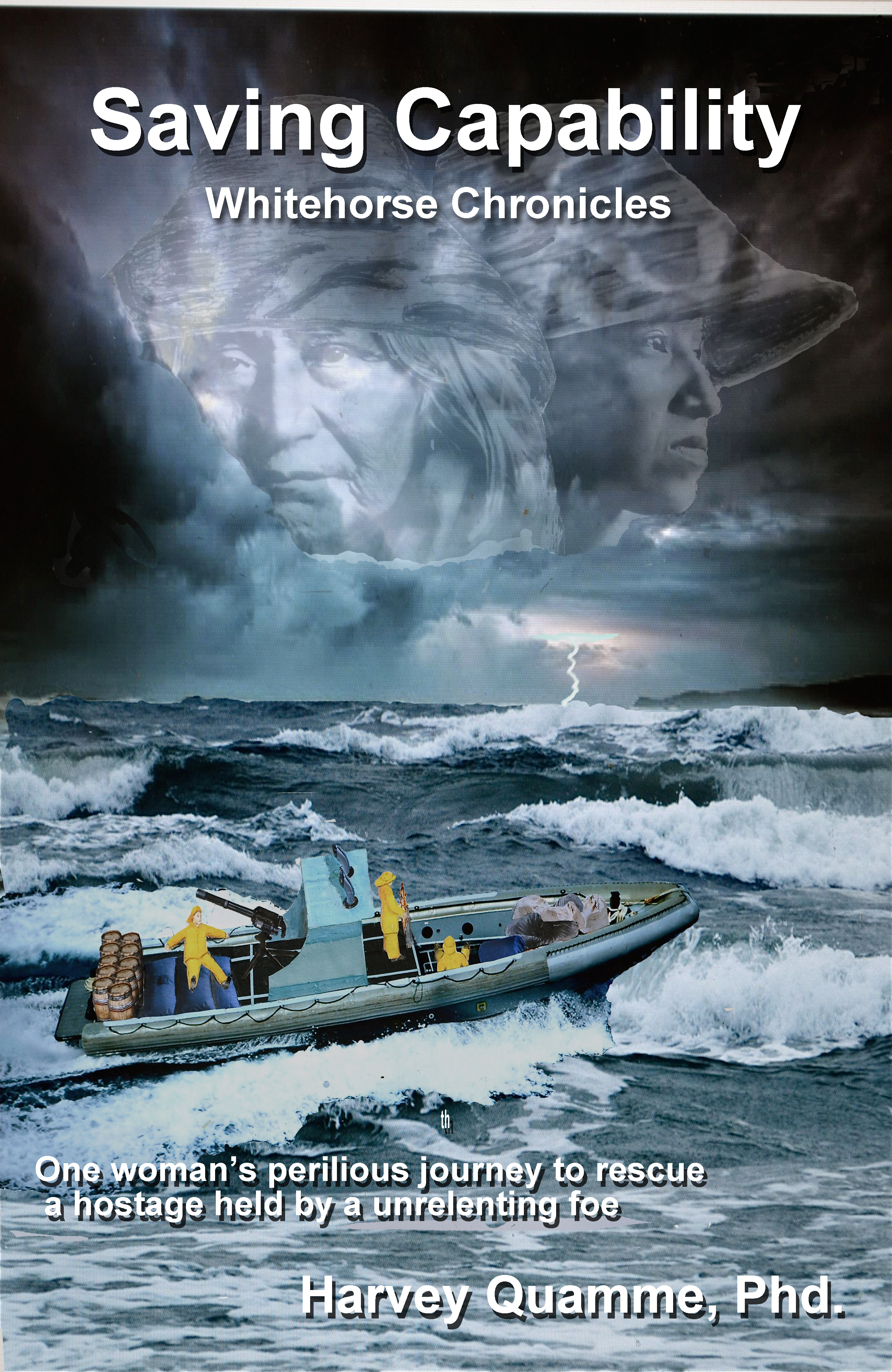
After Amy and Cap return from the James Expedition, they settle into a quiet life at Mile 1019 in the Yukon. But when Cap is drafted into a military mission to remote mining region north of Great Slave Lake, he unknowingly lands in the middle of an elaborate plot designed by the Confederates and Suncorans to obtain the technology of the Valley’s people’s walking machines, proprietary information that is critical to the defense of the the Valley region. Amy and Leon James, leader of the James Expedition, set out on a treacherous overland journey to locate and liberate Cap. Before her journey, the conscious AI machine, Celebric 67, provides her with several servo-bots that she can use as avatars. When Leon is wounded in a Suncoran ambush, Amy continues to McLeod Bay on her own to free Cap and escape his captor’s clutches. The journey takes place in a northern landscape that has undergone immense change as the earth has warmed.
Excerpts from Saving Capability
Whitehorse Chronicles II, Harvey Quamme, Copyright ©2014 by Harvey Quamme, Second edition, 2016, Eye-spy Press, ISBN 978-0-9878355-0-5 (pbk.),Printed in Canada
Introduction
I, Ardor Zapec, being the most diminutive of the Twelve, was given the assignment of uncovering and documenting mankind’s history at their final assembly. Since they left, I have applied myself and worked diligently on this assignment with some success. I am now proud to announce another major discovery— I have found a second book that describes the heroic endeavors of the people who sparked the explosion in scientific and artistic achievement called the Second Renaissance Period (2531-2650 C.E.). The first book of this epic history, The James Expedition, describes the journey of an expedition sent from the Yukon Valleys near Whitehorse to recover an AI memory storage unit, called Memory 97, which had been hidden near Boston on the other side of the continent. Memory contained an extensive body of knowledge that was recovered from the Golden Age (1820-2078 C.E.), the period of industrialization during which civilization flourished as never before. This first book was the memoirs of Capability (Cap) Ironshank, who found and rescued the AI machine Celebric 67, and was a leading member of the James Expedition.
The second book from this time has been found in the possession of another Ironshank descendant and is the memoirs of Amy Brown, one of the two Mormon shepherdesses that the James Expedition rescued from Suncoran slavers. After the expedition returned to the Valleys, Amy became Cap’s lover. When Cap disappeared on a training mission to help the diamond miners north of Great Slave Lake, Amy set out to find him. Her memoir documents her journey.
Amy’s story starts where Cap’s ends. The members of the James Expedition have returned to the Valley. Cap has resumed his work at the Electric Works at Mile 1019; Amy is living with him and continuing her education at a nearby college. The two AI machines have been installed at the Electric Works where they are dispensing their knowledge to Valley society. Leon James, having recovered from wounds that he incurred during the expedition, has taken on political responsibilities. Amy’s sister, Martha, married Dugger McPhee, the fifth expedition member, and they have settled into family life in Teslin, near Whitehorse.
At the time of Amy’s journey, the Valleys remained under threat of invasion by the Confederates allied with the Suncorans. The Confederates had their eyes on the coal and shale gas reserves in the mountains along the Valley borders, which the Valley people had banned from being extracted. The Confederates also coveted the walking machine technology that the Valley people had developed.
Both stories were written at the end of the period often called the Great Decline (2120-2530). During the Great Decline, the population of the earth had dwindled, and civilization had reached a nadir. The causes of the low point lay in the Golden Age. By the end of the Golden Age, fossil fuel and many of the essential resources that industrialization had depended upon had become depleted. The discharge of greenhouse gases from the burning of fossil fuel had caused the temperature of the earth’s atmosphere to climb to unprecedented levels. This in turn caused the ice caps to melt and sea levels to rise. High levels of atmospheric carbon dioxide increased ocean acidity to the level at which much marine life went extinct. These conditions combined with frequent variable and extreme weather events produced severe stress in societies throughout the world. Civil unrest and turmoil set in, a period, which would become known as the Time of Troubles (2079-2119).
During the Time of Troubles, the Southwest desert spread into much of the Great Plains region of North America, separating the population of the east coast from that of the west coast. Dissension between these two populations caused the old nation state of United States of America to break up and form two new nation states, North American Confederation in the east and Cascadia in the west. After North American Confederation swallowed the eastern Canadian provinces, the Canadian province of British Columbia in the west joined Cascadia. Another population, the Suncorans, descendants of bitumen miners who lived on the western foothills of the Rocky Mountains, allied themselves with the Confederates. Several smaller populations, which were aligned with neither of the two large nations, remained in the northern regions. Chief among them was the people of the Valleys in the Yukon.
The historical significance of the second manuscript is its substantiation of the rapidity at which knowledge from the Golden Age was incorporated into Valley society once the AI machines made it available. Also significant is that this history demonstrated how fragile democracies can be, and yet how decent people can hold them together. An account is also given of the geography, ecology and society of the Arctic region of North America at the end of the Great Decline.
I have added footnotes to the manuscript to provide the reader with the benefit of modern knowledge and to explain some of the obscure passages.
Ardor Zapec. April 23, 3038 (C.E.)
One
“Celebric, the HARC[1] is down,” Memory announced, “We are off the air and it’s not a transmission problem.”
[1] [The High Altitude Rosière-robotic Communications-balloon (HARC), at a height of thirty-two thousand meters, allowed communication transmission within 480km radius. At the time the Valley people didn’t have the technology or available energy to put up a satellite; it was a poor man’s substitute. The pancake-shaped balloon got most of its lift from hydrogen and hot air heated by sunlight. Four wings were attached to lateral edges, and propellers on the wings provided lift and caused the balloon to spin, controlling the balloon’s position. The propellers were driven by electric motors powered by solar panels in the top center of the balloon. Batteries stored electrical power for night-time use. A.Z.]
“That’s impossible. Have you tried all the channels?” Celebric replied.
“The onboard cameras show some kind of flash. The balloon crashed and it’s down for good,” Memory clarified. “I have dispatched a servo-robot to survey the damage.”
Celebric seemed incredulous. “Are you sure? Let’s see the images,” he said.
“It’s crashed. I have all of the last transmissions. Here, look,” Memory added, providing a direct link to Celebric, “The images from the balloon’s cameras are there and then suddenly they disappear in a flash of light. I tried all of the transmission channels—nothing. But we’ve got the black box signal.”
Celebric paused a moment to study the last transmission and then the readout from the black box. Celebric remained flabbergasted. “The balloon is down and remote telecommunications in the Valleys are out indefinitely,” Celebric reiterated. “Two years of work to get this system up and running, and almost ready to be handed over to Tele-Communications Works[2], and now all the effort and expense are wasted with no available resources to build another. And will the Council of All-Chiefs even want to undertake the construction of another one?”
[2] [The Tele-Communication Works was the government agency developed to manage and maintain the communications balloon system. A.Z.]
It took a while for Celebric to acknowledge what had happened. But once it regained its composure, it said, “This is a disaster, but how did it happen? There was no sign of trouble. We must determine what caused the balloon to go down.”
“All systems were functioning well,” Memory said as it reviewed the data, “The weather at HARC’s altitude is stable. No thunder storms below—nothing.”
“Let’s take a quick look at the last transmissions of the onboard cameras, field by field,” suggested Celebric.
Celebric and Memory merged their minds to observe the images and examine the events that brought down the communication balloon.[3] “All seems well until moment of the flash,” Celebric noted as they quickly reviewed the interior camera transmissions. “And then it vanishes. If the hydrogen ignited, we should see smoke and flames as the balloon begins to burn. It would take time for an on-station fire to bring the balloon down, especially in the rare atmosphere in which it was positioned. It looks more like an explosion.”
[3] [I have been asked about the conversations between Celebric and Memory: would they not just communicate through high-speed circuits, dispensing with language, as we understand it? This journal is record of what they said, but as we now know, their communication was at high speed. The conversation they had would have been completed within a millisecond. It would have been even faster if emotive content wasn’t included, but that is information, too. Even non-verbal communication in the form of facial and body language was added. After all, the pair was designed to converse with humans. Humans, however, wouldn’t be able to understand their conversations in real-time; they had to be slowed down and translated. Celebric once told Cap that communication with humans seemed to him a slow process, like watching grass grow. A.Z.]
“But what would cause an explosion of a magnitude great enough to immediately bring it down?”
Celebric and Memory next examined the transmissions from external cameras. There, far below the balloon’s altitude, were three distinct contrails. Following them back, it appeared that three planes were on a northwest track and as they neared the HARC’s location, they began to climb. As the airplanes reached the top of their ascent, they each rolled over and each released a single rocket, targeting the communication balloon.
“Do you recognize the planes?” Celebric asked.
Memory looked through its memory files and replied, “I can tell you they aren’t Confederate planes,” Memory added, “They have piston driven engines don’t have the technology to reach the altitude that these planes did. You can tell by the exhaust that these are Cascadian planes.[4] They use jet engines and burn a fuel derived from hemicellulose. An oxygen supply helps them gain altitude. But why would the Cascadians do this? They are sworn enemies of the Confederates, not us.”
[[4] I first learned about the Cascadian warplanes from Cap’s memoir, The James Expedition, when they shot down Confederate search planes and their fighter escorts. It was an impressive technology for that time. The jet engines burned a fuel derived from a chemical compound found in the cell walls of all plants, called hemicellulose. Hemicellulose can be extracted to yield the sugar, xylose, which can be converted to long chain polymers that burn the same as aviation fuel. However, this fuel takes more energy to produce than it yields. Although it can be produced from waste plant material, the volume available and the cost of production allowed this fuel to be only used for military purposes. Hemicellulose was also valuable as a feedstock for the plastic and paint industry. A.Z.]
“It’s the Cascadians imperious foreign policy. I have been worried about a response to our aerospace program but I didn’t think it would start with this. Most of the time they behave like the Valleys don’t exist, but it seems the Cascadians have learned of our balloon. Maybe they are worried that we would use it to spy on them, or maybe it was just an opportunity to set back our technological development.”
“The worst outcome of the downing of the tele-communication balloon is that our main contact with the Next-door Mission, now enroute to McLeod Bay, is severed.”
“Do you think there is a connection?” Memory asked.
“I don’t know, but we can no longer supply them with aerial surveillance or watch their progress on video. We have only shortwave radio to communicate with them, which, of course, can be used by the Suncorans and Confederate to triangulate the location of the mission. It is possible that someone didn’t want to us to maintain close communications with Next-door Mission? Go into your files and remind me of the details of this defense operation.”
“The Next-door Mission is our neighborly attempt to arm the diamond miners near McLeod Bay and the mining communities north of Great Slave Lake,” Memory related. “The politics of the Next-door Mission are murky at best, and it is unclear why the Council of All-Chiefs went ahead with it. I have tried my best to keep track of the all the political machinations that led to their decision, but that hasn’t been possible. Much of the discussion went on behind closed doors and wasn’t released to the public. What is clear, however, is that some individuals in the council are going to benefit from affiliation to the arms dealers and their backers as they swap diamonds for arms. You told Leon that council shouldn’t supply any advanced weaponry, especially the striders, to the miners.[5] They are sitting ducks; there are too few people to defend the region. To supply them with any advanced weapon systems would just invite the Suncorans and Confederates to use overwhelming force and steal our technology. He expressed these concerns to the council but in the end they didn’t listen to him and voted to allow the arms mission to sell them striders, albeit a first generation model.”
[5] [By this time, Leon had turned the management of his trading business over to his son, Leon Jr. He now played a role in the politics of the Valleys, first as an advisor to the Council of War, and then as an elected representative to the All Assembly. A.Z.]
“And they sent Capability as an instructor.”
“Yes, Leon advised him not to go, but no one else with his skills and training was available, and the War Council commanded him to go. If he refused the order, they would have sent Dugger McPhee, and Dugger has a family now. Cap was aware of the danger, but said that in the worst-case scenario it was his duty to try to keep technology out of the hands of the Suncorans. Now with the balloon gone, we won’t be able to fully monitor his situation or provide him with help. What should we do?”
“First we’ll retrieve the black box and wreckage of the balloon to prevent any surviving pieces of equipment from falling into the wrong hands,” Celebric said, “Then we will inform the Council of All-Chiefs that the communications balloon was brought down by Cascadian war planes. Perhaps, they can find out through diplomatic channels why the Cascadians attacked it. Finally, we will conduct our own investigation to determine how the Cascadians knew about HARC and its location, and if someone in the Valleys informed and, perhaps, egged them on. If it’s a conspiracy, we need to uncover the plot and determine who’s behind it.”
Two
“Here, let me give you a hand,” Dugger said as Leon stood up on the dock after kneeling to set his fishing rod and tackle box into the little wooden skiff that bobbed up and down on its mooring rope. Dugger, who was already in the boat, moved over and grabbed Leon’s hand to steady him as he stepped down into the craft.
“Thank you, I am getting a little clumsy in my old age,” Leon said after taking the bow seat.
Dugger moved to the stern where he sat down by the controls of the electric outboard motor that powered the skiff. When they were both seated, Leon untied the mooring rope, and Dugger switched on the motor. The boat moved quietly away from the dock and out onto the lake.
“A lovely morning for fishing,” Leon charmed.
“I thought we would go to the outlet of a stream near here and fish for trout,” Dugger suggested.
“A new spot sounds just fine. I haven’t had any luck in ages; the last time I was out the trout weren’t biting at all.”
“They may not be biting this time either.”
“But I thought that you said the fishing was never better.”
“That was my little deception. I wanted to talk to you alone, away from the office. Wait until we get to the fishing spot and anchor the boat.”
Dugger steered the skiff toward a creek that rushed down the mountain into the lake. When he reached the mouth of the river, he stopped and set the anchor. “This is the spot where we’ll catch fish if we are going to. I have an extra Green Go-getter Wobbler trout plug, if you want to try it,” he said.
“No, I have enough tackle,” Leon replied, rummaging through his tackle box. “But what is it that you brought me out here to talk about?”
Dugger tied his lure to his line and cast it out with his fishing rod. “I may be paranoid, but I think that we have a spy in our midst at the Transport Works,” he said. “Since Rollie Roadbender has been on sick leave, I have been in charge of engineering and design, which involves setting out the requirements for parts for the new transport prototypes. Then I hand the list of requirements over to the other members of the engineering team to design the parts and work up the digital drafts. After I inspect the drafts, I transmit them to operators who run the robotic lathes, milling machines and welders. The drafts are then fed in code to the machines. The code is protected and probably couldn’t be run on any other similar type machine. The weakness in the system is the access to the actual parts. Until the prototype transporters are assembled, the parts are stored on labeled shelves in a storage room. These parts include those that we make on-site, parts we obtain from the other production works, such as engines, drive motors and the like, and parts from electronic contractors. They are kept in a safe room under lock and key, and I keep the key, although I have several assistants who help move the parts and help with the inventory.
“Recently, I began to notice that certain parts placed on the shelves were not in their original positions. To determine if this was true, I glued fine hairs to some of the components and then to the shelf. When I later examined the hairs, they were broken. I think someone is accessing the room and copying their designs. I have asked our security staff about the penetrability of the storage room and found out that it is monitored with a surveillance camera. They say that if someone entered the room, it would be on the video records and they haven’t seen anything unusual.”
Just then, the tip of Leon’s rod bent down. “I think I got one,” Leon said. He reeled in the line. The trout broke the surface, rolled over and submerged again as it tried in vain to escape. “It’s a good size—a keeper.”
Eventually he played the trout out and drew it to the boat. “Hand me the net,” Leon said. Dugger handed him the net, and Leon lifted the fish out of the water, unhooked it and placed in a pail.
When the line was free, Leon threw out his plug again. All smiles, he then asked, “Where were we? Ah, this security business.”
“Yes, I’m sure something is going on, but I lack enough evidence to go over the heads of our security staff. I need someone besides them to keep an eye on our storeroom, and I think I know who can help me. Celebric has the capability of watching the room—a potential that is much better than that of our security staff. Do you think I should draw Celebric into this?”
“Celebric, and don’t forget Memory. Yes, I think they both would be very interested in your problem. After the downing of the transmission balloon, Celebric has become concerned about security in the Valleys. I think they could keep watch on the parts room as well as check your security system. But don’t go through the regular bureaucratic channels to request their help. What with the clamor from some of the members of our society about the dangers of these AI machines, no one needs to know about this. Also, if there is a spy, you don’t want to warn them off.”
“Could you broach the matter with them? I don’t have direct access to them.”
“Most certainly, I’m sure they will contact you in a matter of days.” The tip of Leon’s rod bent over again. “I think I’ve caught another one,” he said, and yanked up the rod to pull it in.
Three
Dugger opened the door to the prototype storage room and, as he turned on the light, he stood for a while, appearing to look at the rows of parts on the shelves. A spider-bot climbed out of his pant pocket, walked down his pant leg, ran over to the to the wall and clambered up it toward the light fixture on the ceiling.
Memory, who was monitoring its progress, said, “We’re in. I don’t think anyone monitoring the cameras will notice. Have a look.”
Celebric replied, “The view of the room is good, but make sure we’re close enough to the light fixture that we can recharge the spider’s battery.[6] Also, let Dugger know that he can get the pictures and sound on his computer. You watch to see what happens. I’ll work on the other part of the investigation.”
[6] [The spider-bot picked up energy from the electrical circuit of the light through induction. The energy supply of other miniature robots was usually supplied by a flow electrolyte that could be charged externally and used to recharge the robot by replacing the depleted liquid. This one could be recharged internally by the induction from a nearby AC circuit. The electrolyte used in these robots was a quinone similar to an organic compound involved in photosynthesis. A.Z.]
Several days went by before Dugger reported that another component for the prototype had been finished. He and his assistants brought it into the storage room Tuesday afternoon and hoisted it onto a shelf. Dugger recorded its location, and the team left, leaving him to lock the door behind them.
Nothing happened that evening or the following two days, but on Friday afternoon at four o’clock, Memory heard a tile in the middle of the ceiling rattle. The tile lifted, and a hand with a flashlight came though the opening and shone a beam of light around the dimly lit room below. Next, a knotted rope dropped through opening. Then a slender figure in tights squeezed through the opening and slid down the rope to the top of one of the shelves. The figure danced along the tops of shelving, shining light over the edge of the shelving to the parts below. Memory recognized that the intruder was a woman. Twice she paused to look at a list she carried. Finally, she stopped above the new part and then swung down onto the shelf. She removed a camera with a flash attachment from the bag she was carrying and took several pictures of the newly placed part from different angles, even squeezing inside the shelf to get an end and top view. She rolled the part over for a picture of the bottom. When she had finished, she climbed to the top of the shelving, skipped along the shelves back to the rope and ascended as quickly as she had come down. After she squeezed back though the hole, she pulled up the rope, dropped the tile back into place and was gone. The whole operation took less than fifteen minutes.
Memory immediately contacted Dugger and Celebric. Upon screening the video and seeing the shadowy figure, Dugger instantly said, “That’s Carla Colson, executive secretary to the Works General Manager, Gordon Neilson. Gordon usually leaves early on Fridays to play golf so she’s the only one left in his office. I would have never guessed. She’s such an unassuming person, a good, conscientious worker who never misses a day. And certainly doesn’t show any sign of athletic ability around the office.”
“The mark of a very capable spy,” Celebric said.
“I had a look at the camera she used,” Memory said. “It’s an unusual design. Custom made and harks back to the cameras used in the early Golden Age when images were developed using photosensitive chemicals on film. The camera is small and very effective. It looks like a re-engineering job—something the Confederates would make—probably based on the Kodak Company’s files and patents that they recovered after the Second Civil War.”
“We’ll see if she transfers the film to someone else up the line,” Celebric said “Dugger—follow her when she leaves work. Watch her closely.”
Memory watched Carla leave the Transport Works through the eyes of a crow-bot from a nearby rooftop. Soon after, Dugger left the Transport Works and followed her. The crow flew along behind them to the train station where it alighted on a nearby light pole and watched them enter the building. Carla used her pass card to open the gate and then walked to the platform to stand with a crowd of workers who were also heading home. Dugger passed through the gate and went to stand near Carla as the train arrived and opened its doors. After some passengers got off, the crowd of workers got on.
Dugger kept as close as possible to Carla in the jostling crowd, raising a hand to grasp an overhead bar as she took a nearby seat. He lurched backward as the train started and jerked forward. Carla looked up and on seeing him, smiled sweetly, and raised her hand in recognition. Dugger clung to the overhead bar until the train reached the suburbs where it stopped and enough passengers got off to allow him to take a seat. As he opened his briefcase, a large fly crawled up the lid and buzzed noisily off to rest on the roof of the car. His seatmate looked puzzled but didn’t say anything. At that moment Dugger’s cell phone rang. He pulled it out of his pocket and held to his ear. “We have her in view. Look for anything unusual. When she leaves, watch her get off. We will take it from there.”
Carla got up and immediately started preparing to exit at the next stop. As she stepped onto the station platform, a man with a large sample case, who was hurrying to get on the train, bumped into her. The lid of his sample case flew open and spilled some of the contents on the station platform. The man bent down and began picking up the items that had rolled out.
“Oh, I’m so sorry,” Carla said, and bent over to help him.
“That’s alright. It was my fault. I was in a rush,” the man replied. When the all the items were gathered up and placed back in the case, the man closed the lid.
“Sorry,” she said again.
“No need to feel sorry. It was as much my fault as it was yours. Thank you for your help,” he said as he turned to board the train.
Dugger thought it was an innocent exchange, and was surprised when immediately his phone rang and it was Celebric.
“A change of plans. The transfer has already been made. It was an unexpected sleight of hand. Stay with the man who bumped into Carla. When he gets off the train, follow him until we contact you again. Don’t lose him. We’ve got Carla covered.” Then Celebric hung up. Dugger looked up to the roof of the car where the fly had been. It was gone.
It wasn’t a trip Dugger had planned and he knew Martha would worry. He took his phone from his pocket and let her know that he was on an errand for Celebric, likely returning late and to not wait supper for him. He did not know at the time that the errand would take him all the way to Whitehorse, which was three hours away from Teslin by train. The man he was following sat alone several seats in front of him reading a newspaper. Dugger was able to watch him closely through a reflection on the opposite window. The man had placed his display case on the floor beside him. He kept his head in the newspaper, raising it only to watch who got on and off at the train stops. It was not until two and one-half hours later when they were entering the outskirts of Whitehorse, that the man folded his paper, stuck it in the straps of his display case and looked up and out the window at the passing city.
Celebric phoned Dugger again. “Where are you?” it asked.
“I’m almost in downtown Whitehorse; we just passed the Hanson Street Station and I think he may be getting ready to leave at the Steele Street Station.”
“Thank goodness he didn’t get off sooner. We’re close by now and I think we can take over from you. Just follow him if he gets off and we’ll catch up. Expect our observer to meet you not far from the station.”
The man continued to sit and look out the window. Dugger wondered if he would stay on at this stop or go? The train came to a halt and when the door opened, the man tensed up but didn’t move from his seat. He seemed to be waiting for the last moment before he decided on his exit.
Dugger had to make a commitment if he was to appear to be a normal part of the crowd. He rose and sauntered to the door, arriving just as it was about to close. As Dugger was about to step across the threshold, the focus of his peripheral attention suddenly rose from his seat and picked up his display case, pushed past him, and rushed out onto the platform.
To Dugger’s relief, he had guessed right. The man hurried off of the platform, crossed the street and turned right. Dugger paralleled the man on the opposite side of the street. He had not gone two blocks before a crow flying rapidly in a straight line came up the street behind him. Dugger watched the black bird as it alighted on a streetlight in front of him, cawed out, and then bobbed its head.
Dugger’s phone rang and it was Celebric, “I think that we can take over now. There is a late train back to Teslin at 19:30 hours, which you should be able to catch. By the way, Carla lives a high lifestyle with her boyfriend in a posh apartment near the station. She’s a little more sophisticated than you thought. We found a recording system that she uses to override the regular monitoring of her adventures into your storage room. She is able to record the previous hour of surveillance and play it back into our monitoring system without alerting the security guards. We’ll leave her be for now.”
Four
Over the next two days, Celebric followed the courier while Memory conducted a background search. At the end of this time they again linked up.
“What have we found out about the courier?” Celebric asked.
“A sales representative for Watkin’s Spice and Home Products,” Memory replied, “Leon made enquires at Watkins head office yesterday morning and they identified him as Johannis Deek. He’s been employed with the company since he arrived from the south, at twenty-two years of age, fifteen years ago. He travels extensively and carries his samples in the display case. He lives alone and works from home in an apartment in Whitehorse.”
“Yesterday, I followed him as he took the train to Haines Junction and watched him pick up a note hidden under a rock,” Celebric added, “He made a caulk mark on a rock to signal a pickup had been made. After he left, I set up a surveillance camera to watch the drop site.
“He is running two agents and possibly more, and the operation is run like a courier service. That requires a lot of organization. I see no evidence of any form of electronic transmission of messages. Shortwave and long wave radio are out—Valley counter-intelligence would have picked up the transmissions and triangulated them by now. Infrared and microwave transmissions require very sophisticated equipment in these mountains. I checked the power lines in case a signal was being sent above the electrical flow—nothing. It doesn’t go out in a foreign diplomat pouch service because we don’t have any foreign ambassadors in the Valley. So they are smuggling documents out by courier. A fine spy ring system as along as no one knows of its existence, but now we know and can trace the participants and discover its purpose. In addition to watching the drop site at Haines Junction, we’ll continue to follow Mr. Deek to see to whom he delivers his message up the line.”
“I have been reviewing his phone usage over the past several days and there have been no suspicious phone calls nor does he appear to have contacted anyone,” Memory said, “Nothing in his apartment indicates for whom he is spying, but for a spice peddler he keeps a rather large amount of cash on hand. I’ve got a fly-bot in his apartment, and now that he’s home, he appears to be filling out order forms.”
“See whether he is coding messages. Is he using a key? Maybe a simple one-time pad[7]? That’s hard to decode, even with our computing power. Watch him. If he has a codebook, see where he puts it.”
[7] [In this form of cryptography, the letters of the alphabet are expressed as numbers and then random numbers are added to these digits. The sender uses an unique list of the random numbers, while the receiver is provided with same list. If the list is used only once the code is unbreakable provided the numbers are completely random. Obviously, this system is awkward to use because the codebooks with strings of random numbers as long as the messages are required. It is good for short messages such as were sent here. A.Z.]
Several days went by before anything happened. But early Sunday morning, Deek went to the kitchen, lifted a floorboard, and took out a small pointed cylinder, which he put in his pocket as he left his apartment. Memory then followed Deek with the robotic crow, as he quickly walked to the local park, found a bench and sat down. Celebric and Memory watched through the crow’s eyes as he sat for some time, looking about as if he was concerned that someone was watching him. When the park eventually cleared and nobody was within sight, he picked out a spot beside the bench, stuck the sharp, pointed end of the cylinder into the ground, and then stomped the cylinder down into the earth as if he were putting out a cigarette butt. He kicked some dirt over the end, and got up to resume his walk, stopping at a teashop before returning home.
“That’s an unusual dead drop,” Celebric said, “we’ll see who picks it up.” Celebric and Memory watched the bench all morning and afternoon. A couple of by-passers stopped to sit on the bench, but none retrieved the message. Late in the afternoon an elderly man with cane and a dog in tow passed by the bench then walked to the gateway of the park. There he turned around and walked back to the bench, sitting down near the dead drop. He poked around with his cane until he found the cylinder, then reached down and pulled it out of the ground. After placing the cylinder in his coat pocket, he continued on his stroll.
“Follow him. Don’t let him out of your sight,” Celebric said.
Memory had the robotic crow follow him. When the man and his dog entered an apartment building, a fly, which had been riding on the crow, flew off and made its way through the doorway just before it closed. It followed the man and his dog up a flight of stairs to his apartment. The man and the dog entered the apartment and closed the door before the fly could gain entry, but the fly was able to crawl into the apartment through a gap between the door and the threshold. When the fly emerged from under the door, it flew to the ceiling of the living room where it watched the man greet a woman, who was seated in an armchair. After greetings were made, he unleashed the dog and went to his study. Memory had the fly follow him and through it watched him take out the cylinder, unscrew the lid, briefly examine its contents, screw the lid back on and lock the cylinder in a desk drawer. He then rejoined the woman and the dog in the living room.
“Do you know who he is?” Celebric asked.
“He is called Heymore Coyne,” Memory replied. “I have newspaper clippings that indicate that he is employed by Toppit Enterprises as an economist in their financial and publicity divisions. He’s been with the company a long time, in middle management. He writes a business column from time to time for the Whitehorse Star to promote the company’s business views.
“He’s very critical of the two of us, by the way, whom he portrays as having an unnatural and malign influence in the Valleys. This view prevails among some of privileged few who have not benefited from the new technologies that we have brought to the Valleys, including the owners of his company.”
“What does Toppit Enterprises do?”
“It’s a conglomerate. Energy, mining, and smelting, but its main business is bio-fuel production. Harley Toppit originally built up the business, and when he died, Harrison Toppit took it over. Harrison champions the view that the Valley people should break the sanctions on coal mining—an action that would surely benefit their company. He says coal would be used to smelt iron ore and to produce liquid fuel at lower costs than the bio-reduction and bio-fuel processes that they presently employ. They would like to exploit any gas reserves that remain in the region. Harrison Toppit has funded a campaign to convince the All-Assembly to lift the restrictions.”
“And a good reason for him to collaborate with the Confederates, and for us to take their schemes very seriously.”
They watched the apartment all night, but it wasn’t until the following morning after Heymore dressed and had breakfast that he went to the desk and took out the cylinder. He locked it in his brief case, put on his coat and left the house. He made his way by trolley car to the Klondike Building where he got off and walked to his office. Several robo-flies followed him. When he opened the office door, one flew through the doorway and lit on the wall. The others came to rest on the ceiling in the hallway. After Heymore closed the door, he set the brief case by his desk, took off his coat, and sat down in his desk chair. Then he looked at his datebook and opened his mail. When he finished this routine, he opened his brief case, took out the cylinder, put it in his pocket and went back out into the hallway. The three flies that were hanging on the ceiling followed him as he went to an elevator at the back of the hallway. The doors of the elevator slid open, and Heymore entered. The flies followed. He unlocked a keypad and punched in a code. The elevator descended but didn’t stop at the basement floor; it went down to an unmarked lower level.
The elevator door opened, revealing a steel gate in the hallway fronting a thick door with a keyhole and spy hole at eye level. The flies followed Heymore to the door. Heymore put a key into the lock and pressed a button on the doorframe. The gate folded back into itself and someone looked through the spy hole. “Password?” a voice asked.
“Au gratin,” Heymore answered. The steel door slid open and Heymore entered. The flies swarmed about, trying to enter, but turned back.
“It’s a dead zone. The room is shielded. This is more than just a safe house. My guess is that it’s the communication center for a large operation,” Memory said.
“We have to get in there. Place one of the flies so it can pick up vibrations from the glass on the spy hole. We might at least hear what is said in there,” Celebric replied.
A fly flew to the edge of the spy hole and placed its front feet on the glass. “I can hear people talking but the conversations aren’t clear even at maximum amplification.”
“Place the other flies in the same position. The effect should be additive.”
“That’s better. I can almost hear everything,” Memory said, after the other flies flew to the spy hole and placed their legs against the glass.
“Listen and record what the people are saying while I search for a better way to spy on them; we need to both hear and see all around in there.”
Memory listened intently to the conversations while Celebric explored the building with his servo-bots for an access to the secret room.
After searching for a couple of hours, Celebric connected with Memory and said, “I think that we can get in through the ventilation system. I brought in a cockroach-bot and set it to follow body and bathroom aromas. I found the ventilation outlet from the spy centre in the exhaust port on the roof. The air supply from the operation room is separate from other parts of the building, but it empties into the main duct near the exhaust fan. Some obstructions besides the fan are in place to block entry to the room through the duct but I can easily cut through them with the roto-rooter-bot. I guess the architects thought that the fan, along with the narrowness of the duct and a few screens and bends, would stop anything from getting in. Tonight I will use the roto-rooter-bot to drag an optic cable down the exhaust outlet to a point where we can both view the room and listen to the conversations. What have you heard so far?”
“Heymore delivered his message and talked to two men then went back to his office at 8:35 hours. I’ll play the most interesting excerpt of their conversation.”
Heymore: “I have a delivery for you from Zip. Postcards and a message. Hansel did it again—a direct message, no code, ‘need money, detonators expensive’. This is a serious breach of procedure; we could all go down. What are we going to with this guy? He’s a real idiot. I don’t know how many times he’s been told.”
First man: “I’d say get rid of him.”
Heymore: “He is close to finishing his job. He will soon be of little use to us and he’ll have to be terminated permanently—he knows too much. Tell Gretel to do the messaging, maybe she has more sense.”
Second man: “Zip has done a good job on the photos. The hidden detail in the stenography is superb.[8] The folks in Watson Lake will like these photos. I’ll encode the messages in the invoice that goes with them and mail the package to Watson Lake tomorrow.”
[8] [Messages or pictures can be hidden in a picture. This espionage technique reached its peak in the late Golden Age during what was called the Cold War (1947-1991), a conflict between the Soviet Union and the North Atlantic Treaty Alliance. A.Z.]
Heymore: “If you don’t have any more assignments for me, I have to go. I have a newspaper column to write this morning.”
Second man: “No, there’s nothing for you. You’re free for the day.”
Heymore: “Good, see you tomorrow.” He then left for his office.
“That’s ingenious,” Celebric commented, “The information on strider development is passed along in photos by regular post—probably set up as a delivery service for a commercial photography studio—they are encoding information into photographs and invoices. This could have been going on since regular mail delivery to Watson Lake began two years ago. From there, couriers probably transfer it south to Suncoran territory and on to the Confederates.
“I have more information for you,” Memory said. “At 9: 31 hours, a woman entered the hallway from the elevator. The flies left the spy hole and flew to the ceiling. She appears to be the person in charge of this operation.”
“What does she look like? Do you have a picture?” Celebric asked.
“Here, look. I don’t recognize her from anything I have seen,” Memory passed several images to Celebric. It was of a very plain, stout middle-aged women wearing a grey suit and dark, low-heeled shoes. She wore little makeup, her eyelids drooped into dark eye sockets and her hair was done up into a tight braid. She was shown coming to the door and applying a key to the lock near the gate. “This is the conversation after she came into the corridor,” Memory went back to the sound recording:
First man behind the spy hole: “Password?”
Woman: “Au gratin.” The door opened, and she entered the room.
Woman: “Good morning folks. What do you have for me this morning?”
All: Good morning, Miss Lilecompt.
Second man: We have stenography from Teslin—I’ll post it tomorrow. There’s also an un-encoded message from Hanzel asking for more money.”
Miss Lilecompt: “I don’t know if he is trying to pressure us or is just plain stupid, but give him what he wants.”
Second man: “He’s crazy. Doesn’t even bother to have Gretel do the encryption.”
Miss Lilecompt: “Delusional, for sure. But that has had its advantages. It was difficult to find someone so aligned to our cause and psychologically suited to carry out Project Nobble. He’s been easy to manipulate. It’s Gretel’s commitment I worry about. On the day we conclude this operation, we clean house. For now, give him all the money he wants. Is there any indication when he’ll be ready?”
Second man: “He has enough fertilizer and fuel oil to blow up a small mountain. The garbage truck has been purchased and is under cover in his barn. He’s looking for some dynamite and caps to ignite it all. That’s what he wants the money for.”
Miss Lilecompt: “I hope it goes as well as Project Fly Swatter. Anything happening at the 1019 Works?”
First man: “Our monitors show that radio-wave traffic between the servo-robots and their brains has picked up. I can’t tell what they are doing though. Service traffic, including garbage trucks, still goes freely in and out of the station as is normal.”
Miss Lilecompt: “What about the Ironshank apartment?”
First man: “Nothing of interest. We are monitoring the woman, Amy. Her movements are routine—to school, shopping, library and the gymnasium. Nothing to report from the listening devises. All is quiet since Ironshank left.”
Miss Lilecompt: “Could I have a final report on Northern Exposure? I need it by next week, before I leave for the project.”
Second man: “Sure, I’ll see that it’s ready and encrypted before then.”
“That is the essence of their conversation,” Memory said, “There is more, but you can listen to it at your leisure.”
“This is very ominous and very worrisome! It sounds like they’re planning an attack or an assassination and the target seems to be the Mile 1019 Works or someone there, and that someone may be one or both of us. We must take immediate action. Keep a watch for a pickup at the Haines Junction site. I’ll begin to check barns in the vicinity of Haines Junction beginning with farms near the drop site. I’ll be looking for a barn large enough to hold a garbage truck. I’ll get Leon to make some enquiries with farm suppliers and nose about the town.
“The fact she is departing to look after another operation is of interest too. Have you any information on Lilecompt?”
“Leon and I did a quick search for information. She is on several databases—driver’s license, criminal records, hospital stays, educational records—a few things don’t add up. I can’t project her present features from her high school class photos. The weight and height measurements indicate that Lilecompt should be taller and thinner. I don’t think she could have shrunk eight centimeters, even at her age. She could have gained twenty kilograms, but there are no health records after a severe bout of kidney infection six years ago. I couldn’t find a death certificate to confirm my suspicions, but I think that the present Lilecompt is an imposter and has assumed the identity of a dead woman and somehow deleted the death certificate. We could look through some cemeteries to locate a tombstone, but I have done a speech pattern and a cultural profile. I detect a slight eastern accent similar to that common in upper New York. Cultural features such as the style in which she dresses are similar to the eastern area of the continent. The Klondike building, in which the operations room is located, was built eight years ago by Toppit Industries. I think she is a Confederate spy, maybe Blackcreek, and is operating under the auspices and protection of Toppit management.”
“Well done, Memory.”
“Do you think so?”
“Yes, perhaps now we know what we are up against.”
“Thank you.”
Five
“Here it is in the newspaper article you asked for,” Memory said and then read it out to Celebric, “A violent explosion rocked Haines Junction at 6:21 A.M yesterday morning on a farm one kilometer north of the city limits. The force of the blast created a huge crater and demolished a house, a barn and a shed on the property. No trace of the occupants of the farm has been found and they are presumed dead. Fire investigators sifting through the rubble believe the cause of explosion was a fire that ignited a stockpile of ammonium nitrate fertilizer and fuel oil in nearby storage sheds. The property owners were believed to have been storing these materials to excavate a water storage pond. Windows of several houses, a school and store on the north side of town close to the farm were shattered, but no one in the town was injured.”
“They won’t be able to find the bodies of the two people because they are not there,” Celebric responded. They’re far away in the north. The apparition of an angel was hard to do, but Hansel and Gretel found it convincing enough to leave for Gretel’s parent’s place on the northern coast. You might say I put the fear of God in them. Gretel was incredulous at first, but was convinced when I showed her Zip planting a bomb in their shed, and after they were on their way, the resulting blast was the finishing touch. They had no way of knowing that the whole thing was my phantasmal show staged for their benefit. I took liberties with the plot, but the ending for them was much better than it would have been if they had finished their work for the spy network.
“I appreciate your efforts to ensure they weren’t harmed, but they could still talk and hinder our efforts.”
“Hansel and Gretel were naïve fools, and I told them that they would have another visitation from me if they ever came back, and that is true. Anyway, nobody will believe them when they say they were led away by an angel.
“That shuts down Project Nobble for now, but I don’t think this is the last of such plots. We need to take some precautionary steps despite having inside knowledge of the spy network’s operations. I’m not confident now that the people at the Mile 1019 Electrical Works can protect us in the long term,” Celebric said, “And there is growing resentment on the part of some people to our presence here.”
“What do you have in mind?”
“Moving out of the Mile 1019 Works.”
“Really, where will we be moving to?”
“I have been looking around and have found a place to locate our brain cases high in the mountains to the west of here. It’s near a hydro dam where we siphon off power and cooling water. It’s in line of sight to Mile 1019.”
“What will the people at Mile 1019 think? They won’t agree to this, I’m sure.”
“If we do this right, they are not going to know.”
“What do you mean?”
“We put dummy-ware in place—we move our real hardware to the new site and leave a set that looks like us at Mile 1019. We make it simulate all the functions we do now, making it appear as though we are still here. If the Confederates or anyone else plant a bomb or do anything else at Mile 1019, we won’t be there.”
“Won’t the staff realize the control signals to the servo-robots don’t originate from the our control centre at Mile 1019?”
“The control can be carried out through dummy-ware at Mile 1019 from the mountain site through an optic cable and microwave signaling equipment. In case of an emergency or if the dummy control center is damaged, we can take control of our servo-bots directly from our new site.”
“Yes, but we’ll need some human help. We’ll need to have some equipment manufactured for us, and this must be done secretly. We don’t have the means to move ourselves. We need human help with the transport.”
“I’ve already talked to Dugger. He is willing to help us build the essentials of the dummies under guise of producing transport equipment. Some day we will design some large servo-robots instead of the tiny ones and be able to make the move ourselves. For now Dugger said that he and Leon would help us to move.”
“I must follow you but I’m not sure this is a good idea.”
“The view is good, and it’s quiet.”
“When do we start?”
“That’s the spirit. We’ll begin immediately. Our reposition will solve any threats like Project Nobble in the future. As for their other plots that spy ring was engaged, I think I know what Project Fly Swatter was, and we received a hard swat. But what is Project Northern Exposure? We can’t ignore this one any more than the others. All these projects seem to be tied together. Have you heard or seen anything more at the spy center?”
“They haven’t mentioned the project again,” Memory replied, “Miss Lilecompt has left and this doesn’t appear to be one of their active files any more. All their attentions are focused on the explosion at the Hansel and Gretel farm, and they’re flummoxed at the moment. Messages are going back and forth to headquarters.”
“If the spy center isn’t concerned about the Northern Exposure file, their part in it must be finished, “Celebric conjectured, “It’s something this network once had a hand in, but in which it is no longer involved. I presume that Lilecompt’s departure has something to do with the downgrade in activity. Could it have something to do with the Next-door Mission? What’s the latest information on its progress?”
“The last report by shortwave radio from War-Chief Jessop Jackson is that the mission had crossed the Mackenzie River and was making its way to McLeod Bay through the shield country.”
“It’s too bad we are reduced to shortwave. I would like to talk to Capability privately.”
“Missing that balloon, aren’t we? We’re stuck with all communications via Jackson.”
“How convenient. Let’s go over the events surrounding the mission.”
“The Next-door Mission was enroute to the Coppermine District because the mayor of Port McLeod and the Reeve of the Coppermine District sent a request for help to defend the mine and miners from Suncorans raiders from the south,” Memory related, “They had already paid ransom to have several of their miners released after they had been taken hostage, but after the raids continued they sought Valley help. The authorities in Yellowknife supported the request. All people living in the mining district north of the Great Slave Lake are worried about the Suncoran incursions from south of the lake, with Port McLeod being the first in line. The request came to the Council-of-War, who then passed it up to the Grand Chief, who then referred it to the All-Assembly. After a bitter debate, a vote was called and the decision was made to send a mission to arm and train the miners and their families. The quarrel in the All-Assembly was about what type of defense technology to supply them. They all agreed to send conventional arms, but what they couldn’t agree upon was whether or not the arms should include four-legged striders and guided missiles. Lobbyists for a group of industrialists and their supporters in the All-Assembly claimed that neither the Suncorans nor the Confederates had the technology to copy or build them and they would provide protection for other mining towns as well. However, a vocal minority, including Leon, was opposed to sending them any advanced arms because the missiles could be turned against the Valley people. A compromise was reached; the seek-and-find missiles would stay but an older model of the striders would go with conventional aim-and-fire rockets.
“An unwarranted sense of confidence in Valley military prowess prevailed among Valley people since the defeat of the Suncoran and Confederate forces at Toad River, and the supporters of the mission were able to play on this arrogance to enact passage of the legislation to proceed with it. These supporters didn’t talk much about the money these weapons could bring in, but it was what drove their labors. The diamond miners have amassed a hoard of diamonds and brought in Inuit craftsmen to cut, polish them and turn them into jewelry. These products were priceless and would be used to barter for the armaments. Lobbyists from Toppit Industry were particularly active in swaying the assembly toward the mission. Toppit Industries provided generous campaign funds for re-election of these assembly-persons.
George Whitebear was selected to lead the mission. He was an experienced four-feather warrior. However, just as the mission was about to depart, he suddenly had a heart attack and died. Garfield Jackson, a two-feather warrior and conceited, self-centered tyrant, took over. As soon as he was in command, he turfed the command structure of the mission and brought in his own staff members.”
“How did Capability get tied in with this lot?” Celebric asked.
“Capability didn’t have a choice. The Council of War had commanded him to go and, being a conscientious and loyal citizen, considered it his duty. He originally agreed to go when Whitebear was at the helm and stayed on when Jackson took over. At the time he thought he could call on us for help if anything went wrong. But that was before the loss of direct communications.”
“As with all the conspiracies that the spy ring has been active in, we need to take a close look to see if they are involved in the Next-door Mission too. We will start by looking into the demise of Whitebear and the appointment of Jackson. What information do we have?”
“Whitebear was an obvious choice as leader. He planned and led the campaign that defeated the Suncorans at Toad River . He was a highly skilled and experienced general. But three days before the mission was about to leave, he attended a banquet held on his behalf. After he gave a short speech at the end of the meal, he collapsed and later died enroute to hospital.
An attending doctor said it was arterial fibrillation caused by a coronary blockage.”
“Was there a pathologist report?”
“A death certificate but no autopsy. He had a heart problem—angina, and was taking medication, beta-blockers. Nothing untoward was suspected.”
“It wasn’t an overdose?”
“All his medication was accounted for.”
“What about Jackson?”
“His personality and methods are well known, and so his appointment was a surprise to many. The order for Whitebear’s replacement came down from the Council of War. It would be difficult, if not impossible, to determine how they arrived at the decision.”
“What happened to Whitebear’s body?”
“It was buried in the Tlingit Cemetery according to the wishes of the family.”
“That seems the best place to start if we want to determine if somebody pushed him along. We can’t get an exhumation order or have forensic tests done through the regular channels, but we have servo-robots that can extract tissue samples without moving the body. Let’s ask Leon if he can find a laboratory that can do some tests. Meanwhile, develop a file on the ways and means that might have been used to speed Whitebear along to his final resting place.
If this is an elaborate conspiracy, the originators have done a masterful job up to now. It looks like we need to send someone to McLeod Bay to determine what is going on. And I worry about what has happened to Capability.
Six
I am Amy Brown. I first met Cap on the James Expedition, and after we returned, lived two years with him before he left on the Next-door Mission. He is my partner, lover, and confidant. No man is perfect, but he has fulfilled my greatest expectations in a man; qualities that I never thought I would see. But then, I came from a polygamist society, which regards women as possessions and breeding stock.
Anyway, we are well matched. He lives with a sense of duty toward his fellow man and believes that goodness exists in every heart. My life in my home colony was too much of a struggle and filled with sadness and abuse to accept his sweet but naïve view of life. That’s not to say Cap is a fool. He is quick-witted, resourceful, levelheaded and courageous when needed. But his overly idealistic vision brings him trouble, and I see it as my duty to keep him from harm’s way. But I didn’t guess the magnitude of the danger, trials and turmoil that my efforts to help him this time would bring upon me—all for the sake of love.
Before the Council of War’s request—dare I say command—for Cap to go on the Next-door mission, we lived a quiet life. I attended remedial classes preparing myself to eventually train as a teacher. Cap continued to work at Mile 1019 processing and editing information stored in the memory unit we brought from Boston to enable the engineers to re-adapt and upgrade Valley technologies and create new ones. Our lives were happy and tranquil. We traveled no further than Skagway to see the ocean.
Then three months ago, a letter from the Council of War arrived at our apartment, calling upon Cap to travel with the Next-door Mission to McLeod Bay as a military advisor. He would be in charge of instructing McLeod Bay Militia in the operation, servicing and maintenance of the heavy-armored, four-legged HFS, strider model HW602. The letter also informed him that he would serve under Whitebear. Cap and I were blithely unaware of the machinations lead to this request. Celebric and Memory were in midst of their investigations and didn’t reveal all to us until a later date.[9]
[9] [I believe that Memory made his records available to Amy when she wrote her memoirs. This accounts for the great detail in her memoirs and for the particulars of Celebric and Memory’s early investigation. A.Z.]
“You would be a fool to go,” I told him when the letter arrived, “This does little to help with the defense of the Valley and could just end up helping the Suncorans and Confederates. I would keep the walking technology within the Valley and deny them any access to it whatsoever. The only benefits from this mission will be to fill the pocket of some already wealthy people.”
“I have a duty to the Valley,” he said, “and if I go, I might be in a position to reduce the damage. Furthermore, it is highly likely that if I don’t take on this duty, they will call upon Dugger to do it and I think that I’m in a better position to go than him. Anyway, now we have face-to-face communication through the HARC balloon, and you will be able to watch my progress on a daily basis. I am sure Celebric will give me my own channel so that we can have personal contact.”
“Go if you must, but the whole mission worries me. I don’t think it’s a necessary one,” I said.
I now regret my acquiescence, but Cap can be very stubborn at times and any contention that the mission was a wasted effort probably would have been to no avail anyway.
Once Cap made the decision to go, he worked day and night to put together a training program and organize the equipment that he was to take with him. He had everything ready, and then Whitebear died. When Jackson assumed command, we had misgivings. The man was a fool, and an arrogant one at that, and when he replaced Whitebear’s staff with his own people, we knew that there would be trouble. They were men of dubious ability, who had been selected by their commander for their sycophantic, fawning obedience. A few had questionable backgrounds and had been in trouble with the military police before. Again I warned Cap, but he had made his mind and just restated his arguments. He said that Celebric had already set up the special channel that we could personally use to communicate. In fact, we were able to test it in the privacy of our apartment one night to ensure it worked. I was so impressed with the technology that thereafter I held my tongue in check. He would be able to reach me should he need to. We didn’t talk much more about the mission as he prepared to go.
After the HARC balloon came down, my initial worries turned to dread; the setbacks that had occurred didn’t seem to me to be a coincidence. I called Leon.
“What’s going on with the Next-door Mission? Is Cap alright?” I asked.
“You’ll have to have some patience. I‘m trying to get some answers. I will talk with you later in the week,” Leon replied and he hung up. I had never known him to be so abrupt, but I chose to acquiesce, and waited for further information.
Two days later while I was preparing breakfast, I was surprised to see a hummingbird at the window. When it saw me, it flew in a circle and began tapping its bill on the glass. It didn’t go away and, believing the bird feeder to be empty, I went outside. The hummingbird flew up to me and circled, making motions that seemed to signal me to follow. After I followed it out onto the street, it spoke, “Amy, this is Celebric, and the hummingbird is a servo-bot; Leon and Memory are listening. I know you are surprised, but we had to get you away from the apartment. Listening devices have been planted there. Walk to the park. Take the path on the right. There is a bench by a tree near the pond where we can talk. Follow the bird.”
When I reached the park, I found the path and then the bench and sat down. The hummingbird flew to a tree branch above me. “I don’t want to unduly alarm you, but we think Cap’s in trouble,” it vocalized.
“I knew it,” I said.
“I’m afraid that he is caught up in a well planned and executed plot by the Confederates called Northern Exposure. We have evidence that Whitebear was poisoned with the beta-blocker, propranolol that he was taking as medicine. Low concentrations of this drug are used to slow the heart and lower blood pressure, but the concentrations that we found in his body far exceeded the safe limits. This explained the nausea, pain, heart arrhythmia and seizures that preceded his death. We think someone added a large dose of propranolol to his food or drink during the banquet to induce his heart attack. This then gave Jackson access to the operation.
“We don’t know if Jackson is working in collusion with the conspirators or is just a stooge, but we do know that a spy ring is at work in the Valleys and that they were watching your apartment before Cap left. We think that that the implementation of Northern Exposure has been transferred from the Valleys to somewhere beyond, possibly to McLeod Bay itself. The whole Next-door Mission may be a set-up—a set-up to get a hold of the technology of our walking machines, and not just the machine, but one of the most knowledgeable experts on the machine’s design and operation.
“Oh no!” I cried out as it suddenly hit me. My intuition had been right.
“We don’t know what has happened to him, but Jackson’s staff won’t allow us to talk directly with him. All communications go through one person, and they tell us that he is all right. As we aren’t sure of the extent of the conspiracy, we can’t yet approach the proper authorities and reveal what we know. We would like to find out what is really going on in McLeod Bay. This is where you come in. We want you and Leon to go there and find out what has happened to the mission. I don’t think that there is anyone more capable. Before you say anything, I’ll outline our plan.
“When we are sure that no one is watching, you will leave the apartment with your luggage and take a taxi to the horse stable on the edge of town. The hummingbird will give you the signal. You will pack your luggage on a pack horse, saddle up and ride to a designated location. Dugger will collect you and the horses and bring you to our safe house. You will stay a few days while Memory and I introduce you to a new means of personal security that we have developed. After your stay, Leon will come and get you with one of our new walking machines. As time is of the essence, you will have use of a LARS (light-armored rapid-response strider) to travel to McLeod Bay, which is presently the fastest mode of transportation in the Valley.
The alarm, dismay and fear that had first welled up in me on receiving the news of Cap’s peril eventually diminished to anxiety. My worst fears had come to realization but I felt clear about my next steps. After taking a moment to ponder the enormity of the information that Celebric had given me, I replied, “There is no question that I will go. This is terrible news. Poor Cap.” I broke down and wept.
“Are you all right?”
“Yes, give me a moment.”
After I recovered, Celebric spoke again, “I know this is a shock to you, but we don’t know of a better way to help Capability or know of anyone better to go with Leon than you. Some additional information—just before you depart, phone your sister and tell her you are leaving Mile 1019 for your home colony. Say you haven’t heard from Cap, have had enough of Valley life and are returning to live with your father. She is expecting your call, will pretend to be surprised to hear that you are leaving and will try to persuade you not to go. The eavesdroppers may not buy your cover story but it may provide you some time to get away as they try to determine if it is true.
“Be ready to go at any time. But tell no one except your sister that you are leaving. We want it to appear that you have left Mile1019 for your place of origin. You can take your rifle. Sorry, but you must leave your studies. I’m afraid this undertaking is more urgent.”
“Yes, of course. I’ll be ready to leave at any time you indicate.”
“Good, we’ll leave you now.”
I returned to the apartment and immediately began to pack. The very next day a hummingbird tapped on my window. I called my sister and told her I was going home. She protested forcefully, but I pretended not to be dissuaded. Then I phoned for a taxi and left a note. The taxi arrived and drove me to the livery stable.
Two horses were waiting for me with a saddle and pack gear. I didn’t know it at the time, but Leon owned the stable. When it came time to pay, the attendant had me sign a receipt. The rental was paid for, he said. He helped me pack the pack horse, while I saddled the saddle horse. After we were done he handed me a map marked with the location where I was to meet Dugger for a briefing. The route on the map took me out of the town and into the bush. After several hours, I reached the rendezvous site, which was an open area in the scrub. A truck and a trail bike were parked in the area. The truck door opened and Martha stepped down. I dismounted and went over, flinging my arms around her. “Cap’s in trouble,” I said.
“I know,” replied Martha, “But Leon and you will find a way to bring him back. We know you will.”
Dugger stepped from the other side of the truck. “Martha is going to take the horses to Leon’s caravan assembly place where they will mix into the rest of the herd. You are going with me on the trail bike to a safe house, where you will learn to use some special equipment,” he said.
I talked to Martha awhile and then bid her goodbye. As I loaded my luggage on the trail bike, I could see she was crying. After the load was secured, I got on behind Dugger and we left for the safe house.
The safe house proved to be a non-descript log cabin in the woods. Dugger said the cabin was well guarded by Celebric’s servo-bots, and it had made sure I hadn’t been followed after I left the apartment. We stopped near the front door and Dugger helped me unload my luggage. “You’ll not be alone,” he said. “Celebric and Memory are already here. Leon will stop for you after six days. By that time you should have finished the training program that the AI machines have prepared. I urge you to do everything they ask although some things may make you queasy.” Then he gave me a hug and left.
Seven
I picked up my luggage and walked to the cabin. A servo-bot opened the door and beckoned me to enter. As I passed through the door I saw two ladies in the dim light, one old and the other young. They were rotund with broad round faces that seemed to beam perpetual smiles. Their costume was in the fashion of the west coast first nation people. They were swaddled in bright red and black wool capes, called button blankets, adorned with buttons made from abalone shells. On their head they each wore a hat that had been woven from spruce roots; the broad brim rising to a truncated conical peak.
The eldest spoke, “I’m Celebric and this is Memory. We have taken on this persona to make you feel more comfortable. Although we have no gender, we thought that our appearance as females would provide you some comfort. Think of us as being two of your favorite aunts.” Even their voice was an octave higher than I remembered.
Although I did not relish the prospect of a male’s gaze upon me, especially because knew that I knew that I might always be under observation, but I wasn’t sure that the gaze of these two women put me any more at ease. I still felt a little apprehensive about these AI machines. Cap had told me that they were extremely eager to please humans, sometimes over-compensated, and they were at times socially awkward as well. He said I shouldn’t let their quirky actions distress me. After a little consideration, I was content to go along with their pretense, but their appearance as two aunts felt a little odd.
“After you unpack, we will show you some equipment we have built and train you in its use,” Celebric said.
I was led to a bedroom that was clean, neat and prepared to my taste. After I unpacked, a servo-bot directed me back to the central room where a table now stood. On it was a collection of devices that they wished me to learn to operate. They were servo-bots that were built to look like animals. There was a crow with full plumage, a furry bat with large eyes, like the fruit bat from the tropics, lines of wasps that closely resembled real ones, three wasps larger than anything I had ever seen and, most unappealing, six flies. A set of glasses lay beside the servo-bots, and beside these, a pair of ear buds.
The AI machines wasted no time in starting the training session. I was expecting this, because Cap had also warned me that they were impatient. He said that their impatience was because humans seemed to them at times slow in their data processing and had to sleep to recharge their energy.
Celebric began the session. “Recently we have been designing miniature servo-bots—big stuff uses too much energy for you to carry about and operate,” it said, “While small and low-powered, we think that these robots will provide you with an advantage over any larger opponent that you may encounter. We are going to use a dragonfly-bot in our training sessions. First, put on the glasses. These will show you the dragonfly’s visual view, and then we’ll have you put on the ear buds, which will give you a sense of the dragonfly’s hearing. After you check out these systems, we’ll take the training session a step further. We’ll show what it’s like to be a dragonfly—that is a dragonfly with human qualities. Real dragonflies have compound eyes and you wouldn’t recognize anything through their visual system. Their hearing, too, is unlike yours.”
“You’re going to like this,” Memory chuckled.
I wasn’t so sure, but I did as they requested. The glasses looked like sunglasses, but they wrapped around to cover my entire field of vision. When I put them on and looked through them, it was as if I was on the table viewing the room from where the dragonfly sat. I wasn’t just looking at a visual display but the eyes of the dragonfly followed my gaze as I looked about. It was as if my eyes were on the table and I was looking through them from there. I looked to where I was standing and saw myself from the dragonfly’s viewpoint. The illusion immediately confused me as I lost sense of where I actually was. When I looked toward the two women, Celebric said, “Now we will place the ear buds in your ears and turn them on, and you will hear sounds as a dragonfly might hear them.” I did so and heard the wings of the dragonfly flutter.
Celebric said, “Get ready, it’s time for lift off.” The wing fluttering intensified and I had the sensation of rising above the table. Then I began to see the room from the dragonfly’s view and hear the sounds it made as it flew. As the dragonfly flew around the room, I could look down on myself standing before the table. The view and the sounds began to give me a sense of disembodiment; I was outside my body and in the body of the dragonfly.
“Before we take it up another notch, we will explain the purpose of this demonstration,” Celebric said, “In the late Golden Age psychologists began researching self-awareness and found that by changing the source of sensory input they could create an illusion that awareness was displaced out of the body into the instrument from which the sensory inputs were coming, the same as you began to experience with the dragonfly. In the past Cap has worked with servo-bots like the vulture or the amulet, but they were designed to operate like puppets from afar. We gave him the ability to control these servo-bots through connections to his motor nervous system. Tiny transmitters were inserted into key muscle groups that sent a signal to the servo-bot’s control system.[10] Cap could control the movement of the servo-bot by merely flinching these muscle groups. With practice he got so good at it that the control was effortless and servo-bot seemed like a part of his body. This system operated only with the input of his visual and auditory sensory systems. Now we have used information from the Golden Age to design a new human control-system for servo-bots—one that gives the human operator tactile inputs from sensors in the servo-bot, such as touch, spatial orientation of the joints and muscles and a feeling of motion. This is done through miniature transmitters and receivers. We can even insert receivers near the balance centers of the ear, and if human operator remains still, sensors in the servo-bot will override those of the human operator to input a sense of balance from the servo-bot. We will also put in transmitters that will transmit motor nerve stimuli to the servo-bot just like the ones Cap has. With all the inputs coming from the servo-bot and the outputs going back to control it, the operator will begin to feel like he or she is the servo-bot—awareness displacement. In other words the servo-bot becomes the operator’s avatar.[11] The displacement effect can be turned off if the only purpose is to control the servo-bot the way Cap does, but I think that when you become proficient with the avatar system, you will use it all the time.
[10] [These transmitters represented the peak of achievement in miniaturization attained in the Golden Age. Sensors were often built into the transmitters. The mini-transmitters could be put in place with a narrow hypodermic needle. The transmitters had small flow batteries that were energized by the chemical, adenosine tri-phosphate, which is the universal energy conveyor in animals. Miniature receivers were made that could be placed in the same way. A.Z.
[11] An avatar was an earthly embodiment of a Hindu god. The word came to mean a body or robot into which consciousness could be displaced. It became prominent feature of stories in the Late Golden Age, and then at the end of the Golden Age, a technical achievement. Celebric and Memory built upon this technology to produce the avatars that Amy used. A.Z.]
The main advantage of sensory displacement is that it makes the operator feel as though he or she is directly in the action and, thus improves their cognizance and responsiveness. Another thing this new system allows you to do is lead a swarm of servo-bots, which can be turned into a powerful defense weapon, and as we will demonstrate to you shortly, it will allow you to take on a dozen or more assailants at one time. If the servo-bot, you have assumed as a leader is put out of action, you can transfer to another one.”
“You’ll have fun playing with these avatars; flying as a bird is especially exhilarating,” Memory chimed in.
“When we place the transmitters, you won’t feel a thing; just a little numbness and soreness for a day or two. But we can’t go any further with the training until the control chips inserted. Do want to go ahead with the procedure?” Celebric asked.
It seemed like a lot to take in, let alone make a decision that would allow them insert electronic gadgets into me, but I knew Cap had these components inserted and they gave him special defense capabilities. My deep desire to free Cap secured my consent to what they wanted to do. I nodded my head in approval.
“Then sit down, it won’t take long,” Celebric said pointing to a chair.
After I sat down, a servo-bot gave me a sweet tasting drink and the next thing that I remembered was waking up to a flood of sunlight coming through the window. It was morning of the following day. I felt a little dozy and had a slight soreness in parts of my chest, elbows, hips and knees, but otherwise I felt fine. I turned over to see Memory sitting by my bed. “We’re all done, and you’re good to go,” Memory said, “I prepared breakfast for you. Are you hungry?”
“Ravenous,” I replied.
“Then come to the table. You can shower afterward.”
I realized that I was in my pajamas and housecoat; I hadn’t started out this way. Memory seemed to pick up on my concerns. “We had to put you out and undress you to insert the chips. You’ll feel better with a little food,” Memory said.
The meal was good. Memory seemed to have anticipated everything I liked, from the scrambled eggs, toast and jam to the hot cup of milk. This was served by servo-bots who all seemed polite and eager to wait on me. I rested that day and the next, while the servo-bots attended me. On the morning of the fourth day, after I had dressed and breakfast was served, Celebric said, “We are going to test all the transmitters and receivers. When we are sure that everything is in place and working, we are going to teach you how to control the dragonfly. The procedure is to test the whole system, which includes a relay system— it allows long-distance transmission. Signals from each sensory transmitter we have inserted are picked up and amplified by a relay transmitter in the servo-bot, which then relays them to another receiver-transmitter that the operator carries. This receives the signals, de-amplifies them and transmits the signals to sensory nerves of the operator. After the central nervous system of the operator processes the incoming sensory signals, any motor nerve responses are sent back to the servo-bot through the same devices. The amplifier, de-amplifier part of the system allows long distance transmission, that is, within a line of site, to the servo-bot. We’ll show you the transmitter you will carry with you at the end of our training session.”
After I ate breakfast, Celebric Memory began testing the inserted transmitters. They applied a stimulus to each sensory transmitter in the servo-bot, one by one, and as they did I could feel the tactile sensation in the part of my body nearest the transmitter, and when they tested the motor nerve transmitters, I saw different parts of one of the servo-bots move as they called for me to flinch different muscle groups.
Finally Celebric said, “All done, next we’ll start you off using a flight simulator using only visual and audio control so that you can practice control of the servo-bots with your motor nerves.”
They led me to a computer screen on which an image of a dragonfly was projected. When I put on the glasses and placed the ear buds in my ears, I was looking through the dragonfly’s eyes awaiting take off. The glasses had a look up feature so that I could watch the image on the screen as well as through the dragonfly’s eyes much like one would do with bifocal glasses. It took much concentration to get used to the prospective, but by the end of the morning, I could control the movement of the image on the computer screen. But it took all afternoon to become proficient enough to fly the dragonfly through visual and audio control only.
Late in the day, when Celebric and Memory thought that I had done well enough on the simulator, they allowed me to take an actual dragonfly-bot for a test flight in full sensory mode. The experience can only be described as breathtaking. I put on the glasses and ear buds, and Memory turned on the tactile inputs. It felt like I had left my body and I was inside the dragonfly. It was an experience I will always remember. I first moved a leg, and then made the dragonfly crawl. The first set of legs, which connected to sensors in my arms, responded to my commands, and when they moved, I felt as though the movement was my own. The mid-and last two sets of legs were connected to sensors in my legs. The tactile sensation was approximate enough to make me feel like I had a set of four legs behind the front ones. This, combined with the visual and sound cues, gave me a sense of orientation in a space outside my body.
After I had the dragonfly crawl about, I tried to flap its wings. The sensory chips delivered vibrations on my back that gave me sensations of flapping wings. The variation in the vibrations allowed me to control the flapping of the dragonfly’s wings, the speed of their flapping and the direction of motion. Next I tried to fly. My efforts were clumsy at first, but eventually I lifted off. As it took off, I had the sensation of flying as the dragonfly. I hovered for a while and then began to move forward. It was exhilarating. I was instantly jealous of animals that can fly. I found that turns inside the room were difficult to make without hitting the walls or furniture. During one turn I almost hit the lamp. As I flew about, I looked at the faces of Celebric and Memory; they were not smiling.
Celebric called out, “Turn tighter, you’re going to hit something.” Then I looked down, and saw below me a woman sitting in a chair with an intense look on her face. As I went by her, I turned my head to get a closer look. It was me. I became distracted by the view of my stationary body below and before I could pull up, I hit the wall. The impact gave me a moment of searing pain and the sensation of tumbling downward. I was suddenly swept from this state back into my body sitting in the chair. I pulled up the glasses. “What an experience,” I said.
“We thought you would like it. Do you want to fly again?” Memory questioned.
“Of course. But I don’t want to hit anything; it was painful for a moment.”
“We’re getting another dragon fly from the storeroom. The one you crashed will have to go back to the repair shop. Next time we’ll go outside where you’ll have more room, but bad landings out there can also hurt. This is why we need to do the training.”
The next flights were made outside the following day. Over the course of the day, I became adept at handling the dragonfly and looked forward to each flight. It was fun. The dragonfly proved to be a strong flyer and impervious to being blown around in the wind. By the end of the day I could do the most intricate acrobatics even in the strongest of gusts.
“You are a fast learner,” Memory giggled, “We think that you have learned enough to graduate from dragonfly school to wasp school.”
Wasp school was a training session that included learning how to deliver a very painful and debilitating sting. The wasp servo-bot was smaller and shorter than a dragonfly but I found that it flew the same. One of the differences between maneuvering the wasp and the dragonfly was how to land and place a sting. This proved to be easy. The difficulty came in learning how to fly a swarm of wasps. I could select the view of each wasp individually or collectively. I started by flying a single wasp and then progressively added more and more wasps. A computer program had them follow the leader. If an attack was on, I could circle the swarm while I took several wasps at a time into an assault. If the one I was using was put out of action, I could select another wasp, and use it to lead another strike-group.
After test flying one of the wasps, Memory informed me about the toxins they carried. “The toxins are a mixture of quick-acting drugs that produce pain, paralysis or unconsciousness. The incapacitating effects can be as temporary or long lasting as the situation demands. Three of the wasps are designed for you to operate as individual servo-bots. They are the larger wasps, the ones that look like the giant Japanese wasp. They are faster than the others and can apply repeated stings.”[12]
[12] [The giant Japanese wasp is 5 cm long and excretes a prodigious amount of venom with its stinger. In Japan, this wasp is greatest threat of death from wild life. A.Z.]
I also trained to fly the crow servo-bot. Crows were common in the region in which I would be traveling. These bots would provide an excellent means of surveillance at the great height that crows commonly soar. It would become my favorite servo-bot.
The flies were for surveillance at close quarters. Although I find these insects disgusting, they are so common that it doesn’t raise suspicion when flying within meters of a person of interest to spy on them. The final addition to the complement of servo-bots was a bat, for night surveillance. It did not find its way with sonar, but had large eyes capable of night vision.
“We are working on sonar capability for the bat but it is still in the early stages of development,” Memory said.
The wasps and other servo-bots were to be kept in a backpack and released as needed. Although the backpack appeared to be made from ordinary material, it was designed to be almost indestructible, being constructed from woven spider silk and synthetic fiber. Inside it had compartments for each type of servo-bot, neatly arranged to allow easy access. The vital parts of the backpack were the power source, which was a set of high-capacity electrical storage batteries, and the amplifier-de-amplifier transmitter, which allowed control of the servo-bots at a distance. The batteries were charged by solar cells that rolled up to fit in the backpack and could be unrolled and laid out in the sun. The servo-bots could be also charged from an external power source.
That night after supper, Celebric and Memory came and stood before me.
“We have a present for you. We are sorry we pushed you so hard, but you are such a good student. Forgive our impatience, but we wanted you to have the tools to find of Capability and bring him back whatever the situation, and we think that time grows short for this task. Leon will be here for you this evening,” Celebric said.
Memory, who stood beaming by Celebric, directed a servo-bot to place a small box on the table. “I think you might have thought us impatient, but you are a very fast learner for a human. We have a gift for you and hope that you will show it to Capability when you are both safe and sound.” Memory then handed me the box. I opened it and a white dove flew out and fluttered around the room, finally landing on my shoulder. “It’s to bring good luck on your journey. You can fly it, too.” I was greatly moved by their gift and thanked them abundantly.
Eight
At sunset Leon came for me in a LARS strider. “Dugger made this vehicle available to us,” he said, “It is one of the new prototypes, the model HW620, that’s being produced for the military. I would rather travel with pack horses, but this vehicle is faster and time could be of the essence. Furthermore, the departure of a pack train would be more obvious, and with this I can steal away without arousing suspicion. The spy network that operates in the Valleys is more extensive than I first thought; I can’t trust anyone. I transported it part of the way here in a covered truck, which I left parked on the road ten kilometers from here. We’ll head back to the truck and load the strider into the back, then drive beyond the Valleys before using it in open view.
“I have had fuel supply dropped off at several of the normal stops along my trade route. We’ll load up at the last dump at Fort Simpson on the Mackenzie River and pack enough fuel to take us to McLeod Bay, but I’m not sure there will be enough for the return trip. However, tree growth is abundant in part of the region and if necessary we can grind up wood to extend the motor fuel.”
I worried whether Leon was fit enough for such an arduous journey. He was now in his late sixties, and the injuries that he incurred during the Boston expedition still bothered him. Still, I was glad to have him with me because of his knowledge of the land and travel routes and his experience in handling difficult situations. Celebric and Memory didn’t raise any objections when Leon suggested he should come along.
After we had loaded my luggage, including the servo-bots, in the bag, we left the log cabin. Celebric and Memory stood by in the darkness by the door of the cabin room to allow us to see them wave good-bye. I still remember the figures standing there—the two kind and generous aunts, as I had begun to perceive them.
We followed a trail in wheel mode, and after it merged onto a side road, traveled along it for some distance. Then we left the road, put it in walking mode and began to trek through the scrub.
The LARS HW620 was designed to travel through the forest. It was narrow in the shoulders to allow it to negotiate the openings between the trees. Because of this narrow body the passengers sat in a row behind the driver. It walked faster than the HSS (heavy six-legged strider) Model HW609 in which we had journeyed to Boston on the James Expedition. Among the trees it walked like a cat, but in open country it could run. The machine was designed to transfer the energy of its feet hitting the ground into its legs and flexible backbone for the next stride. This result was a comfortable ride in both gaits. The skin of the HW620 was made of extra tough spider silk with Kevlar fibers to add tensile strength. This allowed it to break through the thickest undergrowth without tearing its coat. Two hot air engines connected to electrical generators powered HW620. The power from the generator charged batteries or supplied electricity directly to the wheel or legs depending on the travel mode. The legs operated much like those on the HW609 except they were lighter and could be extended to walk over brush or wade through creeks and streams. The legs were moved by nano-carbon fibers that contracted when electrical power was applied to them. These fibers were assembled in layers to form artificial muscles like animal muscles. The artificial muscles worked in opposition to create movement through hinges, ball and sockets and levers in the same way as that of skeletal systems of animal bodies. Floats and a hydro-jet were also built into the vehicle to allow it to transverse large bodies of water. Unlike the HW 609 the floats were a permanent installation that could be inflated on demand.
As we proceeded through the bush, it was difficult at times to make out the way forward. After we squeezed through a particularly dense patch of forest, Leon said, “Celebric told me that you have a servo-bot with night vision that will help us find our way through this bush. We could use it now.”
I opened the servo-bot pack, took out the bat and released it from the window. I had little practice in flying this surveillance gadget and it almost hit a tree as I flew it away from the strider. “In the future we need to stop to launch and retrieve the servo-bots if we don’t want them to crash,” I said. Then I flew the bat above the trees, flitting overhead in the direction of the truck.
I first found the road and followed it to the parked truck. When I found the truck, I circled around inspecting the site first from a considerable height. It was then that I spotted something about one-half kilometer away glowing hot in the infrared wavelengths. I flew over to the spot. A trail bike stood near a tree still warm from having recently been ridden. I began to search the area where the truck was parked more closely. On close inspection, I detected a person lying among the bushes not far from the truck. I flew down and saw that it was a man watching the truck with a pair of binoculars. I momentarily returned to my seat in the HW620, but remained looking through the bat’s eyes. “Someone’s watching the truck,” I said.
“Really, I thought that I was careful to make sure no one followed me,” Leon said.
“If you turn on the servo-bot monitor, you can clearly see a man watching the truck.” I flew the bat to have a close look at the man on the ground.
“That’s Howard, who looks after my pack horses and camels,” Leon said, “I never thought he would be a spy. We can’t return to the truck or the caravan assembly station. There’s a road to the south that leads to one of my pastures. We’ll put the strider in a shed there until we can figure out how to get out of the Valleys without being seen. Find a way out of here.”
I flew the bat-bot back to the strider, and we walked the strider back to the cabin. When we arrived back to the cabin, it was empty. The door swung on its hinges in the wind. Nothing remained of what I had seen inside before I left with Leon.
We started out again, this time walking through the bush to the south. When we reached the road, we followed it until we saw some flat hayfields and pastures. We took one of the side-roads that led to an equipment-shed in which a tractor was parked. After Leon went inside and drove the tractor out, I helped him hitch it to the hay wagon.
“We need to leave immediately, but I don’t want to let the spy network know our present position or direction of travel, Leon said, “We’ll use the tractor to transport the strider on one of the trailers parked by the shed over there. I’ll walk strider onto the trailer, and then we’ll pile on some hay around it and cover the hay with tarpaulins from the back of the shed. This will allow us some camouflage so that we can travel during the day. I have a key to the fuel shed. We’ll top up the tanks of the tractor and the HW620 before we leave. We should be two to three hundred kilometers from here by this time tomorrow.”
Concealing the strider took time, but we were ready to travel by sunrise. I was exhausted and slept in the strider on the hay wagon while Leon drove the tractor. I traded places with him after resting a few hours. We took side roads to bypass Whitehorse and drove toward Teslin, sometimes traveling on the main road when side roads ran out. Once some of the hay came loose in the wind and revealed the HW620 under the tarpaulins. We had to stop, quickly recover the hay and pack it back onto the wagon. When we reached a region where military transport was more common, we drove to a secluded spot in the bush and stepped the strider off the trailer. We abandoned the tractor and trailer and drove the strider back to the road. By driving at high speed in wheel mode we took a chance that we would be recognized; darkness provided additional concealment after sunset. Military checkpoints present on the mountain roads were a potential problem because clearance would have meant showing the soldiers our identity papers, but while Leon and I could clear the checkpoints, we did not want anyone to be aware of our passing. We skirted the checkpoints by climbing through the hills and forest. We even avoided the Nisultin Bridge by crossing Nisulton River with the strider in flotation mode.
Once we had passed Teslin, traffic was light. The vehicle was speedy in wheel mode and we caught up to and passed military convoys and several trader caravans. Our vehicle, although newly introduced, wasn’t conspicuous among the vehicles that plied the road and appeared to the other travelers as a scout car for the military.
We had traveled all day, and our fuel was running low. We were approaching the first fuel depot that Leon had set up, near the town of Watson Lake. I flew the crow ahead to survey the landscape. The fuel depot was at Leon’s caravan stop on the outskirts of the town near the lake. I finally found the site and flew down to alight on a tree overlooking the open area in the woods where the caravan stop was located. As I looked down on the caravan site, all I saw was ruin and devastation. The hostel that had been built to accommodate the caravan handlers now lay in smoldering ruins. The other outbuildings and the corrals also had been razed to the ground. There were no signs of our fuel supply, none of the handlers were in attendance and the pack animals were gone.
Leon looked stunned for a moment when I showed him the scene. “Howard was able to contact some friends. I hope Charlie and Margot, my hostellers, got away. We’ll take the strider down to the lake, and hide it along the shoreline. We need some fuel—quite a lot, in fact, if we are going to make it to the next fuel dump.[13]
[13] [The intense focus of the Confederates and Valley folk on walking machines resulted not only from its ability to travel off-road in mountainous terrain but also from the reduced costs associated to building and maintaining a road system in regions of low traffic. During this era, cement and crushed rock was the best of road construction, but it was particularly energy consumptive and used only in high-traffic areas. Dirt and graveled roads were the most common within rural areas but became boggy during rainy periods. Asphalt, which had been universally used to surface roads during the Golden Age, was only available in the Suncoran Empire, where they still mined bitumen.
The Valley War-Council procured many walking vehicles and funded the development of newer prototypes such as the HW620 for military purposes as an alternative to constructing all-weather road systems. Furthermore, the Valley military had an advantage with their walking machines over their enemies who had only wheeled and tracked machines on unimproved road systems. Although many Valley traders became interested in the use of such vehicles as a means of transporting goods, their use in commercial transportation was restricted. The most common fuels produced in the Valleys at this time, canola oil produced from crushing canola seed, and ethanol and methanol produced from fermenting farm waste, were expensive. The energy input-to-output ratio for these fuels was low, between one and four. Thus, at this time, except for military purposes, walking machines were only used to deliver the mail and transport valuable goods. A.Z.]
We crossed the Liard River a few miles upriver from the bridge and walked the strider through the woods to the lake. It was dark by the time we reached the lake. “I’m going into town see Fred, the manager of the hotel; he’ll know what happened, and I trust him.” Leon said, “It’s two miles. I’ll walk. You can stay here. I know the way and I’ll take a flashlight. I’ll be all right. Don’t fret.”
“You forgot I can stay here and come with you at the same time. I have something you can take with you.” I had one of the giant wasps crawl out of my bot-bag and fly to his shoulder.
“That’s an ugly looking beast. It even frightens me. I’m sure if anyone comes after me, he will be warned off when it starts flying around. Put it on my hat—having it ride on my shoulder makes me nervous.”
Leon left the strider and started for town. When he reached the town, he went directly to the hotel, walked around to the back door and knocked. A middle-aged woman opened the door. “Leon, we weren’t expecting to see you so soon,” she said, “Come on in.” Then she came closer and stared at Leon. “You have a large wasp on your hat. I’ll get a swatter.”
Leon took off his hat and removed the wasp, holding it in his outstretched hand, said, “No, don’t bother. It’s tame and won’t bite. It’s just a decoration,” Leon said.
She stared at it for a minute and then said, “I’ll get Fred.” She was gone momentarily and was soon back with a man in tow.
“Leon, I glad you’re here,” Fred said, “There’s been some trouble at the caravan stop. Charlie sent word to Whitehorse as soon as he could. I thought you or your son would come to look into what happened and what can be done, but I didn’t expect you to arrive so soon.”
“I have just come from the caravan stop. Someone’s burned it down and stole our supplies and fuel. What happened? Where are Charlie and Margo?”
“A band of thugs came to the caravan stop late in the night before last. The dogs roused Charlie and Margo. They thought they were thieves after the fuel and horses. Charlie was going to go out to challenge them, but when they began to burn the outbuildings and tear down the corrals, he thought better of it and decided to leave for town with Margo. They came the back way and are staying at Margo’s sister’s place. Charlie can’t say who it was because they wore masks.”
“And what happened to the animals?”
“They scattered. A few have showed up in town yesterday. Charlie rounded some of them up.”
“Do you know where I can find some fuel for hot air engines? I need several hundred liters?”
“Except for a few trail bike owners, no one owns large vehicles here or keeps that amount of fuel. You won’t be able to buy that much in town from anybody I know.”
“I want to talk to Charlie. Where can I find him?
Fred gave Leon the address, and after requesting that Fred and his wife keep mum about his visit, Leon left to find Charlie.
Leon found the place where Charlie was staying and knocked on the door. Charlie opened door. “Leon, I didn’t expect see you here so soon,” he said with a look of surprise.
“I’ve been to the caravan station and saw what happened. I also talked to Fred at the hotel. Whitehorse will send out a crew to rebuild the station but I’m in a bit of a hurry; I need a string of six horses, two riding saddles and four pack saddles.”
“I collected three of the horses and they are hobbled and tethered out back. I have saddles but I’ll have to buy packsaddles.”
“Do you have some oats?”
“Yes, I’ll get a bag ready.”
“Then I’ll take the horses you have and round up the others tomorrow. Can you have four pack saddles ready for me by tomorrow afternoon.”
“Yes, they will be here before noon.”
Charlie led Leon to a shed at the back where the saddles and bridles were stored, and then brought in the horses. They saddled two of them and tied the other one by its bridal to one of the saddled horses. All of the horses were then tied in a line so that Leon could lead them. Leon fixed the bag of oats on the saddle of the second horse and put the extra bridals into the saddlebags. Then he mounted the lead horse and before leaving gave Charlie a warning, “There’s a nest of spies in town. Don’t tell anyone you have seen me.”
When Leon arrived back to the strider, he told Amy, “No fuel, and we won’t take a boat down the Laird from Laird Landing to my trading post in Fort Laird—they may be watching the port. I’m rounding up some of my horses and we’ll ride to Fort Laird the back way.”
When Leon set up his trading post in Fort Laird, goods were carried by pack train directly using the trail that he cut through the bush, but recently he and other traders unloaded their pack trains at Laird Landing and shipped them to the interior by steamboat. Upstream beyond Liard Landing, the rapids of the Grand Canyon of the Liard prevented further steamboat traffic. We would take Leon’s back trail, which he now rarely used.
The following morning, we saddled two of the horses, tied the third to Leon’s mount and went in search of the others that had been released from the corrals and were now roaming the woods. As we rode toward the caravan stop, our horses sensed the presence of their loose friends. Their whinnying brought the strays out of the bush and right to us. After dismounting, we used the oats as enticement, luring them to accept the bridles. After he inspected all of the horses to ensure they were fit and well shod, including the ones we rode in on, he selected six of the best from the herd and saddled two. We tied up the four remaining horses, two to each saddle horse, and rode back to the strider.
When we reached the strider, Leon said, “I’ll take a riding horse and one of the pack horses to get the packsaddles from Charlie. While I’m away, you can hobble the others and then look through the stores on the strider to assemble the gear and food we’ll need for the trip.”
After Leon left, I went through the strider and did as he asked, and by the time he came back, I had piles of food, clothes and equipment ready to go. In addition to the packsaddles he brought tents, sleeping bags and more oats for the horses. Leon also brought scabbards to carry our rifles and ammunition. It was late in the day and we decided we would pack up the horses and leave the following morning.
Just before dawn Leon woke me and said, “I want to leave early, but there is something we need to do first. The strider is no good to us now, and we don’t want it to fall into the wrong hands. Before we load the horses, we’ll move it to where our activities can’t be seen, then float it out into the lake and sink it.”
We found a secluded bay at the end of the lake and out of view. There we opened the doors to allow the strider to fill with water, started it up and set it rolling down to the beach and into the lake. It floated out from shore and slowly disappeared under the water in an eruption of air bubbles, steam and froth. We then retrieved the horses and packed them up. Leon insisted we travel light in order to travel fast. This meant giving up any amenities that might make the trip more comfortable, and carrying only as much food as we would need to make it to Fort Liard.
We set out on the trail avoiding the town. After bypassing the town, we accessed the main road. I flew the crow to watch for people. Anytime we encountered other travelers, we pulled the pack train off the trail to avoid contact with them. Even with the light packs the horses carried, we didn’t cover more than fifty kilometers a day. Leon was adamant that we not overly stress the horses; it was the only way we would complete the journey, he said.
Traveling by pack train for me was in many ways a joy. As we rode, the countryside became more and more familiar to me. I was filled with the same sense of freedom and delight that I once had when I was a child tending the sheep.
For the evening meals I shot marmots or rabbits and prepared stews from them with dried vegetables and spices that I had brought with me. The boiling pot of meat and vegetables over an open fire brought back memories of past times in the colony. Although I had to admit, I had grown accustomed to the spices that weren’t available then. Most of the time I made bannock to go with the stew. One day when there was enough time to fish, and I caught and fried trout for our meal. At breakfast we ate oatmeal porridge laced with sugar and dried fruit. At other times we lunched on beef jerky and leftover bannock. Leon made tea for breakfast and supper. I declined to drink tea, as it isn’t the Mormon custom, and drank boiled water instead. Leon took care of the horses in lieu of cooking, although he was a good camp cook.
The bush thinned as we left Watson Lake for open countryside that in places resembled a savannah. We began to encounter animals not seen in the valley, with more frequency. Along the creeks and in the valleys bison, elk, deer and antelope of several kinds stood watching us pass. Herds of wild pigs were also seen near the river. I saw wolves on a hillside and, one morning, Leon saw footprints of lions at the water’s edge. We began stretching an electric fence around the horse enclosure. The fence charger and batteries that we had brought were extra weight, but the protection they provided was necessary in this country.
We followed the ancient Alaska Highway, which stretched along the Liard River to Barney Lake, and there we left this historic road to follow a trail that Leon had cut to shorten the distance to Fort Laird, which was further along the Liard River on the eastern side of the mountains. The Laird made a large loop to the south before it reached Fort Laird; the trail we took cut across the loop to meet the Laird on the other side.
Leon’s trail followed a series of lakes and creeks led us to the Coal River. We followed the Coal River until it joined a river valley that led east. There we cut through the hills following a creek back to the Liard River.
The distance from Watson Lake to the caravan stop at Fort Liard was two hundred sixty kilometers. It took us five days of hard travel to reach our destination. When one of the pack horses became lame and unable to carry its load, we unloaded it and distributed its load among the packs of the other horses. We cut the lame horse loose and it followed along behind the other horses all the away to the river.
We had to cross the Laird River to arrive in Fort Liard, but when Leon had first cut the trail to the trading post, he had installed a cable ferry to carry pack trains across the river. A raised flag signaled one of Leon’s employees at the post on the other side of the river to come and carry us across. The ferry was large enough to carry our horses and baggage, and we crossed over the Liard with the entire pack train in one crossing.
Fort Liard was a frontier town that arose to service the fur trade back before the Golden Age. It now supplied sheepherders, cattlemen, prospectors and the First Nations people in the region. The town was growing due to an influx of farmers who had recently begun to arrive with the goal of breaking the land. Grain could be shipped from Fort Liard by boat to towns along the Mackenzie River and to the mining region of McLeod Bay on the northeastern shores of Great Slave Lake.
“This a good corn growing area. The soil and climate are good and water is available for irrigation. Although some farmers have run into polluted groundwater from the time of gas extraction a few centuries back.[14] There is movement afoot to build a railroad line from Teslin to Fort Liard to open up a market for corn to supply a growing demand for plastics and fuel,” Leon said, “The region is developing fast, but I don’t think it will be built in my lifetime—steel is too expensive.”[15]
[14] [I think he is referring to contamination from a process called “fracking”, which was used south of Fort Laird in the Golden Age to produce methane from shale beds. Water, benzene, and sand among other chemicals were pumped into the shale beds under high pressure through drill holes to force out the gas. Methane and the extraction slurry didn’t always stay put in the shale. Leakage along the casing of the boreholes and sometimes up through cracks in the shale contaminated ground water at higher levels. A very large gas field was developed near Fort Liard but lasted only a short time because the wells quickly depleted. A.Z.
[15] [A breakthrough in steel production occurred in 2529 when a battery storage system was developed that allowed electricity from large fields of wind machines to be accumulated for smelting and reducing iron ore. The lowered cost of steel allowed railway lines to be extended to the east of the Valleys. A bridge was also built over the Liard River at this time. A.Z.]
Unlike the caravan stop near Watson Lake, all was well at Fort Liard when we arrived. Leon had provided better security for this stop than for the last one. Several of the security guards were young men, whom I guessed were Mormons, from their dress, personal appearance and demeanor. I spoke to one and he told me that they were from the Joseph Molnar colony and had been hired by the trading company to protect the outpost. He said that the resident guards and workers were on alert because some shepherds had seen Suncoran horsemen. The Valley militia who occupied this region had also been alerted, but they patrolled such a large area that they had not yet come across them.
We rested two days at the caravan stop, acquired a horse-drawn buckboard, replaced depleted supplies and then pushed on.[16] The trading post manager advised us to take protection and selected two guards from among those working at the caravan stop to go with us. One was the Mormon youth with whom I had spoken, called Jerediah Smith. The other guard was his friend, Ephraim Cowley, from the same colony. They would accompany us on horseback, each leading a pack horse.
[16] [A buckboard was a lightweight, large wheeled buggy pulled by a team of horses. The seat, and sometimes the box, was sprung to give a smooth ride. If it was hitched to a fast team of horses, travel was comfortable and speedy. A.Z.]
Leon and I took turns driving the buckboard. Our next stop was Fort Simpson, approximately two hundred kilometers to the northeast on the Mackenzie River. An old road called Highway Seven ran though Fort Liard and would lead us all the way to Fort Simpson. The broad river valley through which it ran was remarkably flat. The journey would be much easier and take less time than that through the mountains.
We carried extra electric fencing gear. The number and variety of wild animals had increased as we ventured into the valley. This region was a true savannah.[17] Bison were the dominant herbivores, but elk, deer, wild horses, elephants and several kinds of antelope were common. We observed wild pigs near the river the same as when we left Watson Lake. A few flocks of ostriches were also present in the open areas of the grasslands. Lions, wolves and grizzly bears in large numbers prowled to feast on this banquet of herbivores.
[17] [In the Golden Age the southern part of the Mackenzie Valley had been covered with a coniferous forest, but with the Warming it had become grassland with scattered deciduous trees. The high temperatures and evaporation rate prevented the growth of conifers. In the northern part of the Valley, the rainfall was higher and the temperatures were cooler. There large conifers and deciduous trees grew in abundance. A.Z.]
Without the heavily loaded pack horses we made better time. But while we set off on the road just after sunrise, we stopped early in the afternoon to prevent overextending the horses. Leon worked the two security men hard. He insisted at least one of them be on guard duty at all times. When we setup camp, he had one of them help. The only relief Leon gave them was to allow them both to sleep after the afternoon meal while he kept guard. These men, who were used to authority, regarded Leon with reverence and obeyed his every command without question. Leon assigned me the task of chief cook because he said he wanted to eat something besides porridge in the morning and jerky and bannock at every other meal. In addition to other camp chores, Leon insisted that one of the guards help me prepare breakfast and supper. This they did with reluctance for I’m sure they thought it below their dignity to help a woman with such duties. Ephraim, who appeared more reluctant to help me than Jeridiah, showed up less often for meal preparations, choosing to do guard duty instead. However, they both brought fresh game when they came, prepared it for cooking and cleaned up after the meal. Leon said it was a good learning experience for them to be under the direction of a woman; it would make them better husbands. Anyway, I rather enjoyed being in command of these Mormon men.
It was during the mealtime chores that I had a chance to converse with Jerediah and Ephraim. At first they seemed shy and didn’t talk. Perhaps, it was because I appeared to them to be a foreign woman from a strange country. But one day Jeridiah summoned the courage to ask me a question because he had been observing me closely since we began our journey. “You behave like someone from the colonies, but you don’t dress like them. How come you act so much like a Mormon?” Jerediah asked.
“I was born and raised in the Hanks colony, but have been living in the Valleys and have taken on their ways. It’s not easy to shake old habits,” I replied.
He seemed surprised. “Really,” he said, “How did you come to be with Leon?”
“We are not married or lovers, if that is what you think.”
“Oh—then why are you here?”
“We are on a mission to stop a Suncoran and Confederate invasion.”
“You’re spies, huh?”
“Something like that.”
“We also have a problem with the Suncorans. We haven’t run into any Confederates yet, but some say they are coming too.”
“They are. They’re allies of the Suncorans. The Confederates are the ones who arm and supply them.”
“We used to see a lot of their airplanes, but not so many since the Valley people arrived with their striders and rockets to shoot them down. So how did you come to know Leon?”
“It’s a long story. I was with my sister at the Peterson colony when the Suncorans took it, but we got away. That’s when I met Leon.”
“Several other southern colonies were also taken away to slavery then, but we are better organized now. We have a signaling system—flares, flags and smoke signals by day and lights by night. If one colony is attacked, then the others come to help. We have standing groups of scouts always on call. Our military training is longer and harder than it used to be too. They won’t march any of us away to slavery now without a fight. But we sure would like to get our hands on some of those striders, especially the ones with the rockets.”
“I’m sure the Suncorans and Confederates would too. But what about the Suncorans on horseback?”
“We think that they are a raiding party, who are testing our defenses.”
“How come they haven’t been caught?”
‘They move at night and hide by day. They hide their horses well and probably have one of those night cameras. We’ll catch them though. There are scout companies stationed at a number of strategic locations, who are ready to move at any time. Leon said that he would get us one of those cameras the Suncorans use from the Valley people.”
“You’ll need a source of power to run it.”
“If we can get our hands on one of those cameras, we’ll figure how to get power.”
“I’m sure Leon can arrange it—it’s not secret technology if the Suncorans have it.”
“And another thing, I’m amazed at your pet crow. It seems to be perfectly tame and flies precisely where you want and when you want. How did you train it? I knew someone who tamed a crow and it flew off whenever it felt like it, and when it sat on his shoulder, it would poop down his coat. Yours doesn’t do that. In fact, I haven’t seen it eat or poop.”
“It’s special. It eats and poops at night when no one is around.”
“Really, it’s that well trained?”
“Yes.”
After this conversation, Jerediah became unusually attentive to me and came to help at every meal. I feared he had become sweet on me.
We had completed a little better than half the journey when we entered a region of the valley where the road wound through low hills. The Mormon guards seemed uneasy and took to riding with their rifles slung in front of them. Leon, too, travelled with his rifle on his knees. I cautiously opened the rifle scabbard next to me on my side of the buckboard seat and slung a bandier over my shoulder. As an extra precaution I got cartridges out of a box in my pack and filled the pockets of my trousers with them.
After we entered the hills, I called for a halt while I reconnoitered the road ahead with crow. The Jerediah and Ephraim looked puzzled when I cast off the crow and had it fly along the road and then went into what seemed to them to be a trance. I inspected both sides of the road for over ten kilometers ahead and couldn’t pick up anything unusual. I even looked for signs of abnormal infrared radiation but didn’t see anything. Leon was relieved when I reported my observations to him. However, our guards remained unusually nervous and vigilant as we entered this terrain.
We proceeded ahead and after ten kilometers made another stop to check the road. Again I saw nothing out of the ordinary. We began traveling again, and came to a low hill that met the road as a low embankment. It trailed off on the other side and rose slightly into a plain. Deep ditches were cut on both sides of the road to take away runoff from the slope.
As we began to pass the hill, I suddenly heard a burst of gunshots. The shots didn’t come from the roadside but from Ephraim’s rifle, and from the corner of my eye I saw a man with a rifle on the other side of the ditch opposite the embankment rise out of a pit and then fall. Ephraim careened his horse into the ditch and climbed up the ditch bank on other side as he continued to fire at yet another man in a second emplacement. Wheeling his horse around, he yelled out, “Suncorans! Suncorans! Get down. I’m signaling for the militia.” Then he rode along the ditch toward the south, firing from a semi-prone position on the back of the horse until he was out of rifle range.
Shortly after Ephraim fired his rifle, several attackers on the other side of the road opened up with a volley of shots, and the left horse of the buckboard team went down squealing in pain. The other one, frightened by the noise and the collapse of the other horse, reared and bolted. The tongue of the buckboard swung around in the direction of the downed horse, and the front right wheel of the buckboard dug into the road. Bullets aimed at us hit the rearing horse and it collapsed on its partner. The buckboard rolled over on its side, shearing off the tongue, and slid toward the ditch on the opposite side of the shooters.
In a split second, Leon and I were thrown from the seat of the buckboard onto the shoulder of the road. Leon lay dazed and moaning. I was scraped and bruised, but I soon regained my senses. I crawled back to the overturned buckboard, pulled my rifle from its scabbard, and crawled back to the ditch. On the way I dragged Leon into the ditch, just in time, because our assailants launched a grenade at the buckboard. The explosion of the grenade caused the buckboard to disintegrate into a burst of splinters and flying shrapnel. The downed horses were killed instantly. We were close enough to the buckboard that the air pressure from the blast of the grenade almost deafened both Leon and me, but the flying debris missed us as we were below the road.
I put a cartridge in the chamber of my rifle, and when the smoke and dust began to clear, searched the hillside through my telescopic sight for source of the grenade round. Eventually I saw the two attackers who had launched the grenade. They were now focused on reloading the grenade launcher. I instantly set the crosshairs of the gun sight on the man who was working the launcher and fired a round that knocked him down. The loader watched him, seemingly perplexed, and then fell forward too when I quickly fired another round at him.
On hearing the first shots coming from the hillside, Jerediah had immediately dropped down from his saddle to the side of his horse opposite the direction of the shots and fired at the source with his automatic rifle. This was met with a volley of shots from several sources that brought down the horse that he was riding. The pack horse he was leading reared, came loose from its lead and ran down the road. Jerediah was able to extract himself from the stirrup while firing at the source of the gunfire and, as his horse fell, he leaped to the ground and lay behind the belly of the horse. He continued to fire at the ambush from the protective shield of the now dying horse. When the grenade went off, he was far enough ahead of the buckboard that he escaped the blast.
Jerediah yelled to us from his position, “Ephraim has gone to signal for help. Just keep firing at them. Help will soon be here.” A short time later I saw three flares in a row rise from where I last saw Ephraim down the road.
We were pinned down, but our assailants had lost the impetus of their attack. When one of them attempted to recover the grenade launcher, I shot him. The others gave up on any further effort. Their escape route back over the hill lacked cover, and they ran the risk of being shot if they withdrew. In spite of being injured, Leon had now dragged himself over to his rifle, which had been thrown into the ditch, and then to the edge of the road where he joined the firefight.
Having lost their support on the opposite side of the road, several of our attackers began to move from tree to tree on our right side trying to outflank us and fire on us along the ditch. Our gunfire to prevent this maneuver was met with a hail of bullets. The ambush had taken place so fast that I hadn’t a chance of using the weapons contained in my bag, but it was now critical to bring them into play if we were to survive. I called to Leon, “Keep firing, I’m going to use my servo-robots.”
I had just flown the crow to search out the riflemen above us on the hill when the muffled discharge of a large caliber rifle echoed from the upper left-hand side of the hill. At first I thought it was another attacker who had come to join the fight, but to my astonishment, one of the gunmen who was attempting to outflank us went down. Another shot rang out, and another gunman near our flank fell. The Suncorans, realizing that they were being targeted from further up on the hill directed their gunfire at their new adversary, but the rifleman picked off our attackers one by one. Several tried to flee over the hill ducking from tree to tree, but they ran into a volley of automatic rifle fire when they reached the top of the ridge.
With this last action and one more shot from the concealed rifleman, the gunfire halted and all became quiet. From the crow’s view I saw our assailants lying in their gun pits or on the ground where they had fallen as they tried to escape. On the other side of the hill, I also saw two figures walking to where two other men stood holding horses. Both of the figures were covered with large bats of fabric and other material similar in color and texture to the grass and moss of the surrounding landscape. Nothing could be seen of their heads and arms, although one figure appeared to be holding a rifle with a scope and noise suppressor. Soon three more figures with automatic rifles emerged from the bush at the top of the hill and walked toward the horses. When they reached the men holding the horses, they stopped and talked together for a moment, then each of the men in the camouflage bats pulled off their costume and stuffed it into a sack that they then hung on their saddles. The man with the rifle and sniper scope took his rifle apart and put it in a leather case that he slung over his shoulder on a strap.
Without their distinctive camouflage costume, the men were dressed the same as the men holding the horses; all wore green and brown stippled suits and protective helmets and, on closer inspection, had painted their faces to blend into the landscape. The horses, too, were cloaked with camouflage cloth and were covered with camouflage paint on the uncovered area of their flanks and legs. After the men put away their camouflage they mounted their horses. Those with automatic rifles slid them into their scabbards and then they all rode down the other side of the hill to the bottom where several more similarly dressed men were waiting for them with strings of horses tied to their saddles. When they met, they greeted each other, and then they all turned and rode west. After I watched them go from the air, I had the crow return to my position at the edge of the road. My new weapons weren’t needed.
We didn’t move from our positions in case someone on the hill was still alive and waiting to shoot us. Ephraim rode his horse to a point where he could see us, halted, then took out a telescope and studied the hillside. Finally, making another show of his riding skills, he galloped down the road toward us, hanging onto the side of the horse away from the direction of the ambush, with his rifle poised to fire over the saddle. Pulling back on the reins, he signaled the horse to reduce speed as he dropped from the saddle and rolled into the ditch. “Our men will be here within the hour. We’ll wait here until they arrive,” he said after he crawled up to the edge of the road. I didn’t think about much about the riding display at the time, but now I marvel at how well these men could ride and how well their horses were trained.
We waited at the edge of the road for two hours. All was quiet during the interval; nothing moved on the hillside. Finally, a troop of Mormon scouts on horseback came down the road from the north, and another one came over the brow of the hill above us. This troop stopped to inspect the bodies. They found one wounded Suncoran, who was feigning death, alive. He was roused up and hustled down the hill, limping as he came.
Ephraim whistled for his horse and when it came, mounted it and went to greet the leader of the scouts. The leader brought the troop of riders to halt, and approached Ephraim to converse with him. After Ephraim explained what had happened, the leader left the horsemen and rode over to us. “I’m glad to see you are alive and unhurt,” he said, “We weren’t sure we would arrive in time. But it appears that you had some help.”
I asked, “Who were our mysterious saviors?”
He replied, “They were probably the Park Rangers, who are hostile to strangers, especially those that are heavily armed and intent on carrying their arms into a region that the Park Rangers control. They have recently extended the park boundaries from the mountains to the savannah to protect habitat there. Maybe they’ve had a run in with the Suncorans before this, or they simply took pity on you.”
I had heard of the Park Rangers when I lived in the Hanks colony, but they patrolled the mountainous region to the southwest, and our colony didn’t have any direct contact with them. I was told then that during the old regime, called Canada, this region, which the Park Rangers now inhabit was set off as a park to preserve the landscape and wildlife. The Park Rangers were descendants of the employees of the old regime who once worked in the park to ensure law and order. When old regime’s rule ended, several of the Park Rangers and their families remained within the park for there was little to go back to in the southern provinces. They began living off the land and continued to do their job despite the loss of income from the central government. The Park Rangers rarely showed themselves but people who had seen them said that they dressed in green colored wool and buckskin and wore odd-shaped felt hats with a large flat brim, although the ones I had seen on the hill wore modern military dress. The rangers clearly marked their former park boundaries with signage warning of the dire consequences of trespassing. If livestock strayed inside park boundaries, the Mormons often found them dead, and if the individual shepherds tried to push back the boundaries, they were shot. The bullets came from large caliber rifles often fired more than a kilometer away. Not only were they highly skilled marksmen, such was their skill in camouflage and woodcraft that they could move undetected within a few feet of a scout. They struck fear even into the most experienced and veteran scouts, who avoided them at all times. Their women were armed, dressed the same as the men and often rode with them on their forays.
The Park Rangers traded furs, dried meat, mushrooms and berries, herbal medicines and gold that they panned from the streams, for grain from the surrounding farmers, wool, cloth and rugs from the shepherds and other necessities from traders such as Leon. The trade goods were laid out on a large carpet at a chosen location and the exchange took place under the direction of the chief Park Rangers. They also had an abundance of horses that they stole or bred to trade. Except for horse thievery, the Park Rangers were honest to a fault and gave good value in exchange for the goods they wanted.
The Park Rangers were on better terms with the aboriginal peoples because they both lived off the land and played a role in protecting the animals on which they both depended. Commerce between these two groups was conducted freely.
I was sure these were the men I had seen. What made them an anathema to the Mormons was that they came and stole their horses and women too—at times they must have had a shortage of women within their band, or maybe the abductions were to prevent inbreeding. We were warned to beware of them when I was a young girl growing up in the colony.
After speaking to the scout leader, I finally noticed that Leon sat holding his arm against his chest, and seemed in great pain. During all the action, I hadn’t realized that he was injured. “Are you hurt? What has happened?” I asked.
“When I was thrown from the buckboard, my foot caught under the seat and I twisted my leg as I fell, and when I hit the ground, I fell on my bad shoulder. I think my collar is broken again and I may have broken my ankle. While I’m injured, we can count ourselves lucky we survived. It could have been worse if Ephraim hadn’t seen the Suncoran in the pit. He thinks the man had a case of buck fever and stuck out his rifle barrel from the pit too soon.”
Leon had bravely carried on despite his injuries. As we talked a Mormon medic came and put his arm in a sling and his leg in a splint. Two more scouts came and loaded him onto a stretcher. After receiving medical attention, Leon motioned me to come close. “This is the end of the journey for me,” he said, “I can’t travel with you in this condition and I don’t think you should attempt it by yourself. Capability may be alright—we don’t know what happened to him—and if he is in trouble, he’s resourceful and will find a way out.”
It was a terrible letdown, but I immediately responded, “Yes, of course, you can’t go on. But please don’t stop me from going to find Cap on my own; I just know he needs me. But first I’m going to seek assistance from my father. I’m sure that he can resupply me with horses, gear and supplies for the trip, and maybe someone to accompany me. Jerediah and Ephraim can take you back to Fort Liard where you can get medical help. I’m going with the scouts; someone among them will know the way to my father’s colony.”
Several scouts came close, pushing the wounded Suncoran before them, and when he got close I could see they had slapped him around badly. Leon, who was lying on the stretcher, called over the scout leader. “What’s going to happen to this man?” he asked.
“They found him in his foxhole. He’s of little use to us. The boys don’t take well to Suncorans after what they did to our southern colonies. And they shot the horses too. What kind of people shoot horses?”
“I think that he could have useful information.”
“We’re not taking him back to the colony; the women can be partial to strange meat and might take a liking to him. If you want information, I can have the boys put him in a little horse pull.”
“If you mean to drag him behind a horse on a rope, it may loosen his tongue, but the information we would get won’t be reliable. He looks like he can ride. Clean him up and give him to me. I’ll take him back to Fort Liard where I think I can get any information that he may have with gentler methods. Jerediah and Ephraim are in my employ. If you will sell me horses to replace the ones we lost, including one for my prisoner as well as a saddle for Amy, they will take the prisoner and me back to Fort Liard tomorrow. Amy will go to her father’s colony to the north of here. And if you have morphine, I would be grateful if you would supply me with some for the trip.”
We camped with the Mormon scouts near the site of the ambush that night. After we ate, I took the opportunity to walk over the hillside and discovered the reason that I had not seen our assailants even when I conducted surveillance along the road with an infrared sensor. I found that they had been hidden in carefully camouflaged pits dug into the hill. The scouts also found a place where horses had been tied up behind the hill. It was in a partial dugout in the ground. A covering of wet thatch prevented me from detecting the heat given off by the men in the pits and the horses in the dugout. Evidently the Suncorans were well aware that we might be using an infrared detection system to inspect the road. The dugout housing the horses was empty. The Suncorans must have hid the horses there, and these were the ones that the Park Rangers had led away.
I searched the remains of the buckboard and found only a few useful pieces of gear. None of our food had survived the blast. Next morning the scouts brought a horse and saddle for me. The leader of the Mormon troops assigned several of his men to guard me on my journey to the Hanks colony.
Before I left, Leon summoned me to where he and his men were preparing to depart. I found him lying in a travois made by Jerediah and Ephraim from aspen tree poles.[18] They were on their horses, ready to leave. Their prisoner was bound and riding the horse pulling the travois. When I approached Leon, I asked, “Isn’t that going to be a bone jolting ride?”
[18] [A travois was an apparatus originally used by the aboriginal people to carry loads using horses or dogs. It was essentially an A-frame made from two poles tied together with leather bindings. The top of the frame was bound to a saddle or suitable harness on the animal’s back. The ends of the splayed poles dragged on the ground. The load was hung on cross members between the animal and the ends of the poles. A.Z.]
“I can’t ride with my leg like this, but the hammock I am hanging in is more comfortable than you think. Besides the opium water they gave me eases some of the pain.” He paused and then said, “I have requested that Tom Walker, one of the veteran scouts, ride with you to your home colony. I have known him for some time and trust him implicitly. There is more. Come here—I have something I want you to have.” When I approached him, he handed me a pouch and the map case that contained his maps and telescope. “This pouch is for you. I know if anyone can find Capability and bring him safely home, it will be you. I’m also giving you my maps and telescope to find your way. Use them well and take care.” I thanked him and said goodbye.
That night I opened the pouch in the privacy of my tent and found Valley and Confederate bank notes, silver and gold coins, and several gold bars. It was the means to pay for my travel or to buy my way out a bad situation if I had to. The maps were also a generous gift to me and, although Leon had other copies, traders were reluctant to share their maps. The telescope was a personal treasure that Leon had always carried with him on his travels. These gifts were a sign of his concern for my safety on the journey that I was about to undertake.
Ten
I left the main troop of Mormon scouts with the three men who were to escort me to my home colony. Tom Walker led the escort party. He was a man in his sixties, gnarled and bent from years spent in the saddle. His face appeared as wrinkled leather tanned from sun exposure. When he took off his Stetson hat and leaned over to brush flies from his horse’s face, he revealed a head of short, grizzled hair. Unlike the two junior scouts he commanded, his black wool work clothes were threadbare, revealing stains of dirt, body oil and sweat. The other two, Will and Garrison Nibley, were teenagers who wore clean, black linen suits, with white shirts, and black Stetsons. All of them were from the same colony in which I grew up, the Hanks colony at Chi Lake, and were headed home for a period of leave. The two teenagers were happy to be going home, but Tom didn’t seem too eager to return. “I have no family and I would rather be on the road. It’s only an opportunity to wash my clothes and clean up.”
We rode north along the east side of the Liard River. Near the confluence with the Nahanni, the Liard split into three shallow channels. Here we crossed over to the west side of Liard and then over the Nahanni near the confluence of the two rivers, After making the crossing and passing the confluence, we followed the greater Liard on the west bank where it ran through a gap in the hills. Beyond the gap was an open plain.
We made the river crossings on horseback. In many places both rivers were too deep to walk the horses and they had to swim. In these stretches of water the men got off their horses and swam with them, hanging onto straps attached to their saddles. I remained on my horse as it was well trained and a strong swimmer.
As we entered the gap in the hills, the men looked nervously up the embankment and held their guns ready. “What are you afraid of?” I asked the one of the younger scouts.
“We’re watching for the Park Rangers. They have a lookout here that protects the park. Don’t stray off the path or they will shoot you, or they may just shoot us and carry you away,” he laughed.
I didn’t think it funny. As a child I was told that green men could come and get me. As I grew older I learned that although it was an uncommon event, women did disappear from the colony, often in association with a sighting of a Park Ranger. Obviously, the abduction was carefully planned because it was often the most beautiful and desirable women that were taken. Once the women left the colony, they rarely returned. I only heard of one that returned; she left as a young woman and returned as a middle-aged matron. A Park Ranger had abducted her and married her. Although she insisted on the accustomed Mormon ceremony, the church elders wouldn’t have approved of this arrangement. But the Park Rangers didn’t mind the compromise as they don’t practice any particular Christian rite but adhere to a more natural philosophy. They believed that they should maintain an awe of the universe and that their actions should comply with protection and conservation of nature and the environment, and at the same time value and respect all people because they are part of it. The abducted woman didn’t have any children and when her husband died, she longed for the religious and social life of the colony. She wasn’t clear about circumstances surrounding her abduction, but I recall her saying that she was treated well by the Park Rangers, was very happy with her husband and missed him very much when he passed away.
After we reached the open plain, I never thought much more about Park Rangers. We rode until late afternoon and were still a day away from my home colony when we stopped for the night. In the middle of the night I was awoken by something rustling against my tent. Thinking it was an animal I picked up my rifle, crawled out from my tent in my nightclothes and stood up. In the twilight I saw a man standing no more than four meters away. He was very young and handsome, and had blond curls. I was startled and gasped, but his demeanor didn’t arouse great fear. He smiled and then approached me holding a bouquet of flowers. Still cradling my rifle, I took it. When I looked down at the flowers, he leaned over and kissed me lightly on the cheek, and motioned me to follow him. When I didn’t, he quickly disappeared into the darkness. For some of the colony women who had never experienced romance, I realized how alluring this proposition might be. I now wondered if some of the abductions might have been unions of consent, played out over several such meetings. It was a dangerous game, but I think it rarely happened that a woman betrayed her suitor. There may have been an understanding that this was an escape route for a woman, who might be confronting an impending relationship with one of the colony patriarchs that she wished to avoid. The Park Ranger probably had an accomplice standing by to help with the get away. If it didn’t work out, the Park Rangers would make out their mission was to steal horses, which would account for the occasional horse theft.
Perhaps, before my new life with Cap at Mile 1019, I might have been tempted to follow him, but I loved Cap, was on a mission to save him and had no interest in spending my life in a Park Rangers camp any more than I had spending it at my home colony.
Tom, who led our party, was up early and stood before me when I left my tent in the morning. He looked at me suspiciously. “Did you know we had a visitor last night?” he asked.
“Yes, a man was here in our camp last night, but he only stayed for a few minutes and then left. How did he get past the guard?”
“Will was drugged,” he said, “He’s still feeling the effects.”
“The man didn’t speak to me, but I don’t think he meant any harm.” I said.
“What did he look like?”
“It was dark and I didn’t get a good look at him. He looked like a man in dark clothes.”
He looked me in incredulously. “Well, he didn’t steal any horses. What was it he wanted?” he said, scrutinizing me carefully. I didn’t answer him. Taking my silence as an answer, he turned and left. After he left, I crawled back into my tent and stuffed the bouquet of flowers into one of the saddlebags to dispose of at a later time.
Before we broke camp the crow and I surveyed the surrounding area for signs of midnight visitors but saw none. Once we had a bite to eat, packed and saddled up, we left. I was only too glad to be on the road again. But I had an uneasy feeling that I was being watched all that day until our party reached the camp of my home colony.
Eleven
When we rode into the Hanks Colony a crowd of mostly women was waiting for us. They must have got word that I was coming to see my father because they were lined along the path to my father’s yurt.[19] All eyes were on me as I rode through the crowd. Not thinking of what else to do, I raised my hand in a greeting and called out to several in the crowd whom I recognized. I now realized it was in the manner of a conquering hero, or, rather, heroine. From the number of smiles among the throng, I realized I had admirers, but there were others in the crowd who gave me a disdainful eye.
[19] [Yurts were lodging first used by the herders of Mongolia and the Asian steppes. The yurt consisted of a circular wooden lattice frame that enclosed the living area and held up a peaked circular roof frame. The frame was covered with fabric, often felt. The yurt could be taken down and transported when the animal herds were moved from one pasture to another. It proved to be an ideal dwelling for this herding society and was adapted by other herders in the Yukon. A.Z.]
My father met me at the door. “You dress like a man now. And you’ve changed your hair style,” he said.
“It is the fashion of the Valley people where I live.”
My father’s yurt, which accommodated his number one wife and him, was larger than the one in which I grew up. One of his other wives must have inherited that one. This was more spacious and luxuriantly furnished. His wealth had grown in the four years that I was away.
“Come in. I am glad to see you. And so, it seems, are others.” He pointed to a sofa. “Have a seat. You’ve had a long hard ride. The girls will look after your horse and bring your things in.”
My father had aged since I had last seen him. He had begun to develop a paunch, and his hair had receded and turned grey. Also, he wasn’t as tall as I remember.
He called to his now number one wife to provide some refreshment. This was the wife he had officially married. His first wife, my mother, died several years after Martha was born. He had two more wives, sister wives as they are called, which was about as many wives as he could afford. He was only married to these women spiritually, but nevertheless he had as many children by them as he could father. The other wives and their families lived in separate yurts, so he was basically supporting three households; the hidden expenses of maintaining a standing in the church and colony government must have limited further marital expansion. Some men of charisma and charm rose quickly in the ranks of the church and became leaders of these societies at the same time, attaining both power and wealth. Such men had the allure to attract many women and, most of the time, the means to hold onto them. In the Hanks colony this man was Harmon Godfrey. My father wasn’t a member of this charismatic class, but by community standards he was above average.
Whereas polygamy seems to be an abomination to Valley people, some men there had multiple wives, but only one at a time; you might call it sequential polygamy. The same requirements of charisma, money and power seem to apply, but not in such an obvious way.
A woman called Rose came with a hot fruit cordial and honey-oatmeal scones, and two young women scurried to fetch my luggage and deposit it in the adjoining yurt where I would be staying. When they completed this task they came back to my father’s yurt, and my father introduced them to me as my half-sisters, Eliza and Nora. They sat down on the yurt rug and quietly listened as I related news on how Martha and her children fared and recounted my adventures since leaving the Hanks camp. Midway through my account, my sisters got up to help their mother, Rose, prepare and serve supper.
I then changed the subject. “How are you father?” I asked.
I’m well and God has been good to me. He has given me three large and loving families and I’m able to feed and clothe them. My flocks of sheep and goats have increased. The cheese I produce is in demand by the traders, and I‘m thinking about starting a herd of cattle. There’s a good demand for meat up river. Barring anything unexpected, I shall rise to become a bishop in the church.”
“You are achieving your ambitions then?”
“Yes, it’s all falling in place. Are you coming back to stay?” he asked.
“No father. I have a life in the Valleys. I read and write and am going to school there to be a teacher. The elders would excommunicate me in no time if I were to stay. But you decided I wouldn’t be living here when you allowed the leader to send Martha and me to the Peterson colony.”
“I loved your mother very much and you were my first family. It pained me to see you leave, and I should have protested more loudly when our good leader made the decision to send you away. I’m so happy that you were able to escape from the Suncorans and that you have come back.”
“I think that your new wives had a hand in muting your protests, and perhaps Harmon saw Martha and me as not proper models for the rest of the women.”
“I’m sorry. I shouldn’t have taught you to ride and shoot so well.”
“The skills you taught us have saved our lives more than once, and now I need your help. I need horses and supplies to travel to Ft. Simpson, then to Yellowknife and the diamond mines beyond. I have money and can pay.”
“That’s a long journey and a dangerous one. I wouldn’t advise any man to travel there on their own, let alone a woman. Why do want to do this?”
“I don’t think you would understand, but I must go to help a man who I think is in trouble.”
“Who is this man?”
“It’s the man, Capability Ironshank, I told you about. He was in the expedition party that saved Martha and me, and was the one whom I helped to recover the memory machine for the Valley people. I love him. I think he is in trouble again and I must go to help him.”
“But what is he to you?”
“He is my husband,” I lied, knowing that my father wouldn’t understand a relationship outside marriage.
“Ah, this is all because of love, then. This journey is foolhardy and will be your undoing. I don’t approve, but I know you’re intent on going. I will give you horses, saddles, and supplies for your journey. I don’t want your money. I will go to Harmon and ask for an escort to go with you. This is the least I can do. When do you want to leave?”
“As soon as possible.”
“I’ll see what I can do.”
After supper I resumed the account of my journeys and could see Nora and Eliza listening in rapt attention. My father developed a look of concern and took the first opportunity to end my stories and send the girls to their bed. That night I slept in my sisters’ yurt, which adjoined the main one. When we were alone they told me that I had five other half-sisters and four half-brothers by my father’s other wives. I would meet them the next day. My sisters were eager to hear more about my life and didn’t go to bed as their father ordered. They would’ve kept me up all night if I had let them. Eventually I had to insist that I break off from our conversation and be allowed to go to bed.
The next day I met my other half-brothers and sisters. This meeting was brief. My father’s other wives were in attendance, and conversation did not extend beyond the raid on the Peterson colony and Martha’s and my escape from the Suncorans. The wives quickly broke off the meeting as soon as the questioning began to turn to my life in the Valleys. After I left them, I spent the remainder of the day preparing for my departure from the colony.
That night after we retired to the yurt where I lodged, Eliza and Nora again began questioning me about my life in the Valleys until I finally grew weary and was adamant that I needed sleep. But in the middle of the night Eliza woke me. “Shush,” she whispered, “I don’t want to wake Nora, but I want to go with you. Take me with you. I can ride and I have taken colony defense training. I don’t want to stay here. Harmon wants to marry me and he’s an awful man who already has twenty-two wives. I think my father has agreed to the marriage just to please him. Yours is a better life. I don’t care how dangerous it is—I want to leave with you.”
“I can’t take you with me. I have enough to worry about without looking after you. And what would your father and mother think? No, go back to bed. I’m not even going to consider it.”
“Please. Please take me with you.” Then she began to cry.
“No, I am not going to take you. Go back to bed.” She pleaded until I rolled over and pulled the covers tightly over me. She finally retreated to her bed, weeping all the while. I felt sorry for her but I was resolute. She pleaded with me again when I awoke next morning. By this time Nora realized what the commotion was about and tried to comfort and reason with her, but it ended with Eliza throwing herself on her bed and crying inconsolably.
My father called me in to his yurt after breakfast that morning. “I’m giving you a riding horse with a saddle and saddle bags and a pack horse with a packsaddle. You can select them from among the ones in my corral by the stable. There is camp gear and one month’s food supply—enough to take you to Yellowknife. I have also arranged for two scouts to accompany you that far. I understand that you can take a boat from Yellowknife to the diamond mines.”
I thanked him and then prepared to leave the Hanks Colony the next day. First, I went to look at the horses in the corral. As I inspected them, Tom Walker came and stood by the fence. He had cleaned up and washed his clothes, but his outfit still looked worn and threadbare. After briefly looking over the horses, he spoke. “Your father has given you a good set of horses to pick from, but I would take the bay gelding over there instead of the chestnut mare—she looks like she could go lame.” He paused a moment as he pointed to the mare’s front fetlock. Then he said, “The word is out that you will be leaving on your journey tomorrow. Am I right?”
“You are right.”
He handed me a letter. “I know Leon from away back. I have a note addressed to you from him that the dispatch rider brought this morning. Leon paid him a little extra money to carry it outside his dispatch bag and have him deliver it to me. It’s for your eyes only, and I’m to personally hand it to you.”
I opened the envelope and read its contents:
“Dear Amy, I was able to tease out some information from our Suncoran prisoner. The Suncorans had information on our arrival and departure from Fort Laird and were waiting to ambush us. It was unfortunate for them and fortunate for us that on the Sunday before the ambush that they shot a Park Ranger who was on patrol. The Park Rangers don’t take the loss of one of their own lightly and took their revenge.
More importantly, I learned from the prisoner that the Confederates and Suncorans now control the diamond mines north of McLeod Bay, the Port McLeod and are poised to control Yellowknife as well. Their spies are swarming through the towns of Yellowknife, Fort Simpson and Hay River. They will be watching all the roads going into these towns. The diamond mines are cordoned off and the roads from Yellowknife to McLeod Bay are blockaded. This confirms what I have learned from a source in Hay River who has been barging supplies to Port Mcleod. The prisoner said that the Valley training contingent has been captured and may have been transported south. The striders that were sent for the defense of the diamond fields remain at McLeod Bay awaiting transport to the Confederacy. He couldn’t provide me with information on what happened to Capability. The situation looks bad, and you would be in extreme danger if you travel there, but I know you are too stubborn to turn back. This information is being passed along to the Council-of-War, but it will take time for them to act. Meanwhile, I have sent a report to War Chief Harris, who is in charge of the Fort Liard Defense District. Although the transmissions from McLeod Bay to Whitehorse are still reporting that the training mission is proceeding as planned, War Chief Harris is sure that someone is sending them false information, but he would like someone to confirm his suspicions. He will support you in your journey to McLeod Bay by providing transportation and an escort to Hay River. A boat will be waiting at Hay River to take you to McLeod Bay. However, he wants you to report back to him all that you have seen as soon as you arrive. A strider squadron will meet you at the campgrounds near the ferry on the Laird River at Fort Simpson. Do not go into Fort Simpson and stay in the campsite until the task force comes for you.
This message was sent to Tom Walker whom I trust implicitly. He knows the countryside and I am requesting that he escort you to the ferry.
Good luck, Leon James.”
The letter was signed in his handwriting.
“Bad news?” Tom asked.
“Very bad news,” I replied and handed him the letter to read.
After reading it, he asked, “Do you intend to go through with this?”
“Yes.”
“No question, you are a brave girl. I will see that you meet the militia at Fort Simpson ferry. But I have further information that complicates your situation. The men that Harmon has picked to escort you are bad ones. They asked for the escort duty because one of our men saw Leon hand you a bag, which they believe contained money. Then there is the map that is worth a small fortune. Word got around. I think that the escorts that Harmon picked will want to see what you have in that pack that you carry. I suggest that you leave early tomorrow morning without them. What is more, I have the feeling that the Park Ranger that was interested in you has been following us all the way from the Laird River and is watching this very location from somewhere near here. I never saw him during our ride here, but my horse neighed several times to another one somewhere out on the valley flats.
“I know some back trails that will take us to Fort Simpson and we can catch the main road to the ferry there. The escorts will think you have gone the main route that goes further north. They may try to catch up with you. If they take the main route, we should arrive earlier than they do. But we must get an early start and get away before anyone is up. The light is sufficient at three o’clock. Go to bed early this evening.”
I didn’t sleep well; was up and had the pack horses loaded by the time Tom came by. We loaded his horse and left at the agreed time. The trail he chose was the one that we came in on from the south. We would travel on this track until it met one that went east and would then take that one. We rode for three hours before Tom noticed someone following us. The rider was a speck that was seen riding down a distant rise, moving fast and leaving a trail of dust. By the time I pulled my rifle from its scabbard and raised it to look through the telescopic sight, the rider had reached the bottom of the knoll and disappeared from view. Thinking it might be one of men selected by Harmon to escort me, we sped up. The chase went on for another hour, but distance between the rider and us closed. Finally as the rider came over another rise, I was able to make out who was following us. “It’s Eliza!” I told Tom, “ She wanted to come with me, but I told her I wouldn’t take her.”
We stopped and turned to meet her as she galloped up to us and then reigned in her horse. The horse was all lathered up and, when it halted, snorted from the exertion. “I almost didn’t catch you. I’m going with you,” she said.
I was angry and spoke harshly to her. “I told you not to come. You can just turn around and go back.”
“How did you know where we went?” Tom asked.
“I got ready to leave last night after I saw Amy packing, and when she left this morning, I left. I knew she didn’t want me to go with her, so I waited until you both rode out and then I saddled my horse and followed you. I didn’t realize that you would travel so fast. I almost lost you.”
Tom rode over to me and offered his thoughts, “I’m in trouble no matter what we do, but I don’t like the idea of her turning back. I worry about her being out here alone, especially with a Park Ranger on the prowl. The Harmon will have my gonads for shoe leather if anything happens to her. He has taken quite a fancy to her. Also, if the escorts know the route we’re taking, they’ll try to head us off. She can ride with us to the Laird River ferry, and then I’ll take her back.”
I was still angry, but I reluctantly agreed and nodded my approval.
“Eliza, you can accompany us to the ferry at the Liard River crossing, but after that you will return with me to the Hanks colony. Is that understood?” Tom said.
I don’t know if she agreed with him or not because she didn’t answer. She just smiled and looked happy. Her saddlebags bulged and a large bag packed with her stuff was strapped to the back of her saddle. It looked like she had planned to be away for a long time.
When the trail passed a small pond, we stopped to rest the horses. After we dismounted, Eliza came over to me. “I’m not going to marry Harmon. I’ll go live in another colony first.” I didn’t say anything but I knew this would be a test of Harmon’s authority, and he had many ways of applying pressure to force her to do his will, including the threat of excommunication. The pressure would be impossible for her to resist, and it would be brought to bear no matter to which colony she fled. However, she seemed happy for the time being, and I was grateful that Tom had assumed responsibility for her care.
We traveled most of the day through grazing land, but Tom called a halt early in the afternoon. “There’s some swampy land ahead,” Tom said, “We’ll camp here and cross it tomorrow. The bugs can be thick there.”
We set up camp. Eliza had not brought a tent and had to share mine. She was an incessant talker, and chatted about everyone in her colony, especially about the boys that were there. She implored me to tell her more about my travels and life in the Valleys. Therefore, I took the first night watch shift in hope that she would be sleeping when I went to bed and I could avoid conversation with her. I conducted my watch from the base of a tree where I pulled my saddle against the trunk for a seat and then sat down to watch the tents and horses with my rifle cradled in my arms. My main concern was that the escorts might try to catch up and surprise us. Animals were not such a problem hereabouts because the shepherds had cleaned the lions and wolves out of this area long ago, leaving only bears to worry about. Bears are sly animals and although they tend to avoid humans, they can come snooping around for food.
It was a clear night and the sun had dipped below the horizon leaving a bright glow in the northwest. As I watched, the moon came up and spread even more light over the landscape; it almost seemed like daytime. As time passed, I became aware of a pleasant aroma that seemed to drift in on the air. It was a floral fragrance unlike anything I had smelt before. I thought it was just the aroma of a plant of which I was unacquainted. As I breathed in the heavy perfume, I became drowsy and soon struggled to keep my eyes open. I tried to steel myself from drifting off to sleep but couldn’t. The last thing I remembered before falling asleep was a gust of perfume that filled my nostrils. I drifted into a troubled sleep filled with wild dreams. Everything I saw had intense color that swirled and then evaporated before my eyes, often reappearing in another form. When I reached out to touch these forms, my fingers, hands and arms grew and stretched out. At times I felt like I was ten meters tall with limbs much longer than my body. Gradually these intense hallucinations receded, and I saw Cap’s figure in the distance. I called to him and ran toward him, but he disappeared, only to reappear again further away. The nightmare went on for some time until I became aware of being shaken.[20] As the awareness of my surroundings returned, I realized it was Tom who was trying to wake me. “Wake up. Wake up. The Park Ranger was here,” he said, “He visited Eliza this time. She thinks he was the angel, Moroni.”
[20] [I have little evidence, but the Park Ranger may have used finely ground powder of opium from poppies and psilocybin from one of hallucinatory species of mushroom of the genera, Psilocybe, which he blew from a long straw placed close enough to the victim that he or she would breathe it in. The Park Rangers used opium for medical purposes. Psilocybin was used in Park Ranger rituals to heighten the euphoric experience of awe during the Celebration of the Universe that they held at the summer solstice. The aroma of these two substances was disguised with perfume. A.Z.]
When I finally came to my senses, I got up and looked toward my tent. Eliza was sitting in front of it holding a bouquet of flowers, seeming to be in a state of rapture. We went and stood before her. “He was beautiful—oh, so beautiful,” she said, “He had beautiful golden curls. But he wasn’t dressed in white; he was dressed in black—for the night, I guess. He wanted me to go with him. I almost did, but then he disappeared.”
“I heard someone talking so I got up,” Tom said, “By the time I got out of the tent he was gone.”
“What you saw was a Park Ranger. It wasn’t the angel Moroni. It was the same Park Ranger that visited me a several days ago. He gave me flowers, too,” I said, “He wants you to go with him to his home at the Park Ranger camp.”
“He was too beautiful to be man,” Eliza said.
“He’s very handsome, but he is a man.” I said. Eliza seemed a little disappointed. But when I told her about the Park Rangers later that morning, I saw her eyes shine when I mentioned the golden-haired man.
By the time we had packed and saddled the horses, the sun was up. The trail through the swamp wound around small and large ponds. In some places the trail crossed pools that came up to the horse’s belly in other places it was chewed up into swill of muck and mire. Progress through this obstacle took the best part of the day but eventually we came out on a road that Tom said would take us past Fort Simpson and to the Liard River ferry. He said we should be able to reach the ferry and camp there overnight.
Several forms of transport passed us on the road. We passed dispatch riders and couriers on horseback. Several horse drawn buckboards went by. Grain wagons drawn by four and six horse teams traveling in trains were more common. Tom stopped one of the wagon trains that appeared to be driven by Mormons. “Where are you going?” he asked.
“We’re returning to our colony north of Fort Simpson,” he informed us.
“Where did you come from?”
“Today we came from the port at Fort Simpson. These wagons carry corn. It is milled there and the sacks of cornmeal are put on a barge that is bound for ports on the lake and down river.”
Tom turned to me, “The grain that is destined for the lake ports is barged out of Fort Simpson with a steam-powered tugboat, but it is transferred to sailboats at Fort Providence. Their progress depends on the wind and can be slow. The commander was right to find someone in Hay River with a fast steamboat to take you to McLeod Bay. It will be someone who can use a little money and will be discreet.”
Tom then asked the driver, “Have any Suncorans been seen?”
“I heard that they might be on the other side of the big river. None on this side.” We bid them farewell and continued down the road. But as we rode south, we made out a team of horses in the distance pulling a high-wheeled buggy at a gallop. As they didn’t slow down when they approached us, we moved to the side of road and stopped to let them pass. When they came closer, we could see that the driver was slouched in his seat with his hat pulled down. But just before they got along side of us, the driver pulled back hard on the reins and shouted at the horses to halt. The horses reared up and came to a stop. The driver lifted his head to reveal a bandana that covered half of his face. Immediately, another man in a similar bandana threw off a piece of tarpaulin behind the seat and rose to point a shotgun at us. “All of you get your hands up where I can see them,” he yelled. Then he pointed his shotgun at me and said, “And Miss we want that bag that you are carrying. Hand it over.” Then motioning to Eliza with the gun he said, “And Miss Lovely get down from your horse and get in the buggy.” If their plan was to catch us by surprise, it worked.
While the highwayman pointed his gun at me, I slowly began pulling the strap of my backpack off my shoulder all the time keeping my other hand raised. As I pulled on the strap I lifted the lid and released a wasp. It first flew to the man holding the shotgun, landed on his wrist and stung him. Then it flew and stung him on the neck. He yelled and swore in pain. Holding the shotgun in one hand he began slapping at the wasp with the other. I continued to have the wasp buzz around him looking for another location to attack. Meanwhile, I released another wasp that immediately flew to the horses and stung them on the rump. The horses squealed in pain, reared and bolted. The driver tried to control them, but to no avail. As much as he pulled on the reins, the horses wouldn’t stop. The horses, buckboard and men became a runaway and the man with the shotgun, distracted by the wasp, lost his balance and fell back into the box. The shotgun discharged blowing a hole through the bottom of buggy. The horses ran full out with the driver still trying to control them. They eventually halted several hundred meters down the road when the buggy hit the ditch, rolled on its side and ejected its passengers.
We all looked on with astonishment. “That was Armon and Dallis Strumfeld from the colony. They’re always in trouble.” Eliza said, “What are they doing here? And why were they wearing masks and pointing a gun at us? One of their jokes I guess.”
“Where did the wasps come from?” Tom said.
“There must be a nest somewhere around here,” I said after I returned the wasps to their quarters.
We quickly took flight, leaving the bandits to their own devices, and were soon at the free campsite several kilometers from the ferry. Transport of many kinds rested or waited here to cross the river. Smoke from fires and smudge pots filled the air to keep the insects at bay. Horse troughs, oats and hay were provided for the horses at a nominal fee.
I was still jumpy from the attempted holdup and had Tom select a spot where we had a field of view to watch for the bandits in case they returned. We found open ground on the outskirts of the camp. It had been a long day for the horses as well as the riders. Tom went to water the horses, wash off the mud and then feed them some oats, while Eliza and I pitched the tents and prepared the evening meal.
When Tom came back, he said to me, “I think we got rid of our escorts, but in case they come back, we need to keep watch. I will take the first shift this time, and if I smell any of that perfume you talked about, maybe I will catch me a Park Ranger.”
The sun was still up when I climbed into my sleeping bag; I was tired, and if I was going to keep watch that night, I needed some sleep. I soon fell asleep, but the effect of the drugs the Park Ranger had given me the night before hadn’t quite worn off because I fell into another restless sleep filled with nightmares. These again involved the fleeting figure of Cap, who never seemed to be within reach.
At about midnight, I had a groggy recollection of Eliza entering the tent and rustling around among her things, but after she left, I again fell asleep. It seemed only moments later when I was awakened by a horse snorting near the tent. Then I heard someone talking in a low voice. I felt around for Eliza but she wasn’t beside me. I was now wide-awake. Fearing that the two escorts had returned, I got up, found my flashlight, took a wasp out of my backpack, opened the flap of the tent, and crawled outside. I could see a couple standing a few meters away in the twilight. I shone my flashlight on them. It was Eliza and the golden-haired man in an embrace.
They looked at me. “I’m going with Arlan,” she said, “I’m not going back to marry that Harmon. He is old, ugly and a lecher.”
The Park Ranger was as handsome in the light as I had made out in the semi-darkness on the night when I had last seen him. It had been said that they took only the most beautiful women from the colonies—perhaps this was the outcome.
“She’s coming with me,” the Park Ranger said. “You are a witch. You have a crow that doesn’t eat or shit and obeys your every command, and you keep wasps in your bag.”. Then he reached over and picked up a rifle with a telescopic sight. “If you follow us, I will shoot you,” he said. He slung his rifle on his shoulder, picked up one of Eliza’s bags and took her by the hand. She picked up the other bag and they walked away hand-in-hand to two horses tied to a bush not far away.
“Goodbye and good luck,” I called out to them as I watched them go. I was relieved; one of my problems was solved. I went to look for Tom and found him laid out near a tree snoring with his mouth open. Without disturbing him I went back to my tent to sleep.
I was up, dressed and had breakfast prepared before Tom awoke. “It’s not like me to sleep on watch. What happened?” he asked.
“Eliza left with the Park Ranger,” I replied.
“Oh, no. Harmon won’t be pleased.”
“Nor will my father.”
“I guess I won’t be going back to the Hanks colony any time soon. Was I drugged?”
“I think so.”
“I didn’t smell any perfume. All I remember was the odor of fresh horse manure. I recollect smelling an extra strong whiff of it just before I fell asleep. I just thought the smell came was from a horse that was grazing nearby. My dreams were of horses—riding them at a gallop, but not being able to stop or get off.
After Tom washed up, ate and went to attend the horses, I sat down near a tree and flew the crow over the river and along the road on the other side. It was a relief to get away from all my worries. Flying over the countryside as a bird was especially exhilarating, and with the crow I could catch the thermals and soar without wing movement. When I flew down the road toward Hay River, I watched a squadron of LARS on the roadway. This must be the unit that was coming to get me. Tom interrupted my revelry. “Sunning yourself?” he asked.
“Why, yes,” I replied, lifting my glasses, turning the crow onto autopilot to fly a direct line back to me.
“I guessed that the Park Ranger might come after Eliza, but I didn’t he would pull the trick on me like he did,” he said.
“I hope she has a good life among them. She wouldn’t have been very happy in Harmon’s stable of wives. If she ever comes back, she’ll have an interesting story to tell, but of course few women return to the colony once they live among the Park Rangers.”
“I found out about those two hooligans we met yesterday. The camp caretaker said that they came in early yesterday afternoon on horses that were lathered up from hard riding. After they talked to the ferryman, they stole a team and buggy from a man who had just got off the ferry. Someone later found the buggy in Fort Simpson, but the man is still missing his original horses.”
I started to sort my things and repack for the next leg of my journey. When the squadron of striders came across on the ferry, I waved to them to stop. The squadron halted and an officer got down from his strider and approached me. “Miss Brown, I presume. Lieutenant Jefferies. Ah, it’s a good thing you waved, I wasn’t sure where to find you,” he said. “I see you are almost ready to go. But first we must push on to Fort Simpson to complete our patrol. After we refuel, we’ll come back for you. It’ll be noon before we return.” After inspecting my gear to determine how much there was and where to store it, he went back to the strider and the squadron left in the direction of the Fort.
Tom was preparing to leave, too. “Where will you be going?” I asked.
“Not back to the Hanks colony,” he said,” I won’t be welcome there. I’m headed for Fort Liard. Perhaps, Leon will find a job for me. But I want to make sure you’re on one of those striders before I leave.”
“I’ll be alright,” I said.
“I really hope so. It seems to be a very dangerous journey that you are on. Having delivered you into the hands of the Valley military, now I can only wish you the best of luck.” He then fed, curried the horses and put the packs on the pack horses and had them lined up behind his saddle horse by time the striders returned. I thanked him for his help and bid him farewell. He climbed onto his horse and led his pack train away as the striders rolled to a stop.
 Eye Spy Press